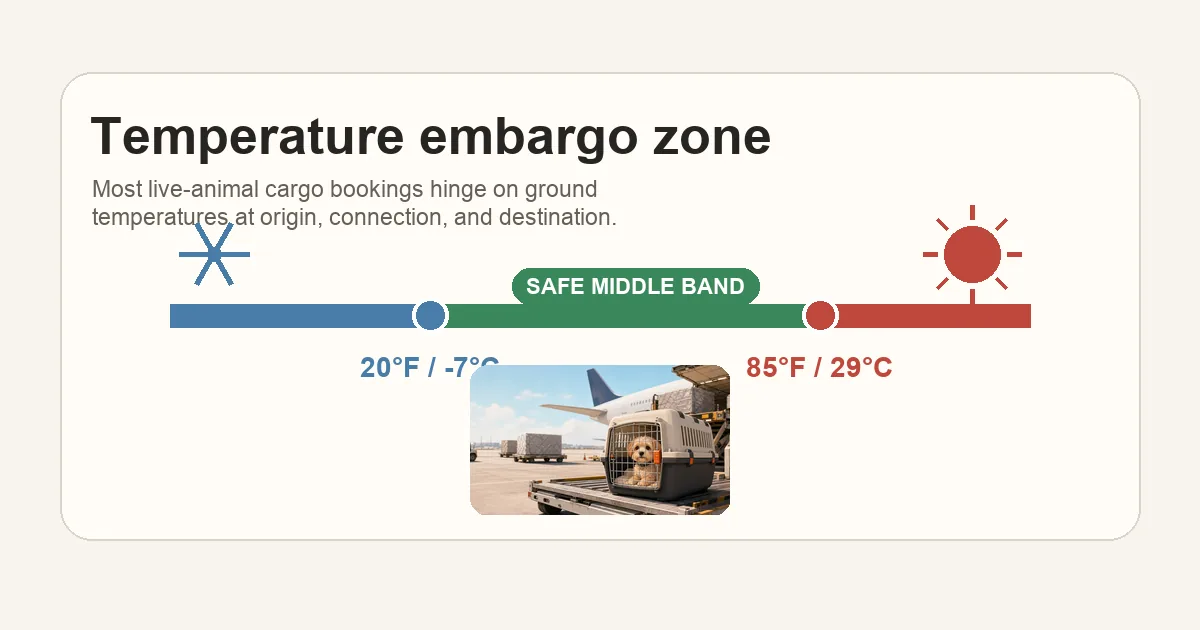
Why the 85°F / 20°F cutoffs exist
The cargo hold is climate-controlled in flight, but the pet spends time in the tarmac and cargo terminal before loading and after unloading. During summer, hot tarmac can hit 130°F+ even when the shade temperature is 95°F. During winter, exposed tarmac during de-icing can drop well below freezing.
US DOT and IATA Live Animals Regulations require carriers to protect pets from extreme temperatures throughout ground handling. The 85°F / 20°F cutoffs are the industry-standard implementation — conservative enough that even a sudden 20-minute tarmac delay doesn’t put the pet at risk.
How the embargo is applied
The embargo checks the forecast temperature at the time of departure, arrival, and transit (if any) for the next 24 hours.
If the forecast for any of those points is above 85°F or below 20°F, the airline can:
- Refuse to load the pet entirely (most conservative carriers)
- Re-route the pet onto an alternative flight via a cooler / warmer hub (KLM, LH sometimes do this)
- Push the pet onto an early-morning or late-night flight when the tarmac is cooler (UA, AA)
The decision is typically made 6–12 hours before flight time. Some carriers run a final check 2–3 hours before. You may show up at the LAX cargo terminal with your pet, only to be told the destination forecast just crossed the embargo line.
The per-carrier policy table
| Carrier | Hot embargo | Cold embargo | Brachy notes |
|---|---|---|---|
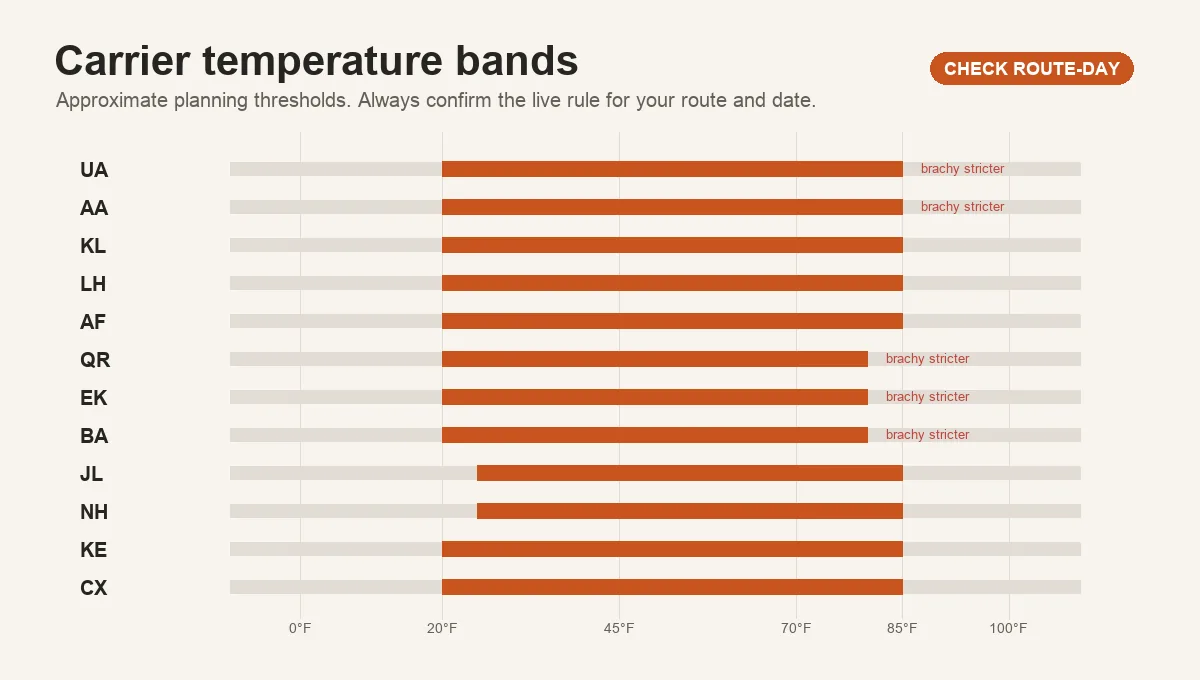
| United Cargo (UA) | 85°F at any point on route | 20°F at any point on route | Brachy embargo at 75°F |
| American Airlines Cargo | 85°F | 20°F | Brachy refusals stricter |
| Delta Cargo | 85°F | 10°F | Variable brachy policy |
| Alaska Air Cargo | 85°F | 10°F | Same |
| KLM Cargo | 27°C (~81°F) | –7°C (~19°F) | Stricter than US carriers; reroutes via AMS hub |
| Lufthansa Cargo | 27°C | –7°C | Reroutes via FRA |
| Air France Cargo | 27°C | –7°C | Reroutes via CDG |
| Qatar Airways Cargo | 29°C | –10°C | DOH hub handling |
| Emirates SkyCargo | 30°C | –10°C | DXB hub |
| British Airways IAG Cargo | 27°C | –6°C | LHR hub; brachy stricter |
| JAL Cargo | 29°C | –10°C | NRT/HND hub |
| ANA Cargo | 29°C | –10°C | Same |
| Korean Air Cargo | 29°C | –10°C | ICN hub |
| Cathay Pacific Cargo | 29°C | –10°C | HKG hub |
Brachycephalic breeds (pugs, French bulldogs, Persian cats, Shih Tzus, etc) have stricter embargoes on most US carriers — often 75°F upper limit. See our snub-nose airline restrictions article.
How to plan around the embargo
Strategy 1 — Pick the right season for your route
For hot-weather destinations (Mexico, Dubai, Singapore, Hong Kong, Australia), schedule outside summer. April / May / October / November are typically safe.
For cold-weather destinations (Iceland, Northern Europe in winter, Northern China), schedule outside December–February. March–April or October–November.
Strategy 2 — Pick early-morning or late-night flights
Tarmac temperatures peak around 2–4pm at most airports. Flights departing 6am or arriving at 10pm have cooler ground handling. Most cargo carriers prefer these slots for summer pet shipments.
Strategy 3 — Use a carrier with hub re-routing flexibility
KLM (AMS), Lufthansa (FRA), Air France (CDG), Qatar (DOH), Cathay (HKG) all have global hubs and can re-route a pet via a different city if the direct flight’s destination is in embargo. UA / AA / DL re-routing options are more limited.
Strategy 4 — Be ready to delay
The embargo is decided same-day. If your move is in mid-July and you booked a Dubai cargo flight, build 2–4 days of flexibility into your move plan. The carrier may push your flight by 1–2 days for cooler weather. Have a place for the pet to stay (boarding, friend, family) if the date slips.
What happens at the cargo terminal when an embargo hits
You arrive at LAX cargo 6 hours before flight with the pet in the crate. The cargo airline checks the forecast. If embargo applies:
- Pet is not loaded onto the booked flight.
- Cargo airline contacts you (sometimes already by phone).
- Options offered: re-book onto a later flight, re-route via a cooler/warmer hub, or cancel + refund.
You take the pet home or to a boarding facility. The cargo airline re-books the flight at no fee for the embargo case (this varies by carrier — verify in advance).
The brachycephalic embargo is stricter
Pugs, French bulldogs, English bulldogs, boxers, Persian cats, Shih Tzus, Pekingese — short-faced breeds — have respiratory anatomy that makes heat stress more dangerous. Most US cargo carriers apply a 75°F hot embargo to brachycephalic breeds vs the standard 85°F.
Some carriers refuse brachycephalic cargo entirely year-round:
- United Cargo: refuses most brachycephalic breeds for international routes (specific cut-list)
- American Cargo: similar stricter cut-list
- Delta Cargo: variable by season
Workarounds:
- Fly KLM, LH, or AF — European carriers tend to be more permissive on brachycephalic (but still apply temperature limits)
- Schedule the move strictly in cool months
- See our snub-nose article for the per-breed per-carrier landscape
Real failure modes we’ve seen
- “LA in July to Dubai” trap: LAX summer 90°F + DXB summer 100°F+ = almost every cargo carrier refuses. Owners assume DXB is “always hot” and book anyway. The embargo catches them. Move slips by 1–2 months.
- “Early morning fix doesn’t work”: an LAX 6am departure has cool LAX tarmac (~65°F) — but if the arrival airport (e.g. Singapore) hits 30°C at landing time, the embargo still applies. Both ends of the route are checked, not just origin.
- “Transit hub embargo”: an LAX → FRA → BLR routing checks LAX, FRA, AND BLR. A 32°C Frankfurt summer day puts the pet in embargo even if both LA and Bangalore are within range. KLM’s AMS hub, LH’s FRA, QR’s DOH all have this checkpoint.
What this means for the LA owner
Most LA → international moves are best scheduled in spring or fall. Summer is workable for European cool-hub routes (KLM via AMS works through June; gets risky July–August). Winter is workable for most routes except deep-winter Northern Europe / Northern Asia.
If you have to move in deep summer or deep winter:
- Book through a carrier with hub re-route flexibility
- Plan for 1–2 day delays
- Have a boarding backup
- Avoid brachy breeds altogether for hot-weather routes (consider professional pet shipper coordination)