Why this list matters
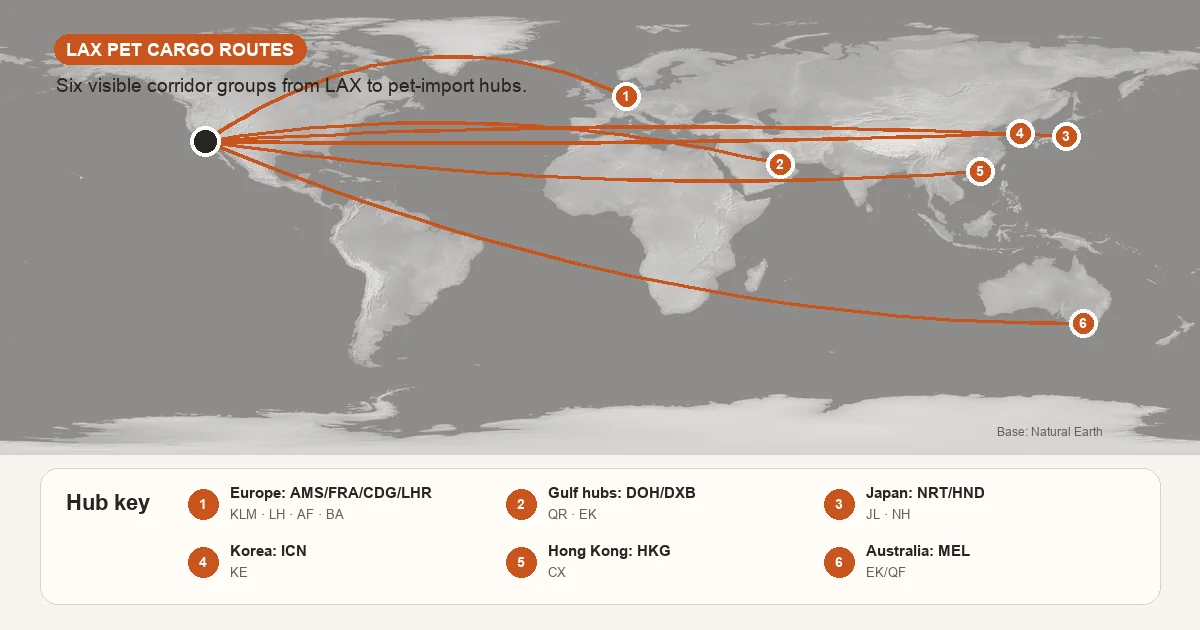
Pet shipping isn’t a service every airline offers, and the major US passenger carriers retired most of their international pet programs post-2020 (United’s PetSafe retired, Delta and American narrowed acceptance). What’s left is a mix of European, Middle Eastern, and Asian cargo divisions — plus thin US carrier coverage.
If your destination requires a specific airline (because it’s the only one flying the route), or because brachy / temperature embargo rules out other carriers, knowing the live list matters.
The carrier-by-carrier table
| Carrier | LAX routes | Hub | Brachy policy | Notes |
|---|---|---|---|---|
| KLM Cargo | LAX → AMS → most of Europe | Very strong (AMS) | Moderate | Pet Hotel at AMS for comfort stops. Strong UK + EU reach. |
| Lufthansa Cargo | LAX → FRA → most of Europe / Asia | Very strong (FRA) | Moderate | Animal Lounge at FRA. Strong EU, India, parts of Asia. |
| Air France Cargo | LAX → CDG → Europe / Africa | Strong (CDG) | Moderate | Similar profile to KLM (KLM-AF group). |
| British Airways IAG Cargo | LAX → LHR | Strong (LHR HARC) | Stricter | Heathrow Animal Reception Centre handles arrivals. |
| Qatar Airways Cargo | LAX → DOH → ME / Asia / Africa | Very strong (DOH) | Moderate | Excellent Asia + Middle East reach. |
| Emirates SkyCargo | LAX → DXB → ME / Asia / Africa | Very strong (DXB) | Strict | DXB hot-embargo trap in summer. |
| JAL Cargo | LAX → NRT / HND | Strong (Japan) | Strict | Japan-specific. |
| ANA Cargo | LAX → NRT / HND | Strong (Japan) | Strict | Same as JAL. |
| Korean Air Cargo | LAX → ICN → Asia | Strong (ICN) | Moderate | Best for Korea + onward Asia. |
| Cathay Pacific Cargo | LAX → HKG → Asia | Strong (HKG) | Strict | Best for Hong Kong + onward China/Asia. |
| Alaska Air Cargo | West coast US + limited Mexico / Hawaii | Limited intl | Standard | Best for Hawaii NIIP routes. |
| United Cargo (UA) | LAX → limited intl (FRA, NRT, etc) | Retired PetSafe | Strict + breed cuts | Reduced post-2020. |
| American Cargo | LAX → limited intl | Limited | Strict | Reduced acceptance. |
| Delta Cargo | LAX → limited intl | Limited | Variable | Cargo only, no passenger checked. |
| Air Pets / IPATA shippers | LAX → most major hubs (via above carriers) | Coordination layer | Per carrier | Brokers a flight on one of the above + handles paperwork. |
How to pick the right carrier for your destination
To Europe (UK, EU, EFTA)
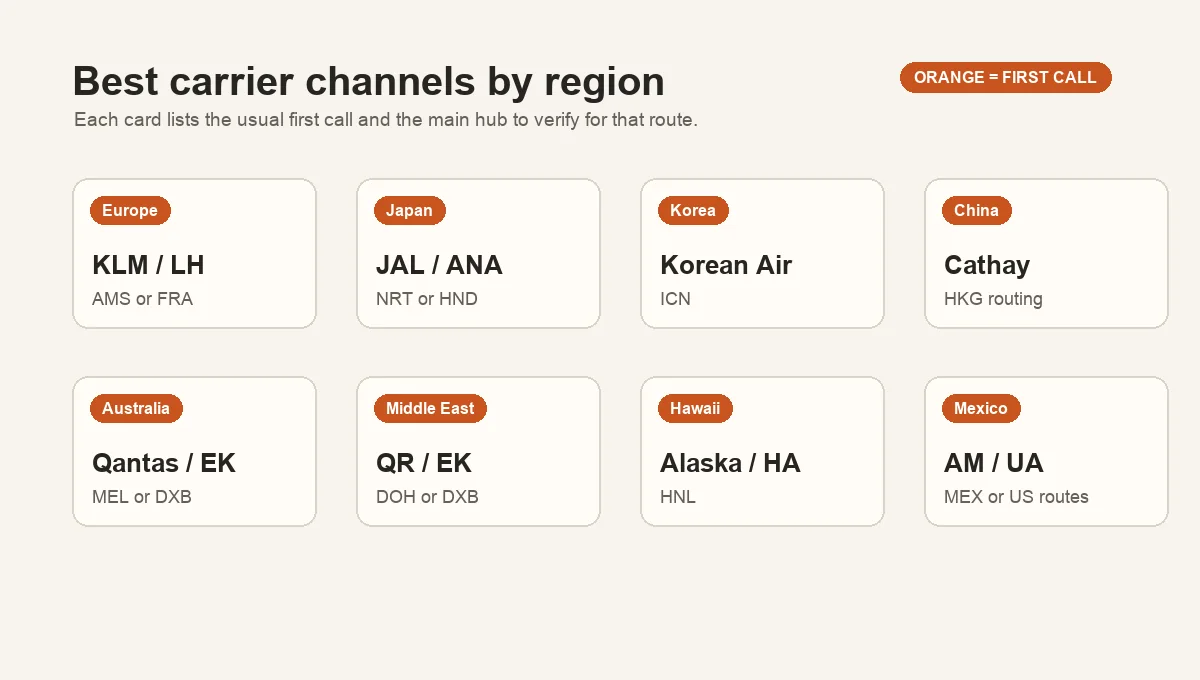
KLM Cargo (via AMS) and Lufthansa Cargo (via FRA) are the standard choices. Both have animal lounges at their hubs for layover comfort. KLM has slightly broader European destination coverage.
Air France Cargo is the third option (via CDG). Same KLM-AF ownership, similar profile.
British Airways IAG Cargo is the direct LHR option — useful if you specifically want a one-leg journey to London with no transit.
To Japan (NRT / HND)
JAL Cargo or ANA Cargo are the natural choices — Japanese carriers know Japan AQS rules cold. JAL has historically had slightly more LAX cargo slots.
To South Korea (ICN)
Korean Air Cargo is the obvious choice — ICN hub.
To China (PEK, PVG, CAN)
Cathay Pacific Cargo via HKG is the cleanest path (then onward to mainland on a partner). Direct mainland China cargo from LAX is more limited; some carriers like UA Cargo operate occasional services.
To Australia (MEL)
The Australia route is specialty. Mickleham PEQ rules require direct cargo to MEL with specific airline handlers. Qantas Cargo is the local Australian option (operates LAX → MEL/SYD), but their LAX live-animal cargo capacity is limited. Emirates SkyCargo via DXB is the European-style alternative.
Most owners book through a pet shipper that coordinates the cargo booking on Qantas or Emirates, plus the Mickleham PEQ booking + onward ground transport.
To Middle East / Africa / India
Qatar Airways Cargo via DOH is the strongest. Emirates SkyCargo via DXB is the second option (watch summer embargo).
To Hawaii (NIIP)
Alaska Air Cargois the easiest. They’re West-coast specialised and know NIIP rules. Hawaiian Airlines Cargo is the Hawaii-native option for in-state moves.
To Mexico
Confirm your pet’s transport mode on the exact operating flight. Mexico’s dog entry paperwork changed in August 2026; check the current dog and cat document rules alongside your airline’s requirements.
What changes year to year
Carrier policies shift. We’ve seen, in the last 5 years:
- United PetSafe retired (2020) — used to be the gold standard for US carriers; now reduced to a much narrower service
- Delta narrowed brachy acceptance (2021)
- American narrowed brachy + breed cut-list (2022)
- KLM raised brachy temperature embargo (2023) — now stricter
- Qatar Cargo expanded LAX live-animal slots (2024)
This list is current as of 2026-05. Verify directly with the carrier before booking — especially for brachy and route-specific changes.
How to actually book
Path 1 — Direct booking with the cargo airline
Most major cargo airlines accept direct customer bookings via their cargo division (separate from passenger booking):
- KLM Cargo: book via klmcargo.com or call regional cargo office
- Lufthansa Cargo: lufthansa-cargo.com
- Air France Cargo: afklcargo.com (joint with KLM)
- Qatar Cargo: qrcargo.com
- Emirates SkyCargo: skycargo.com
Process: get a quote → confirm pet details + crate dimensions → pay booking fee → receive AWB number → bring pet to LAX cargo on flight day.
Path 2 — Pet shipper / pet relocation company
Companies like Air Animal, Pet Express, IPATA-listed shippers — they coordinate the cargo booking on the right carrier, handle paperwork, sometimes handle crate sourcing, and coordinate destination retrieval.
Cost: ~$1,000–$2,500 in shipper fees on top of the cargo cost. Worth it for complex routes (AU, multi-leg) or first-time owners.
What the carrier asks at booking
- Pet’s species, breed, age, weight
- Crate dimensions (length × width × height) — IATA CR-1 compliant
- Origin + destination + intended date
- Whether USDA-accredited vet has signed the cert (or will by flight day)
- Any permits required at destination (BICON, MPI, GACC, etc — verify permits before booking)
- Brachycephalic status — they’ll ask
Some carriers also ask:
- Pet’s microchip number (for the AWB)
- Owner’s destination contact + cargo agent (for retrieval)
- Whether the pet is sedated (must answer NO — see our sedation myth article)