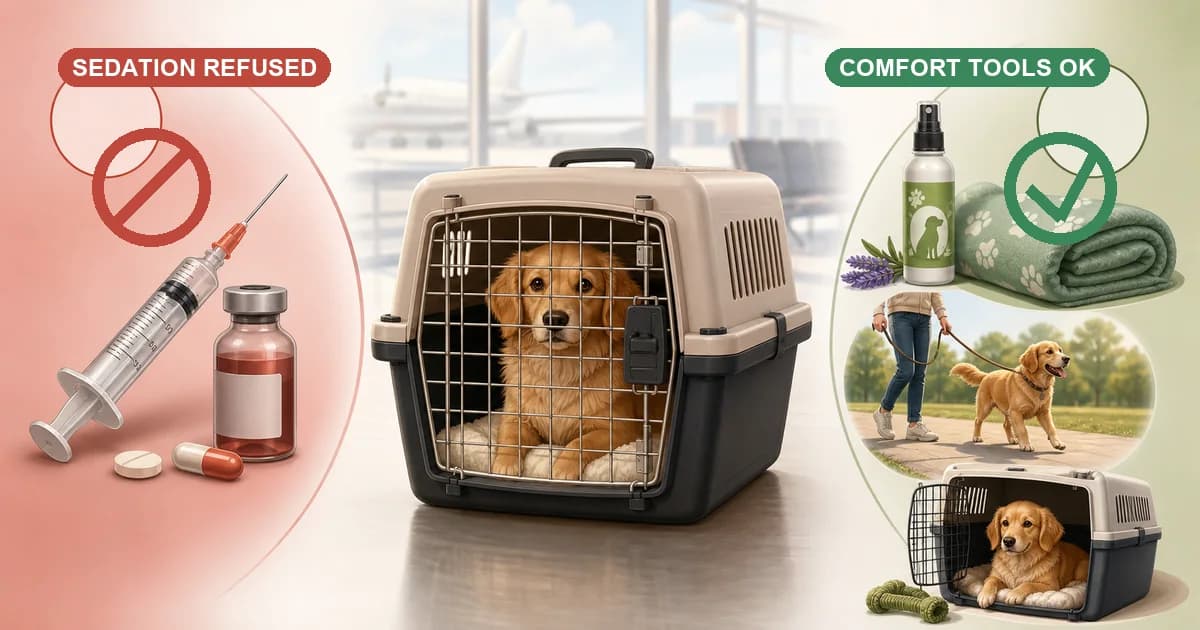
Why owners ask about it
The instinct is human: a 12-hour flight in a crate sounds terrifying. Surely a mild sedative would help the pet stay calm?
It would, on the ground. At altitude, in a pressurised but climate-shifted cargo hold, the same dose creates risks the pet can’t compensate for. This is why the airline policy isn’t “we prefer not to” — it’s a hard refusal, sometimes with veterinary attestation required.
The IATA / industry stance
The IATA Live Animals Regulations (the industry standard followed by virtually every commercial cargo carrier) specify that pets being shipped should not be tranquillised or sedated for transport.
The reasoning, per AVMA and ASPCA guidance:
- Cardiovascular depression: sedatives lower blood pressure and slow the heart. At altitude, with lower oxygen pressure even in a pressurised cabin, the safety margin shrinks.
- Thermoregulation: sedated pets don’t pant or shiver effectively. In a cargo hold that can fluctuate ±5°C during ascent / descent / ground handling, this matters.
- Loss of balance: a sedated pet can’t reposition in the crate. Turbulence or a hard takeoff can leave the pet stuck in a position that compresses the airway. This is the most common in-flight pet emergency on sedated animals.
- Breed-specific risk: brachycephalic dogs (pugs, bulldogs) and cats (Persians) have narrower airways. Sedation amplifies their baseline respiratory risk.
The AVMA’s official position: “Animals should not be sedated when shipped by air.” (Quoted in multiple cargo carrier policy documents.)
Per-carrier sedation policy
| Carrier | Sedation policy |
|---|---|
| KLM Cargo | Sedated pets refused. Owner attestation at intake. |
| Lufthansa Cargo | Sedated pets refused. Vet form required attesting 'not sedated.' |
| Air France Cargo | Sedated pets refused. |
| British Airways IAG Cargo | Sedated pets refused. |
| Qatar Airways Cargo | Sedated pets refused. Vet attestation. |
| Emirates SkyCargo | Sedated pets refused. |
| JAL Cargo | Sedated pets refused. |
| ANA Cargo | Sedated pets refused. |
| Korean Air Cargo | Sedated pets refused. |
| Cathay Pacific Cargo | Sedated pets refused. |
| United Cargo (UA) | Sedated pets refused. |
| American Cargo | Sedated pets refused. |
| Delta Cargo | Sedated pets refused. |
| Alaska Cargo | Sedated pets refused. |
The policy is uniform across major carriers. The shipper’s vet has to sign a fitness-to-fly certificate that explicitly attests the pet is not sedated.
If you sedate the pet before drop-off and the airline detects it (dilated pupils, unresponsive behaviour, slow respiration), the airline will refuse the shipment. You’re out the cargo booking fee and the flight; the pet has to be re-evaluated.
What’s the alternative — how to actually reduce flight stress
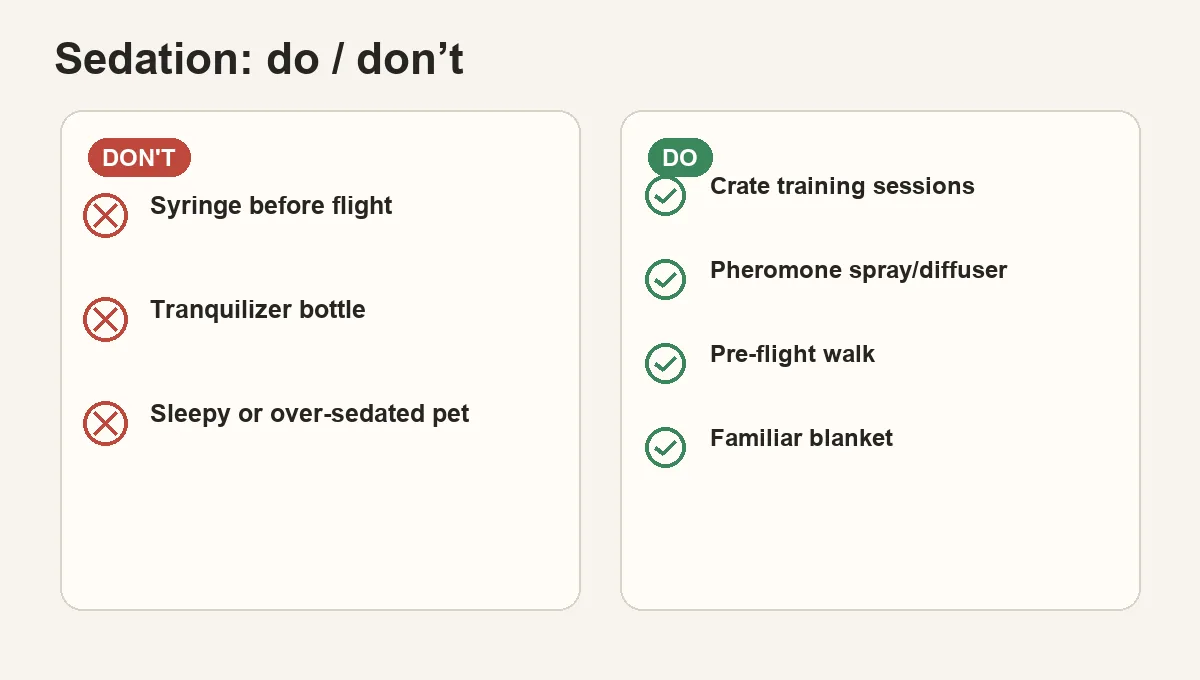
Five things that DO work, per AVMA + cargo industry guidance:
1. Crate acclimation, started 4–6 weeks before flight
The pet should see the IATA CR-1 crate as a familiar safe space, not a trap on flight day. Start with the crate in the living room, doors open, treats inside. Build up to 30-minute sessions with door closed, then to overnight, then to drives with the pet in the crate. See our crate training timeline article.
2. Familiar scent items in the crate
A small piece of unwashed bedding or a t-shirt with the owner’s scent gives the pet olfactory continuity. Don’t overload the crate — IATA limits how much padding can be inside. One thin piece is enough.
3. Pre-flight exercise + bathroom
A thoroughly exercised, recently-toileted pet handles the crate much better. Aim for a long walk or play session 2–3 hours before drop-off.
4. Food timing
Feed a small meal 6 hours before flight. No food during flight (per IATA — vomiting risk). Water bottle attached to door is fine.
5. Pheromone diffusers / non-sedative calming products
Vet-approved options that don’t sedate:
- Adaptil (DAP) for dogs — synthetic dog appeasing pheromone, spray inside the crate 15 minutes before loading
- Feliway for cats — similar feline pheromone
- Zylkene (alpha-casozepine) — vet-recommended in some cases for high-anxiety pets; not technically a sedative, but check with your vet AND confirm the carrier accepts pets on it
Carriers generally accept Adaptil/Feliway. Zylkene is borderline — some carriers want a vet note that explicitly states the pet is not sedated.
What “sedation” actually means in airline policy
There’s a distinction worth understanding:
- Tranquillisers / sedatives (e.g. acepromazine, ketamine, benzodiazepines) — refused. These are central nervous system depressants.
- Anti-nausea (e.g. Cerenia / maropitant) — accepted, with a vet note. Anti-nausea isn’t sedative.
- Pheromones (Adaptil, Feliway) — accepted.
- Behavioural training-based calm — accepted and encouraged.
A vet might recommend acepromazine for a high-anxiety pet on a short-haul drive. For international flight, the same vet should advise against it.
The vet’s role
Your USDA-accredited vet signs the international health certificate. On most carrier forms, there’s a tick-box for “this pet is fit to fly and has NOT been administered any sedative or tranquilliser within the 24-48 hours prior to flight.”
If the vet checked that box and you sedated anyway, you’ve created a paperwork mismatch. The carrier checks at intake. If the pet shows sedation signs, refusal.
Best practice: discuss the flight plan with your vet during the fitness exam. They’ll often offer non-sedative calming strategies + Adaptil recommendations.
What about service animals and cabin pets
Service animals (ADA-defined) often travel in cabin and aren’t subject to the same cargo refusal. But the same advice applies — even in cabin, sedation increases medical risk. See our service animal vs ESA article.
For cabin pets (under-seat carrier), only a few US carriers (UA, AA on some routes) accept small in-cabin pets on international. The same no-sedation rule applies — the airline will refuse boarding if the pet appears sedated at check-in.
When sedation is actually appropriate
A few narrow cases where a vet might prescribe a mild sedative specifically for travel:
- Pets with veterinary-diagnosed severe anxiety conditions
- Pets being driven (not flown)
- Pets on extremely short flights (<2 hours)
- Veterinary referral hospitals
For international cargo, this is rare. The vet who knows your pet best is the right person to make the call — and most will tell you no for a long-haul international flight.