Why this confusion exists
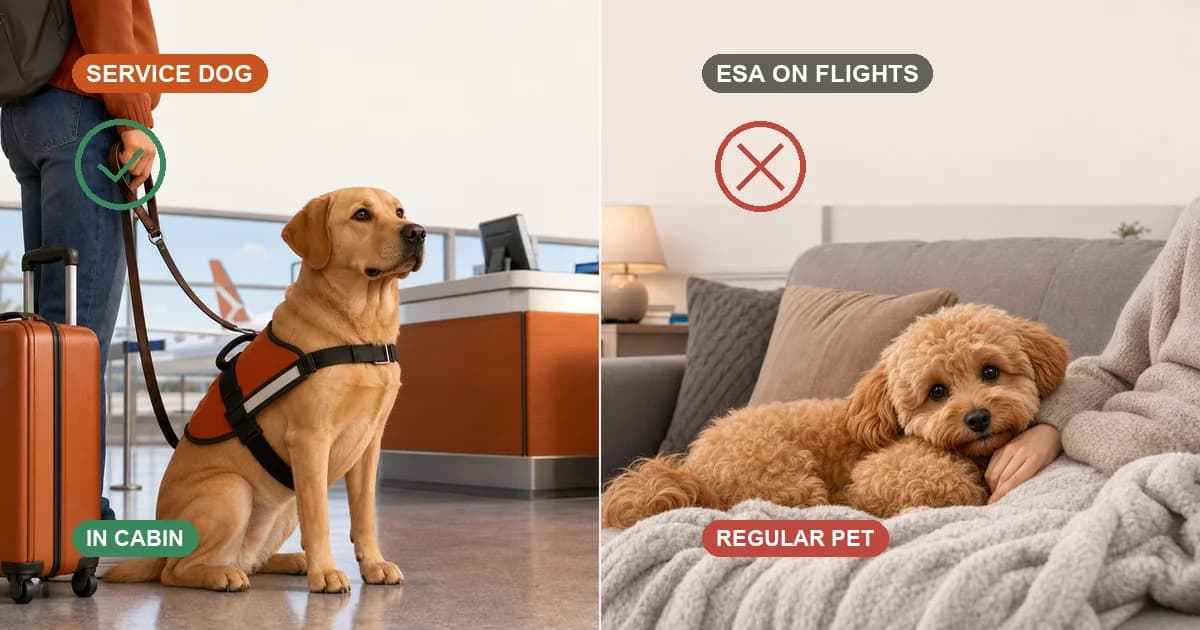
For about a decade (roughly 2010–2020), ESAs flew alongside trained service animals in cabin on US airlines under the old Air Carrier Access Act regulations. Owners with anxiety, depression, or PTSD got a note from a mental health professional, and the airline let the pet fly free in cabin.
In December 2020, the US Department of Transportation issued a new rule (effective January 2021) that:
- Removed ESAs from the protected “service animal” definition for air travel
- Defined service animals strictly as dogs trained to do work or perform tasks for the benefit of a qualified individual with a disability (matching the ADA standard)
- Required US airlines to accept service-dog DOT forms
The shift was immediate. Owners who’d been flying with ESA paperwork suddenly found their pets were no longer accepted as service animals — they’d have to fly as regular pets.
The 2026 reality
| Animal type | US flights | International flights |
|---|---|---|
| ADA service dog (task-trained) | In-cabin, no fee, with DOT form | In-cabin on most US carriers; varies on foreign carriers |
| Psychiatric service dog (task-trained for psychiatric disability) | Same as service dog | Same — but documentation tougher to validate abroad |
| Emotional support animal (ESA) | Treated as regular pet | Treated as regular pet |
| Therapy animal | Treated as regular pet | Treated as regular pet |
| Trained guide dog (visual) | In-cabin, no fee | Generally in-cabin; well-recognised worldwide |
| Trained hearing alert dog | In-cabin, no fee | Less recognised abroad |
The key distinction: task-trained vs emotional-only. Service animals have specific, demonstrable tasks they perform (guide a blind owner, alert a deaf owner, alert a diabetic owner to hypoglycemia, ground a PTSD owner during flashback). Emotional support is comfort by presence, not task — no longer protected.
How US airlines now handle it
Per DOT 14 CFR Part 382:
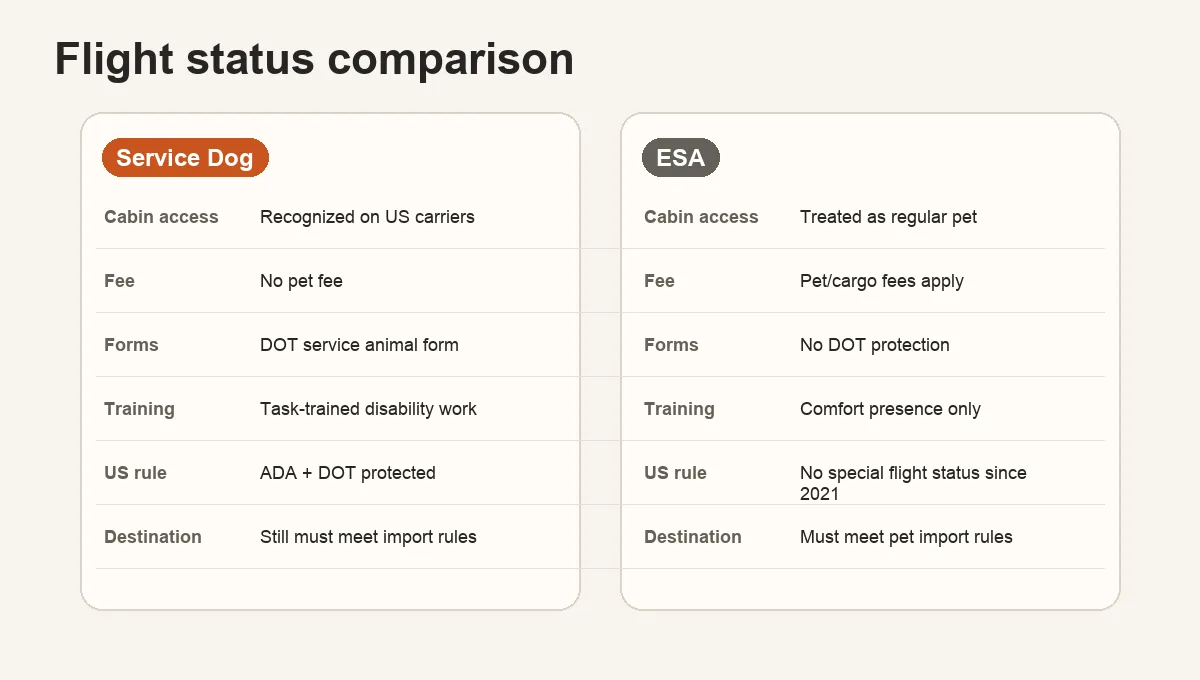
- US carriers must accept service dogs for in-cabin travel with no fee
- Owner provides a DOT Service Animal Air Transportation Form (signed by owner, attesting to training, behaviour, vaccination)
- Some US carriers also ask for the DOT Service Animal Relief Attestation form on flights ≥8 hours
- The pet rides at the owner’s feet — no carrier required, but must be under control on a leash or harness
- The carrier can refuse if the animal isn’t behaving (growling, unsafe behaviour, not housebroken)
Major US carriers (UA, AA, DL, AS, B6) all follow this. The forms are on each carrier’s website.
How foreign airlines handle it
Foreign airlines are NOT bound by US DOT rules. They have their own service animal policies, varying widely:
Strong service-dog recognition
- British Airways: accepts ADA service dogs in cabin on most routes with prior arrangement
- Lufthansa: same — service dog policy, prior arrangement
- Air France / KLM: well-established service-dog cabin acceptance on most flights
- JAL / ANA: accepts service dogs in cabin, with documentation + prior arrangement, often more limited than US
More limited
- Qatar Airways / Emirates: service dogs sometimes accepted, with significant restrictions (some routes only, kennel during flight, etc)
- Some Asian carriers: accept guide dogs (visual disability) but not always other task-trained service dogs
Per-destination overlay
Even if the airline accepts service dogs, the destination country may have its own rules:
- UK: service dogs follow same import rules as regular pets (rabies vax, cert, microchip). The “in cabin” status doesn’t waive destination paperwork.
- EU: same — service dog status doesn’t change EU AHC requirement
- Australia: same — service dogs still go through Mickleham PEQ in most cases (limited exceptions)
- Japan: service dogs still subject to the 180-day FAVN wait
The cabin-vs-cargo distinction is separate from the destination’s import paperwork.
What ESA owners moving abroad need to know
If your dog was an ESA pre-2021, the change is:
- In cabin on US international flights: no longer free. Either pay the in-cabin pet fee (if the dog meets size + carrier rules) or ship the pet as cargo.
- At the destination: ESA status was never recognised by foreign pet-import authorities. It’s always been regular-pet rules.
- At the destination on the ground: most foreign jurisdictions don’t have ESA legal protections at all. The dog is a pet there.
If you depended on your ESA letter for housing, transit, or other contexts, those protections vary widely abroad. Most are US-specific.
What about psychiatric service dogs
Psychiatric service dogs (PSDs) are task-trained dogs that perform specific tasks for a psychiatric disability — interrupting panic attacks, retrieving medication, providing deep pressure therapy, checking rooms.
PSDs are recognised as service animals by US DOT. The DOT forms cover them.
Abroad, recognition is patchier. Some European countries recognise PSDs; some require additional documentation; some don’t recognise them as distinct from ESAs. If you have a PSD and are moving abroad, contact the destination’s disability rights office (or the relevant ministry) for the local landscape.
Cabin vs cargo for service dogs internationally
Most foreign carriers that accept service dogs accept them in cabin — that’s the whole point of the service dog protection. But there are exceptions:
- Some Middle Eastern carriers require service dogs to ride in cargo (with the standard live-animal handling)
- Some Asian carriers restrict service dogs to specific routes
- Australia / NZ-bound service dogs still face the Mickleham PEQ / MPI quarantine — no exemption
The fitness-to-fly requirements (no sedation, IATA-style health) still apply even when the dog is in cabin.
The “I want my dog with me, but it’s not a service dog” question
For owners who want their pet in cabin but the pet isn’t a task-trained service dog:
- Small dogs/cats under ~8kg fitting an under-seat carrier: most US carriers (UA, AA, DL, AS) accept in-cabin pets on international flights for a fee ($125–$300 each way)
- Larger pets: cargo only. See our LAX cargo article.
Some foreign carriers (KLM, AF, LH) also accept in-cabin pets, with varying size limits. Check per-carrier.