Why LAX cargo is different from “checked bag”
A lot of LA-based owners assume international pet shipment is like checked baggage: drop off at the curb, pet rides in the same hold as the suitcases, retrieve at baggage claim. It isn’t.
Live-animal manifest cargo means:
- The pet is booked separately from your passenger ticket (often on a different flight than yours)
- The crate is handled by the cargo division of the airline, not passenger services
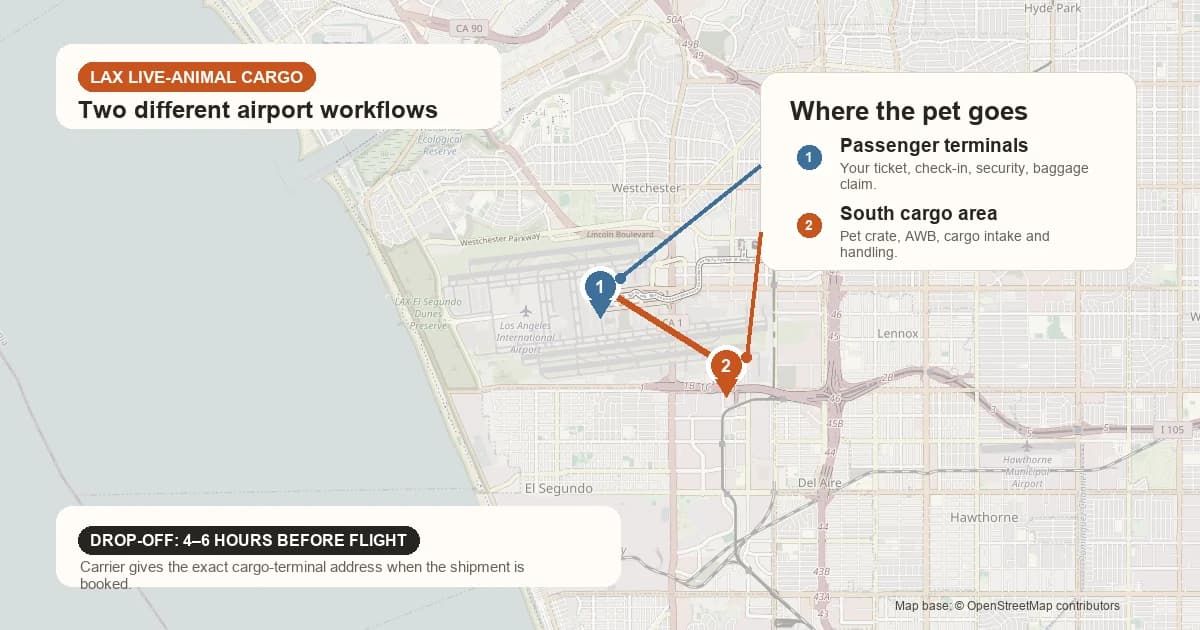
- Drop-off is at the cargo terminal, not the passenger terminal
- The hold is temperature-controlled, pressurised, and dedicated to live animals — different from baggage hold even on the same plane
- Retrieval at destination is at the destination’s cargo terminal, not baggage claim
This is the international-pet-shipment norm. The exception is a few cabin-eligible small pets on the few US carriers that still offer in-cabin international travel (UA, AA on some routes) — but for most LA → international moves, it’s live-animal cargo.
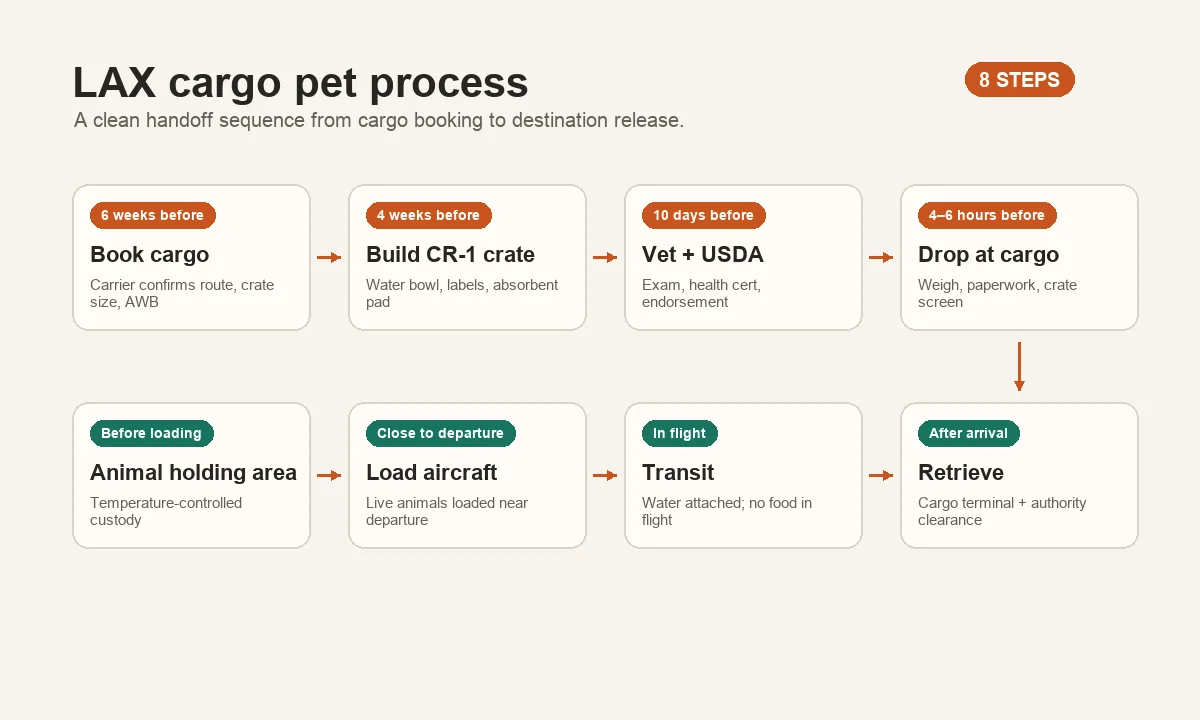
The full step-by-step at LAX
Step 1 — Book cargo via the airline (or a pet shipper)
About 6–8 weeks before flight, contact the cargo division of your chosen carrier. Major options operating live-animal cargo from LAX:
- KLM Cargo
- Lufthansa Cargo
- Air France Cargo
- Qatar Airways Cargo
- Emirates SkyCargo
- British Airways IAG Cargo
- JAL Cargo
- ANA Cargo
- Korean Air Cargo
- Cathay Pacific Cargo
See our cargo airlines comparison for per-carrier notes. The carrier confirms availability for your specific date + destination + pet size and issues a booking confirmation with the airway bill (AWB) number — what destination customs uses to track the shipment.
Step 2 — Buy or build an IATA CR-1 crate
The crate has to meet IATA Live Animals Regulations Container Requirement 1 (CR-1). Most major airlines now refuse non-compliant crates at the cargo terminal. See our IATA CR-1 crate sizing article for the size formula. Build out: absorbent padding (no straw — banned by IATA), water bowl secured to the door, ID labels (Live Animals + Owner name + flight number + destination), zip-tie the screws, tape food to the top.
Step 3 — Pre-flight vet exam + USDA endorsement
≤10 days before flight (or per your destination’s cert window — see our validity windows article):
- Vet exam by a USDA-accredited vet
- International health certificate signed
- Submitted via VEHCS (electronic, 1–3 business days) or shipped to APHIS for ink endorsement (5–9 business days) — compare VEHCS vs paper filing before choosing a timeline
You print the endorsed cert and bring it to LAX cargo on flight day.
Step 4 — Drop-off at LAX cargo terminal
Each carrier has its own LAX cargo terminal address. KLM, Air France, and Lufthansa share a complex; JAL and ANA have their own. The carrier gives you the specific terminal at booking.
Timing: drop-off is typically 4–6 hours before flight time. The airline needs that window to:
- Re-weigh the crate
- Verify paperwork (health cert, USDA endorsement, AWB)
- Screen the crate against IATA CR-1
- Move the crate to the temperature-controlled holding area
- Load the crate onto the aircraft
Some carriers (LH Cargo, KLM) require earlier drop-off for international: 6 hours is the typical minimum. JAL and ANA prefer 5–6 hours.
Step 5 — Between drop-off and flight
The crate is held in a temperature-controlled animal holding area at the cargo terminal. Carriers monitor the temperature, give water checks, and physically inspect the crate before loading. You can’t visit during this window — the pet is in the carrier’s custody from drop-off until destination release.
Step 6 — Loading the aircraft
Live-animal cargo is loaded last — closest to flight time, so the pet spends the minimum possible time in the hold pre-flight. The hold is the same temperature/pressure profile as the cabin (climate-controlled for live cargo).
Most international live-animal cargo holds are in the forward belly hold of a wide-body aircraft (777, 787, A350). The hold is dim, quiet, and isolated from regular baggage.
Step 7 — In flight
The pet flies in the hold. No food during flight (per IATA — risk of vomiting + dehydration). Water bottle attached to door.
For long-haul (≥12 hours), some carriers offer a layover at a crew-attended hub(KLM at AMS, LH at FRA, QR at DOH) where the pet may be moved off the aircraft, given a comfort break + water, and reloaded. Most direct flights don’t have this; it’s a feature of long multi-leg routes.
Step 8 — Destination retrieval
At the destination’s cargo terminal:
- Crate is offloaded and moved to the destination’s animal holding area
- Destination customs (CBP-equivalent) inspects the AWB + paperwork
- Destination’s vet authority (DEFRA / EU CHED / GACC / MAFF) inspects the cert
- Once cleared, the crate is released to the owner — or the owner’s designated agent (destination vet, pet shipper)
Timing varies. EU + UK can be ~1–3 hours from landing to release. China can be longer due to GACC checks. Australia: pet goes directly to Mickleham PEQ — owner doesn’t retrieve.
What “live-animal cargo” costs out of LAX
Cargo carrier rates are not publicly published as static fares. They’re quoted per shipment based on:
- Origin / destination route (LAX → AMS vs LAX → DEL)
- Crate dimensions (volumetric weight matters more than actual weight for CR-1 crates)
- Class of pet (cats lower, dogs higher, brachycephalic higher still)
- Booking lead time
Ranges we’ve seen for LAX → major hubs:
- LAX → LHR / CDG / FRA / AMS: ~$1,500–$3,500
- LAX → NRT / HND / ICN / PVG: ~$2,000–$4,000
- LAX → MEL (AU): ~$3,500–$5,500+ (specialty carriers required)
These are quoted by each cargo airline directly. Get 2–3 quotes. The cheap one usually has tighter slots; the expensive one usually has more route options.
What the cargo terminal looks like at LAX
LAX’s cargo complex is on the south side of the airport — separate from the passenger terminals. Each carrier has its own building. Drop-off is at the cargo loading dock, not curbside.
Bring:
- Your printed USDA-endorsed health certificate
- The cargo airline’s AWB number (printed)
- Photo ID
- The pet, in the IATA CR-1 crate, ready to load
Expect 30–60 minutes of intake processing at the cargo terminal — airline staff re-weighs, photographs the crate, checks the paperwork, prints the AWB sticker, and moves the crate to holding.
Common LAX-specific failure modes
- Late drop-off: airlines have strict cargo cut-off windows. Show up later than the 4–6 hour minimum and the airline can refuse to load the pet. Re-booking onto the next flight costs the rebooking fee + storage.
- Crate doesn’t meet CR-1: airline staff measures + inspects. If the crate is too small, too large, missing bolt-on zip ties, or has prohibited padding (straw, hay), the airline refuses. You have to source a compliant crate at the cargo terminal — some carriers have spares for sale; expect ~$200–$400.
- Paperwork mismatch: the USDA-endorsed cert has to match the AWB and the cargo manifest. A name mismatch, microchip mismatch, or expired cert triggers a paperwork redo. The cargo flight goes without your pet.
- Hot/cold embargo: if any airport on the route is above 85°F or below 20°F on flight day, the carrier may invoke the temperature embargo and refuse to load. See our temperature embargo article.