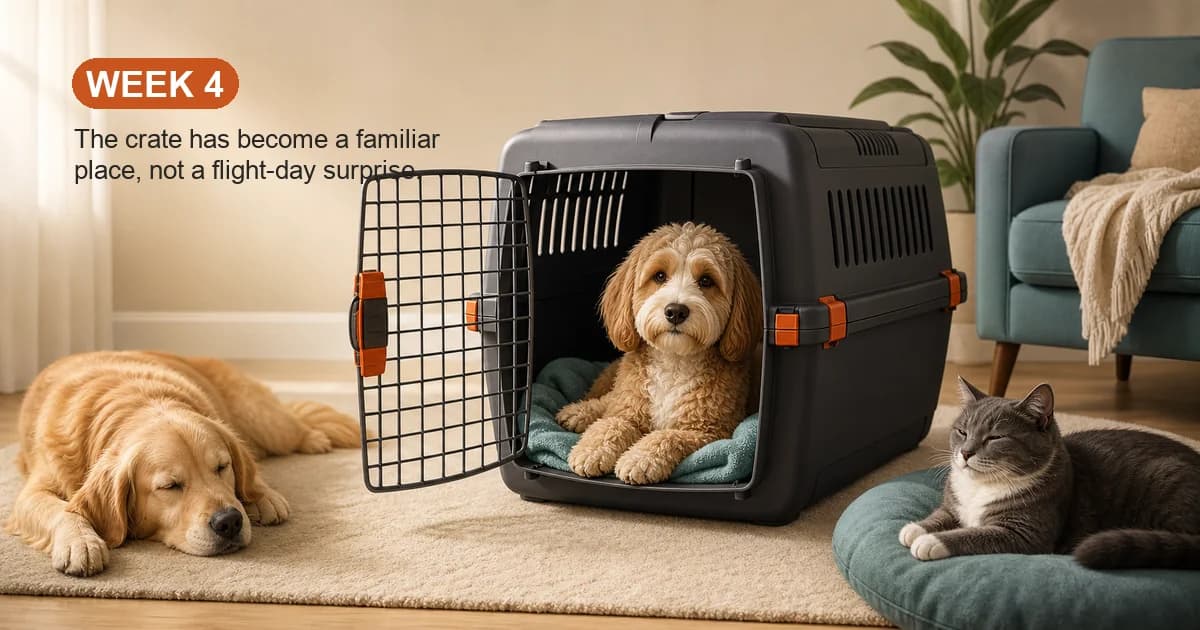
Why this matters more than owners expect
The crate isn’t just a flight requirement — it’s where your pet spends 12–20 hours of one of the most stressful days of their life. A pet who’s never been in a crate, dropped at LAX cargo on flight day, has nothing to fall back on but raw instinct.
A crate-trained pet sees the crate as a known safe space. They settle. They don’t panic. They don’t injure themselves trying to escape. They arrive at the destination still recognisable as themselves.
This is also the single most evidence-based non-sedation strategy for reducing flight stress, per AVMA + ASPCA + IATA Live Animals Regulations guidance.
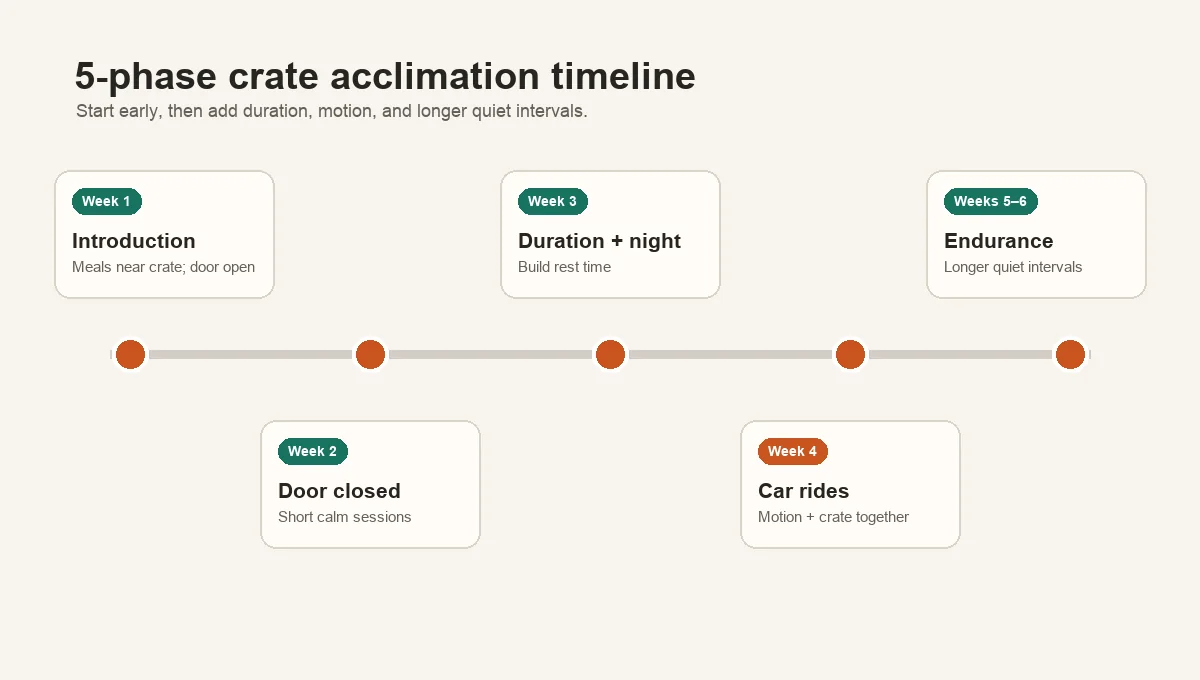
The 5-phase timeline
Week 1 — Introduction (door always open)
Place the IATA CR-1 crate in a high-traffic family area (living room, not garage). Door open, locked open if needed. Inside:
- Soft bedding (within IATA padding limits)
- A few favourite treats
- A familiar toy
- An item of unwashed clothing with your scent
The pet investigates on their own. Do not push them in. Let them go in voluntarily. Reward any voluntary visit with calm praise + a treat.
Goal: pet enters the crate of their own accord, multiple times a day, by end of week 1.
Week 2 — Closing the door briefly
When the pet is comfortable lying in the crate, gently close the door for 30 seconds, then 1 minute, then 5 minutes. Stay nearby. Reward calm behaviour.
Build up to 30 minutes door-closed by end of week 2. The pet should settle calmly — not whining, scratching, or barking. If the pet panics, you’ve gone too fast. Open the door, reset, try shorter durations.
Week 3 — Building duration + nighttime
Continue daytime sessions up to 2 hours. Add one night sleeping in the crate at the end of week 3 (in your bedroom, so the pet feels your presence).
Most pets that sleep in the crate one night learn it’s “the safe spot to nap” — a powerful association for the flight.
Week 4 — Car rides
Take the pet to the car in the crate (secured with seatbelt or cargo-strap). Start with a 15-minute drive, then 30, then 1–2 hours.
The car-ride simulates some of the flight’s sensory load: motion, sound, motion sickness exposure, separation from familiar walls.
Week 5–6 — Endurance + final acclimation
Build up to 8+ hour sessions in the crate (with food/water access). For very long-haul flights (LAX → SIN, LAX → SYD: 16+ hours), add a 12-hour session.
This isn’t for the pet’s “endurance” — they don’t need to learn to hold their bladder — it’s for the acclimation to extended crate time. The pet realises that even after a long stretch, the crate is still safe and they get released eventually.
What to do if you’re starting late
If your flight is 2 weeks away and you haven’t started:
- Skip car rides, focus on duration + door-closed sessions
- Do 3 sessions a day instead of 1–2
- Add nighttime sleeping by night 7
- Accept the trade-off: your pet won’t be fully acclimated, but they’ll be more comfortable than no training at all
If your flight is 1 week away with no training:
- Do what you can. Get the pet in the crate for any duration.
- Don’t sedate to compensate — see our sedation myth article
- Be ready for a stressful arrival — give the pet 24–48 hours to recover at the destination
Signs your pet is well-acclimated
By end of week 4–6, look for:
- Pet enters the crate voluntarily when tired
- Pet settles within 5–10 minutes of being put in the crate
- Pet doesn’t whine or scratch during a 1-hour session
- Pet doesn’t panic when you leave the room with the door closed
- Pet eats / drinks / rests calmly in the crate
If most of these are true, you’re ready.
Signs more time is needed
- Pet still panics or whines beyond 5 minutes
- Pet refuses to enter voluntarily
- Pet shows stress signs in the crate: heavy panting, excessive drooling, dilated pupils, hiding bodily functions
- Pet has tried to escape (scratched door, bent bars)
Don’t fly with a pet showing these signs — add 2–4 more weeks of training, or postpone the move.
Crate selection is part of acclimation
The crate has to be:
- IATA CR-1 compliant (see our crate sizing article)
- The right size: pet can stand up without crouching, lie down fully extended, turn around. Too small = cargo refusal. Too large = the pet slides around in turbulence.
- Solid plastic, not soft-sided (for cargo; soft-sided okay for in-cabin only)
- Metal door, fastened with metal hardware (zip ties on bolts)
Buy or build the actual flight crate at the start of training. Don’t acclimate on a temporary crate then swap for a flight crate at the last minute — the pet will see the new crate as unfamiliar.
Bringing acclimation cues to the flight
On flight day:
- Spray Adaptil/Feliway inside the crate 15 minutes before drop-off
- Include the familiar scented item (unwashed t-shirt, blanket, worn shirt)
- Include a familiar toy that the pet associated with calm in training
- Don’t change the bedding — the existing bedding has weeks of the pet’s own scent
- Walk the pet immediately before drop-off (30+ minutes of exercise)
- Bathroom break right before crate-up
These small cues — pheromones, familiar smells, exercise — compound the acclimation benefit.
What about cats
Cats can crate-train, but the process is different:
- Cats often prefer smaller, more enclosed crates with a covered top
- Pheromone spray (Feliway) is even more effective for cats than dogs
- Cats acclimate to crates faster than dogs (often in 2–3 weeks vs 4–6)
- Cat carriers for cabin are different from cat cargo crates — make sure you have the right type
The same 5-phase timeline works, compressed to 3–4 weeks for cats.
What about brachycephalic dogs
Pugs, French bulldogs, English bulldogs, boxers face additional challenges:
- Crate-training takes the same time (4–6 weeks)
- But acclimation matters more — brachycephalic dogs are more stress-prone, more heat-stress-vulnerable, more likely to panic
- Add extra duration sessions and temperature variation practice (the crate in a slightly cooler/warmer room)
- See our snub-nose airline restrictions article for the per-carrier acceptance landscape — many carriers refuse brachycephalic cargo entirely
For brachy moves: start crate training 6–8 weeks ahead, not 4–6.
Common mistakes
- Using the crate as punishment during training — pet will associate it with negative experiences. Crate = positive only.
- Skipping nighttime sleeping— pets that haven’t slept in the crate have a much harder time settling on flight day.
- Too-large crate — pet slides in turbulence. Choose size per CR-1 spec.
- Acclimating on a temporary crate, switching to flight crate at last minute— pet doesn’t recognise the flight crate.
- Sedating to compensate for poor training — refused at cargo intake.