The IATA sizing rule
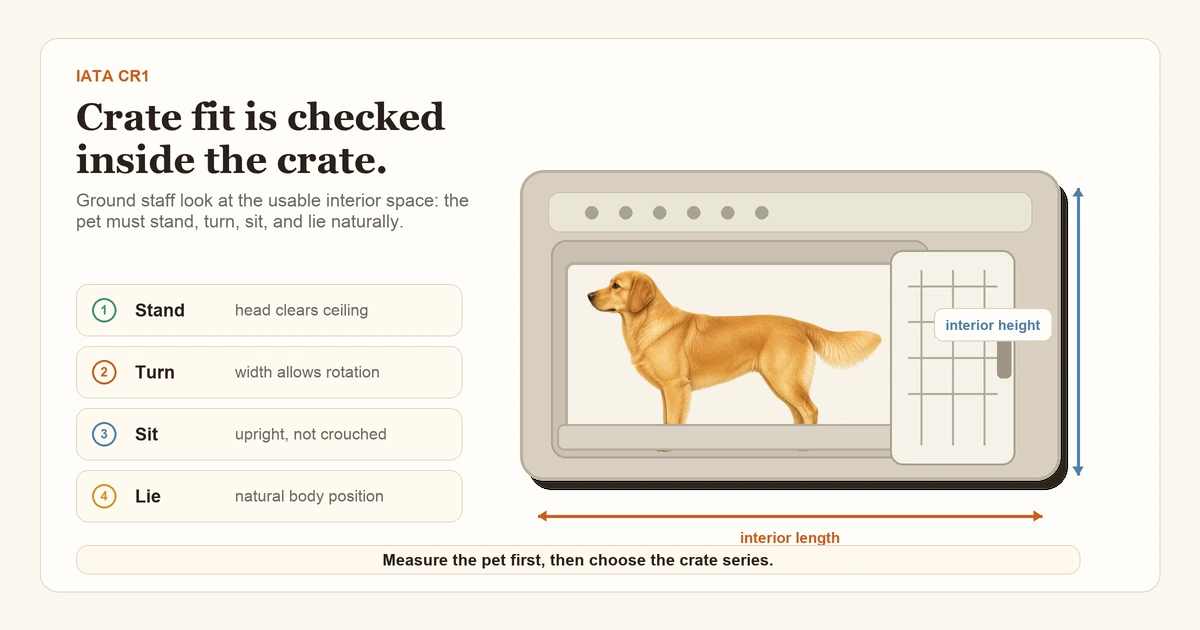
IATA’s Live Animal Regulations specify four physical requirements for the pet inside the crate:
- Stand — the pet must be able to stand fully upright with head clear of the ceiling. No bending, no neck-down posture.
- Turn around— the pet must be able to turn around while standing. Width has to be at least 1.5x the pet’s standing shoulder width.
- Sit erect — full upright sitting position with head clear.
- Lie in natural position — stretched out, not curled, fits the full body length comfortably.
These aren’t suggestions. Airline ground staff at LAX (and at the destination port) measure the pet against the crate. Fail one of the four and the booking is refused. You go home with the pet, rebook, replan.
The measurement formulas
For the LA owner picking a crate before talking to an airline, the standard formulas:
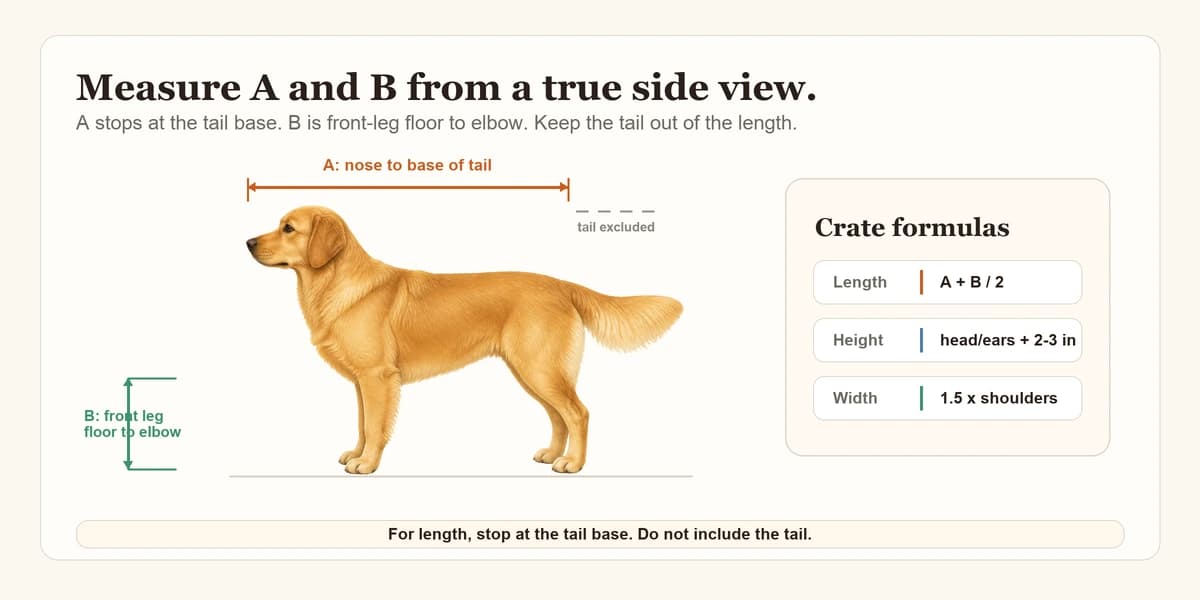
Interior length (front of crate to back wall, not including bowls):
Interior length ≥ A + (B / 2)
Where:
- A= pet’s length from tip of nose to base of tail (not including tail)
- B= pet’s leg length from floor to elbow (front leg) while standing
So a Labrador with a nose-to-tail length of 30″ and a leg length of 12″ needs an interior length of at least 30 + (12/2) = 36 inches.
Interior height (floor to ceiling):
Interior height ≥ top of head (or top of ears if upright) + 2-3" clearance
A dog whose head reaches 26″ off the floor when standing needs interior height of at least 28-29 inches.
Interior width (side to side):
Interior width ≥ 1.5 × shoulder width
For a Labrador with 10″ shoulder width, interior width ≥ 15 inches.
Common crate sizes by IATA series
IATA classifies crates by series number. Common sizes for dogs:
| Series | Interior dims (L × W × H, in) | Typical pet weight | Common breeds |
|---|---|---|---|
| 100 | 21 × 16 × 15 | up to ~12 lbs | small cats, chihuahua, toy breeds |
| 200 | 28 × 20 × 22 | up to ~25 lbs | beagle, small terriers, cats |
| 300 | 32 × 22 × 23 | up to ~40 lbs | cocker spaniel, springer, medium-small dogs |
| 400 | 36 × 25 × 27 | up to ~70 lbs | labrador, golden retriever, boxer |
| 500 | 40 × 27 × 30 | up to ~90 lbs | german shepherd, doberman |
| 600 | 48 × 32 × 35 | up to ~120 lbs | mastiff, great dane (smaller individuals) |
| 700 | 53 × 35 × 38 | up to ~150 lbs | great dane (larger), st. bernard |
These are typical commercial-crate sizes (Petmate, Sky Kennel, Vari Kennel). Measure your pet first, then pick the smallest size that satisfies all four IATA rules. Going one size up “just in case” can disqualify you on weight limits or on certain narrow-body aircraft.
Weight limits airlines enforce
Most international cargo carriers have a combined-weight limit:
- Many US passenger-airline cargo divisions: 100 lbs combined (pet + crate)
- Lufthansa Cargo, KLM Cargo, BA IAG Cargo: up to 150 lbs combined
- Air Canada Cargo: typically 100 lbs
- Smaller regional cargo carriers: varies, sometimes lower
If your pet + crate exceeds the limit, the airline either refuses or routes to a different aircraft type. For very large dogs (great danes, st. bernards), some routes have no live-animal cargo option at all — the only path is a chartered pet flight or commercial pet relocation specialists with dedicated aircraft.
Beyond size — the other CR-1 requirements
A crate that fits the pet still has to meet the other CR-1 specifications:
- Hard-sided. Plastic, fiberglass, or metal. Soft-sided carriers are CABIN ONLY (where allowed), not cargo.
- Ventilation on at least 4 sides for international flights (3 sides for domestic).
- Maximum ventilation opening 1″ × 1″(so dogs can’t escape or chew through).
- Spring-loaded metal door latches — not plastic.
- Bowls accessible from outside the crate for food and water without opening the door.
- Drainage tray or absorbent material on the floor.
- Live Animal sticker affixed to the outside.
- Owner’s contact info on the outside.
- “This Way Up” arrows on multiple sides.
Most major commercial crate brands sell IATA-compliant models. Confirm the label says “IATA CR-1 compliant” or “meets IATA Live Animal Regulations” before buying.
The “soft carrier” mistake
Some owners assume their nice fabric cabin carrier works for international cargo. It doesn’t. Cargo airlines refuse soft-sided carriers at the gate without exception — even if the dog is small enough to fit comfortably.
The only place soft-sided carriers are accepted is in the cabin (where the destination allows in-cabin pets — UK doesn’t, for example).
When in doubt — buy crate, then measure, then exchange
The best workflow:
- Measure your pet (length, leg, height, shoulder width).
- Buy a crate one size up from what the IATA formulas suggest — gives a small margin.
- Put the crate together at home, put the pet inside, observe. Pet should be able to do all four IATA actions (stand, turn, sit, lie) comfortably.
- If the pet is cramped, exchange the crate up. If the crate is hugely oversized, exchange down to avoid weight-limit issues.
Most pet retailers accept crate exchanges if the box isn’t damaged. Buy locally if you can; online exchange logistics are slower.
Pawvisa’s $29 readiness analysis
Includes the recommended crate size and series for your pet’s measurements, with current Petmate / Sky Kennel availability on Amazon and at LA-area retailers. Avoids the “wrong size, return, exchange” delay that costs days against your flight booking.