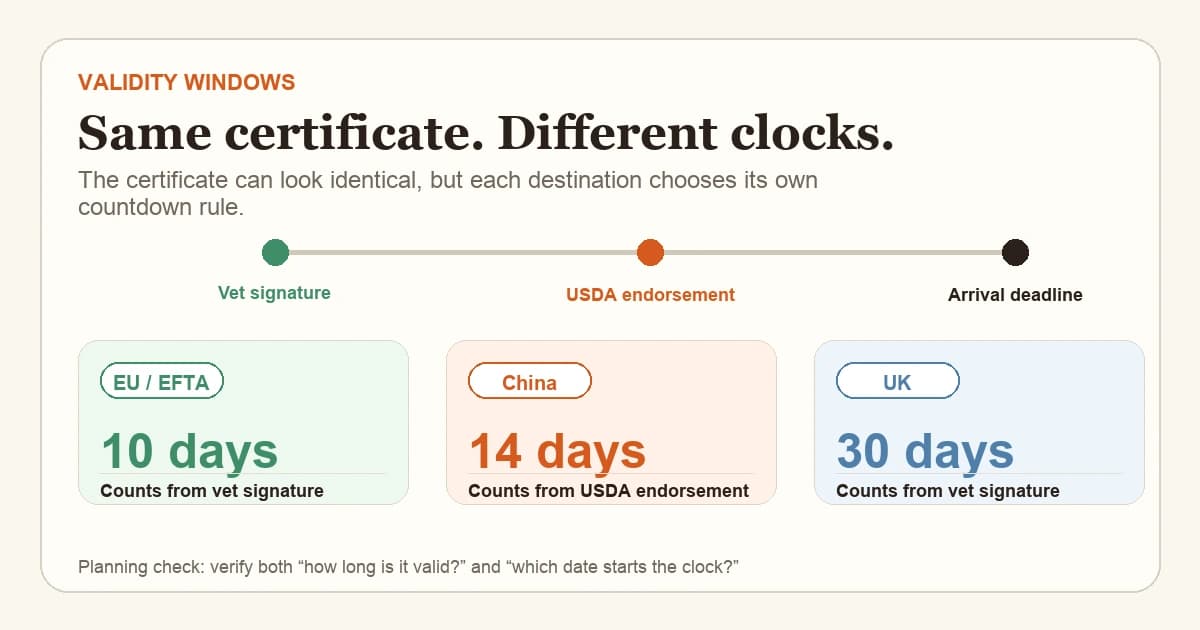
The comparison table (the heart of this article)
| Destination | Validity window | Counted from | What “invalid” means |
|---|---|---|---|
| United Kingdom (non-commercial) | 30 days after vet signature; arrival within 10 days of vet sig | Vet signature | Refused at LHR/LGW/EDI; redo cert |
| United Kingdom (commercial) | 48 hours from vet sig | Vet signature | Refused; commercial moves use a much tighter window |
| EU + EFTA (non-commercial AHC) | 10 days from vet sig to enter; 4 months for onward EU travel | Vet signature | Refused at BCP airport; redo AHC |
| Northern Ireland | Same as EU (NI follows EU rules) | Vet signature | Same as EU |
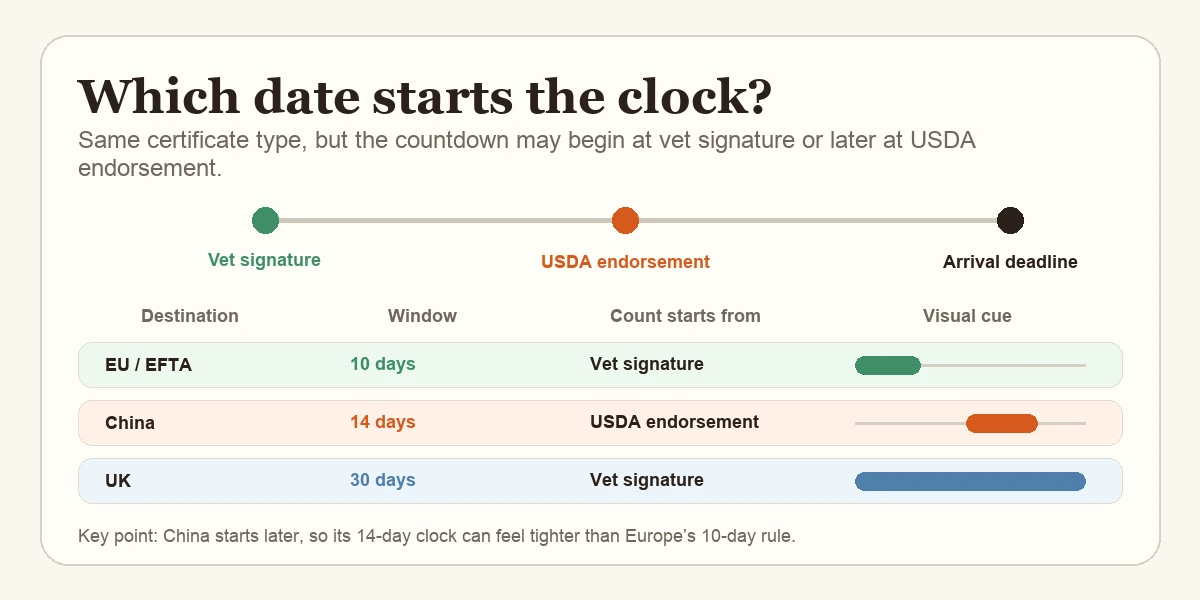
| China | 14 days from USDA endorsement to arrival | USDA endorsement date | Certificate must be redone; noncompliant entry can mean designated-port processing and 30-day quarantine |
| Japan | No fixed days-before-arrival rule we found; FAVN validity (2 years) dominates | — | FAVN-keyed; see our Japan FAVN article |
| Australia | Per BICON permit; cert issued just before flight per 7-step sequence | Permit-conditional | Permit + DAFF rules; see Mickleham article |
| South Korea | ~30 days from issuance | Vet signature | Refused; redo |
| Hawaii (HDOA) | 14 days from USDA endorsement | USDA endorsement date | NIIP / DAR adjustments |
| Taiwan (rabies-free origin track) | Per BAPHIQ permit; specific Taiwan-Hawaii/Guam form | Permit-conditional | See Taiwan via Hawaii article |
| Mexico | Dogs: NWS inspection certificate issued within 5 days before entry; cats: not required | Entry into Mexico (August 2026 update) | See Mexico article |
| Canada (dogs >8 months) | Often no cert required | — | Varies |
China at 14 days is the tightest. UK at 30 days (non-commercial) is the most forgiving among destinations requiring a cert at all.
What “valid” actually means (the technical detail)
Two terms get mixed up:
- Vet signature date: when the USDA-accredited vet signs the international health certificate at the final fitness-to-fly exam.
- USDA endorsement date: when APHIS adds the federal endorsement (electronic or ink) on top of the vet’s signature.
For most destinations, the vet signature date starts the clock. The USDA endorsement happens between vet signature and travel — and APHIS endorsement turnaround is typically 1–3 business days for electronic, longer for ink-signature destinations.
For China specifically, the clock starts at USDA endorsement(not vet signature). That’s why the 14-day window is even tighter than it looks: you can’t add the cargo flight schedule onto the vet signature date — you have to add it onto the (later) endorsement date.
What happens if the window expires before you fly
The cert gets refused at the destination port. The pet’s fate depends on the destination:
- UK / EU: pet is held at the port at owner’s expense while you reissue paperwork. New vet exam, new cert, new USDA endorsement — back at the US end. Sometimes the airline can hold the pet at the cargo terminal; sometimes the pet has to fly back.
- China: an expired certificate breaks the compliant any-port path. The pet may need designated-port processing and 30-day quarantine, refusal, or a return flight so the documents can be reissued.
- Japan: FAVN-keyed, so the cert validity is less of an issue than the FAVN window (180 days). But cert paperwork errors trigger AQS quarantine.
- Australia: permit-conditional — DAFF will refuse a cert outside permit window.
The cost of getting this wrong is the cert + endorsement re-do (a few hundred dollars), the additional vet exam, and whatever it costs in delays / quarantine / return-flight while you regroup.
Why the windows are so different
Two factors drive the variance:
- How much the destination trusts the US vaccination + cert system. Countries that consider the US “low risk” for pet-borne disease (UK at 30 days) give longer windows. Countries with stricter biosecurity (China at 14 days) give shorter ones.
- What other timing constraints are in play. Japan’s centrepiece is the FAVN test + 180-day wait, so cert validity is a secondary timing concern. Australia’s centrepiece is the BICON permit, so the permit window drives everything. UK and EU have simpler regimes where the cert validity IS the main clock.
This is why the windows aren’t centrally harmonised. Each destination has its own constraint hierarchy.
How to time your USDA appointment
For most outbound trips, the safest plan:
- Pick your departure date.
- Subtract your destination’s validity window (10 / 14 / 30 days).
- That’s your “vet signature deadline” — the latest date you can have the fitness-to-fly exam.
- Subtract another 3–5 days for USDA endorsement turnaround. Most destinations accept electronic endorsement via VEHCS (1–3 business days) — UK non-commercial, EU, Japan, and most other major destinations. A few cases still need ink endorsement (UK commercial moves; some Middle East and specific case-by-case destinations) — add 5–9 business days for those. See our USDA endorsement turnaround article for the per-destination breakdown.
- That’s your “vet appointment booking deadline.”
For China specifically: subtract the 14 days from the USDA endorsement date, not the vet signature. So your vet signature has to be 17–19 days before flight (14 + endorsement turnaround).
For Japan / Australia, the FAVN / RNATT timing dominates — the cert window is a minor concern compared to the 180-day wait clock.
The “what if my flight gets delayed” failure mode
Cargo flights get delayed. Mechanical issues, weather, slot changes. If the cert is signed exactly 30 days before your scheduled UK arrival and the flight gets bumped by 2 days, you’re outside the window on arrival.
Build a buffer. The owners we’ve seen succeed sign the cert with at least 5 days of cushionbetween the cert-validity expiry and the planned arrival date. That way a single delay doesn’t force a paperwork redo.
If you’re already at the airport and the flight is delayed enough to push you outside the window — call the destination’s animal-import authority directly. Some accept a vet attestation that the pet was healthy on the original date. Others won’t. Better not to find out which kind your destination is by experiment.