Why this comparison matters
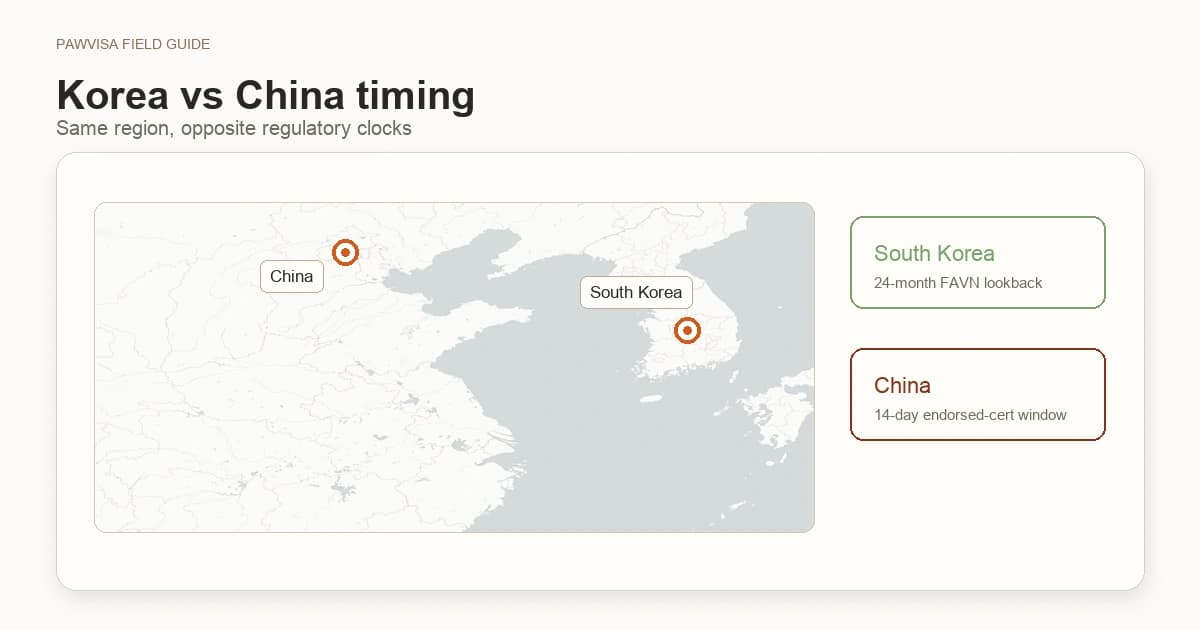
Most owners planning an Asia move see “Asia = strict” and assume one ruleset. The reality is the opposite. Korea’s pet-import regime is one of the more forgiving in the world if you’ve already done a recent FAVN for another destination. China’s is one of the tightest cert-validity windows anywhere — tighter than the EU’s 10 days, tighter than the UK’s 30, tighter than Hawaii’s 14 (because China’s clock starts later).
If you’re choosing between Korea and China for a relocation, or doing both as part of a multi-destination move, knowing which way each destination bends matters.
The comparison table
| Dimension | South Korea (APQA) | China (GACC) |
|---|---|---|
| Rabies serology (FAVN) | Yes — lookback to 24 months | Yes for the compliant no-quarantine path; ≥0.5 IU/mL |
| FAVN sample → arrival wait | Often none — recent FAVN counts | No fixed wait; sampling date valid up to 1 year |
| Cert validity window | ~30 days from vet signature | 14 days from USDA endorsement |
| Clock starts at | Vet signature | USDA endorsement (later than vet sig) |
| Permit required pre-shipment | No (arrival notification) | Yes — GACC import permit for some categories |
| Microchip standard | ISO 11784/11785 | ISO 11784/11785 |
| Quarantine on arrival | None for paperwork-complete pets | 30-day owner-paid quarantine if cert refused |
| Approved entry airports | ICN, GMP | Any port for compliant pets; designated ports for the noncompliant quarantine path |
| Failure cost | Redo cert at destination (rare) | 30-day GACC quarantine OR return-to-US flight |
How Korea’s “lookback” works
South Korea’s APQA (Animal and Plant Quarantine Agency) accepts a FAVN test result dated within the previous 24 months before arrival. As long as:
- the pet has been continuously vaccinated against rabies since the test,
- the FAVN was run at a Korea-accepted lab (KSU is on the list for US origins), and
- the result was ≥0.5 IU/ml.
If you’ve already done a FAVN for Japan (180-day wait was 12 months ago) or for Australia (RNATT 6 months back), Korea accepts that titer. You skip the 6-month wait that other “rabies-controlled” destinations require. The trade-off: Korea is stricter on the cert paperwork at arrival — the FAVN result has to be physically annotated on the cert or attached.
This makes Korea a strong “secondary destination” for owners who’ve already invested in the FAVN timeline for another country.
How China’s 14-day window works
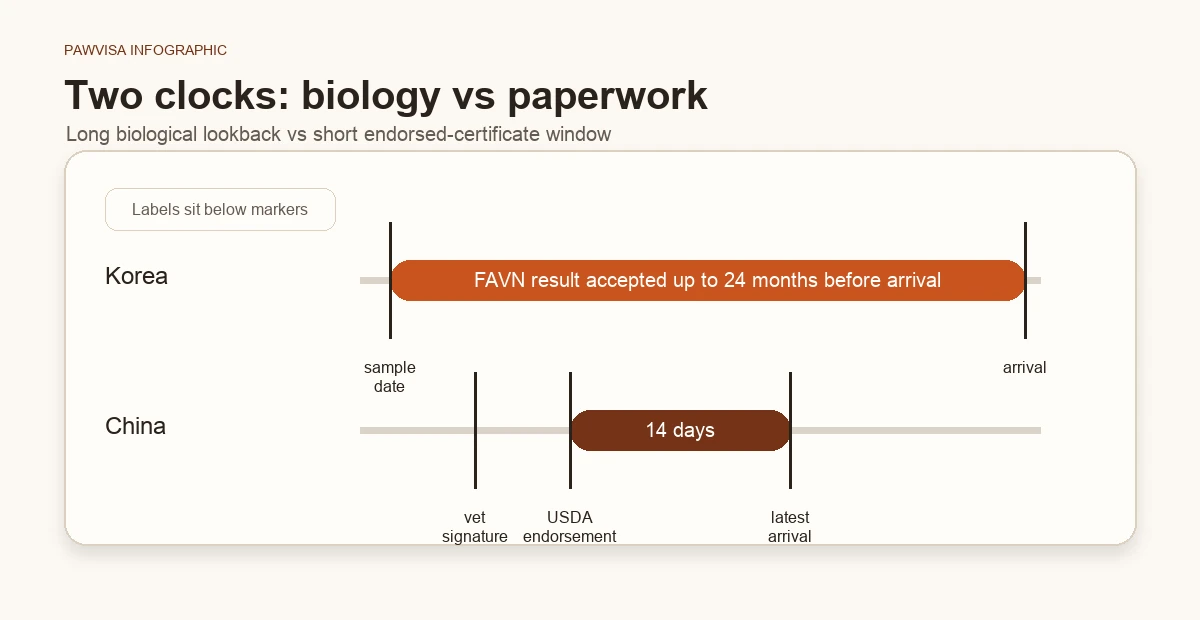
China’s General Administration of Customs (GACC) sets a 14-day clock starting from the USDA endorsement date— not the vet signature date. This is the trap. Most countries count from vet signature; China counts later, which means you have less calendar runway than you’d think.
The math:
- Vet signature date: Day 0
- USDA endorsement: typically Day +1 to +3 (electronic) or +5 to +9 (ink). APHIS does not expedite ink-only routes for China.
- China’s 14-day window starts at endorsement.
- So vet-signature-to-arrival has to be ≤ 14 + endorsement turnaround ≈ 17–23 days, max.
If a flight slip pushes arrival outside the 14-day certificate window, the certificate needs to be redone. Arriving without a compliant packet can force the designated-port, 30-day quarantine path or refusal, so revalidate the documents before accepting a delayed flight.
Why the regulatory philosophies differ
Korea (APQA) treats the rabies titer as evidence: if you can prove neutralising antibodies in the past 24 months and continuous vaccination, the disease-import risk is low enough to wave through. The paperwork timeline is loose because the biology timeline (titer + vaccination continuity) is tight.
China also uses a rabies-antibody titer for the compliant no-quarantine path, but its timing is different: the sampling date remains valid for up to one year and the final official certificate must still fit the tight 14-day arrival window. A pet missing the compliant conditions uses the designated-port quarantine path.
What to do if you’re considering both destinations
- If you’ve already done a FAVN (for Japan, Australia, UK, or EU returns), Korea is the cheap onward destination. The FAVN result you already have probably qualifies — just confirm with APQA via the destination vet that the lab is on their accepted list.
- If you’re choosing between Korea and China for a one-time relocation and don’t already have FAVN data, China is technically less work on the biology side (no titer wait) but much more risky on the cert-timing side. We see more rejections at PVG than at ICN by a noticeable margin.
- If you’re doing both as a multi-stop move: do China first (use the fresh cert window), then Korea (with the same FAVN if it’s still in range and the cert can be re-issued for Korea). The other direction — Korea first, China second — is harder because you have to redo the 14-day China cert from scratch when you arrive in Korea.
The 14-day China cert: a survival checklist
- Use VEHCS electronic endorsement if your destination’s pet-import authority and the APHIS state office both accept it for China (varies by year — check with APHIS Western Region). When available, this cuts endorsement turnaround to 1–3 business days.
- Book your cargo flight before scheduling the vet exam. Work backward from the cargo flight date.
- Build at least 3 days of cushion between expected endorsement receipt and the cargo flight. Flight delays are common.
- If the cargo flight slips: contact APHIS state office to ask about re-endorsement. In some cases the existing cert can be re-endorsed at a fresh date without redoing the vet exam.
- GACC permit: not universal on the standard accompanied-pet path. Cargo, unaccompanied, visa, or other special cases should get a current written determination from GACC or the China-side agent. See our China GACC permit article for the current cut-list.
The Korea FAVN: how to qualify
- The lab must be on APQA’s accepted-lab list. KSU is on the list for US-origin pets. Other US labs are not.
- The FAVN result has to be ≥0.5 IU/ml. Below that, you need a new test.
- The test sample date has to be within the previous 24 months from arrival.
- Rabies vaccination has to be continuous since the FAVN sample date — no lapse, even one day. This is the same rule as Japan; see our rabies-lapse Japan article.
- The cert must explicitly reference the FAVN: lab name, test date, result value, sample date.