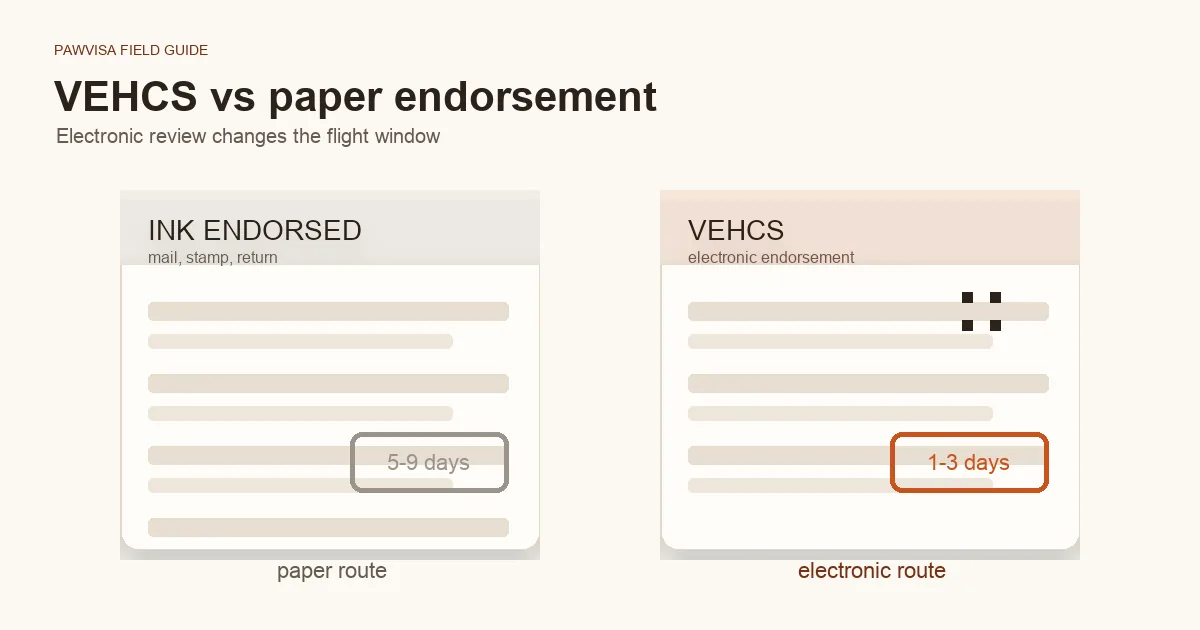
What VEHCS is, and why it changed turnaround times
VEHCS (Veterinary Export Health Certification System) is APHIS’s electronic export-cert endorsement system. When your USDA-accredited vet finalises an international health certificate, the cert goes into VEHCS, an APHIS officer reviews and electronically endorses it, and you receive a PDF you print and present at the cargo terminal.
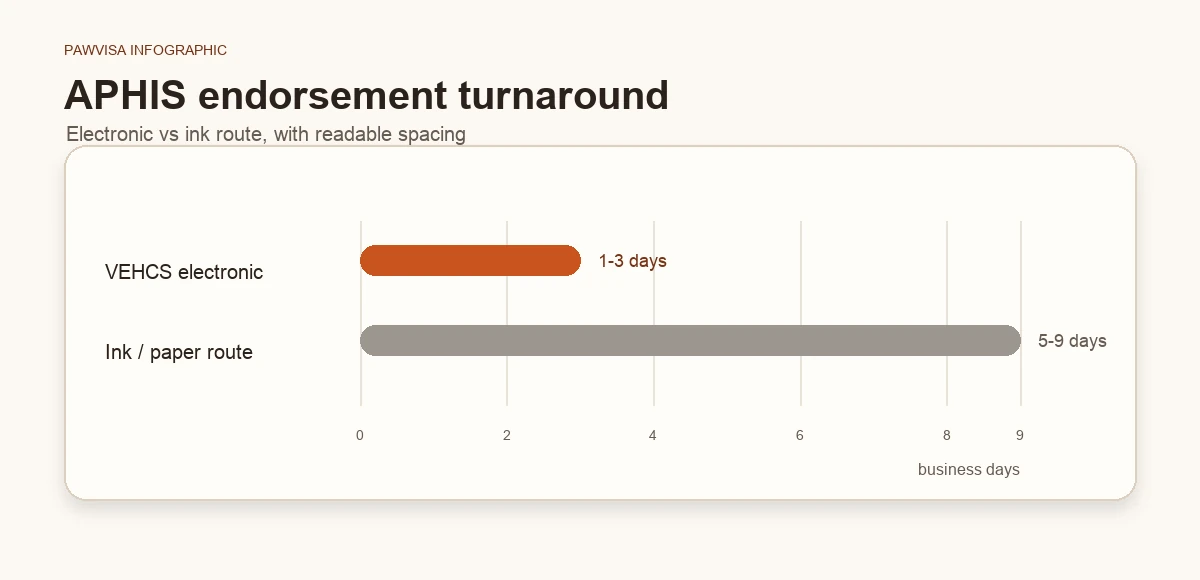
Turnaround before VEHCS (paper-only era, pre-~2020 for most destinations): 5–9 business days. APHIS regional offices had to receive physical certs in the mail, sign, and ship back.
Turnaround with VEHCS (most destinations now): 1–3 business days for routine cases. Often same-day if you submit early in the morning.
The change effectively compressed the pre-flight timeline by 4–6 days for VEHCS-accepted destinations. That’s a big deal when you’re working against a 10-day EU AHC window or a 14-day China cert window.
The full destination map
| Destination | VEHCS accepted? | Endorsement turnaround | Notes |
|---|---|---|---|
| EU + EFTA (all states) | ✅ Yes | 1–3 business days | Most common path for US owners |
| UK (non-commercial) | ✅ Yes | 1–3 business days | GBHC issued via VEHCS |
| UK (commercial) | ❌ Ink required | 5–9 business days | Different cert + ink |
| Japan | ✅ Yes | 1–3 business days | Standard path |
| South Korea | ✅ Yes | 1–3 business days | Standard path |
| Australia | ✅ Yes | 1–3 business days | BICON permit separate |
| New Zealand | ✅ Yes | 1–3 business days | MPI permit separate |
| Mexico (US-origin dogs/cats) | No APHIS endorsement for the dog NWS document | Vet appointment required for dogs | From Aug 3, 2026: dog NWS inspection certificate within 5 days before entry. Cats do not need it; see the Mexico guide. |
| Canada | ✅ Yes | 1–3 business days | Standard |
| China | ✅ Yes (current) | 1–3 business days | 14-day window — plan tightly |
| Taiwan | ✅ Yes | 1–3 business days | BAPHIQ permit separate |
| Hawaii (NIIP) | ✅ Yes | 1–3 business days | HDOA application separate |
| Hong Kong | ✅ Yes | 1–3 business days | Standard |
| Singapore | ✅ Yes | 1–3 business days | NParks licences separate |
| Saudi Arabia | ⚠️ Some routes ink | Varies | Check current bulletin |
| UAE | ✅ Yes (most) | 1–3 business days | Some sub-routes ink |
| Israel | ⚠️ Mixed | Varies | Check current bulletin |
| Iceland | ✅ Yes | 1–3 business days | MAST permit separate |
| Brazil, Argentina, Chile | ✅ Yes | 1–3 business days | Standard |
| Malaysia, Thailand, Vietnam | ✅ Yes | 1–3 business days | Per-country variations |
How to read this table
- Green check (✅) = VEHCS works.Your USDA-accredited vet submits the cert via VEHCS, APHIS endorses electronically in 1–3 business days, you print the PDF, and you’re done.
- Red x (❌) = ink only. Your vet still submits through VEHCS, but encloses a pre-paid express return label so APHIS can mail back a wet-ink, embossed paper cert. APHIS has retired its regional and state endorsement offices, so there is no drop-off; a fully paper submission (which APHIS discourages) goes to one central paper endorsement office in Raleigh, NC. Turnaround: 5–9 business days, plus express postage.
- Mixed (⚠️) = depends on the specific route / current bulletin. Some destinations have been moving toward VEHCS but with edge cases. Always confirm via your vet or the APHIS VETS team (askvets@usda.gov) before booking the cargo flight.
The UK commercial-vs-non-commercial split
UK is unusual in that the same country has both VEHCS-accepted and ink-only routes:
- UK non-commercial (owner travels with pet, ≤5 pets, etc): VEHCS, 1–3 days
- UK commercial (separate dates, ≥6 pets, relocation company, etc): ink only, 5–9 days
If you’re not sure which category you fall into, see our commercial vs non-commercial article. Getting this wrong has a real cost: a commercial-route cert sent through VEHCS won’t be endorsed; APHIS will reject the submission and ask for re-submission via paper. You lose a week.
How to find out if your destination accepts VEHCS
Three sources:
- Ask your USDA-accredited vet. Most accredited vets know the current status for the destinations they regularly endorse.
- Check the APHIS destination page for your country — APHIS publishes endorsement options per destination.
- Email the APHIS VETS team at askvets@usda.gov. APHIS no longer runs state or regional endorsement offices — the Veterinary Export Trade Services generalist team is the published contact for pet endorsement questions.
The status changes year to year. The list above is current for 2026 but verify before booking.
What you save with VEHCS (timeline math)
For a destination with a 10-day cert validity window (most EU):
| Ink only | VEHCS | |
|---|---|---|
| Day 0 | Vet signature | Vet signature |
| Day 1 | Mail to APHIS | Submit via VEHCS |
| Day 5–9 (ink) / Day 1–3 (VEHCS) | APHIS endorsement received | APHIS endorsement received |
| Cargo flight window | Day 9–10 | Day 3–10 |
| Effective flight window | 1 day | 7 days |
That’s a 7x improvement in cargo-flight flexibility. Worth the small admin cost of using VEHCS.
When VEHCS isn’t faster — endorsement backlogs
The 1–3 business day VEHCS turnaround assumes APHIS isn’t backlogged. A few times a year the endorsement queue backs up (peak summer relocations, post-holiday surge). Turnaround can stretch to 5–7 business days even for VEHCS submissions. APHIS publishes no fixed SLA; routine VEHCS processing is staffed Monday–Friday, 7:00 a.m.–4:30 p.m. Central, excluding federal holidays.
If you’re working with a tight window (China 14-day, EU 10-day): add a 2-day buffer beyond the expected VEHCS turnaround. If endorsement takes longer than that, you have a backup plan.
What VEHCS doesn’t replace
- Vet exam: still required, done by a USDA-accredited vet, in person, ≤10 days before flight (per destination’s cert validity window).
- Permits: BICON, MPI, GACC, NIIP, etc. still need separate pre-flight applications. VEHCS only handles the endorsement of the cert itself.
- Destination-side paperwork: the cargo airline, the destination customs, and the destination vet still need physical or electronic copies of the endorsed cert. The PDF is the output.
The print-and-bring rule
Even though VEHCS is electronic on APHIS’s side, you still print the endorsed cert and bring it physically to the cargo terminal + destination customs.
The endorsement includes a QR code that destination officials can scan to verify the cert’s authenticity against APHIS’s records. Don’t show up with the PDF on your phone screen — print it on standard paper, along with all the other paperwork.