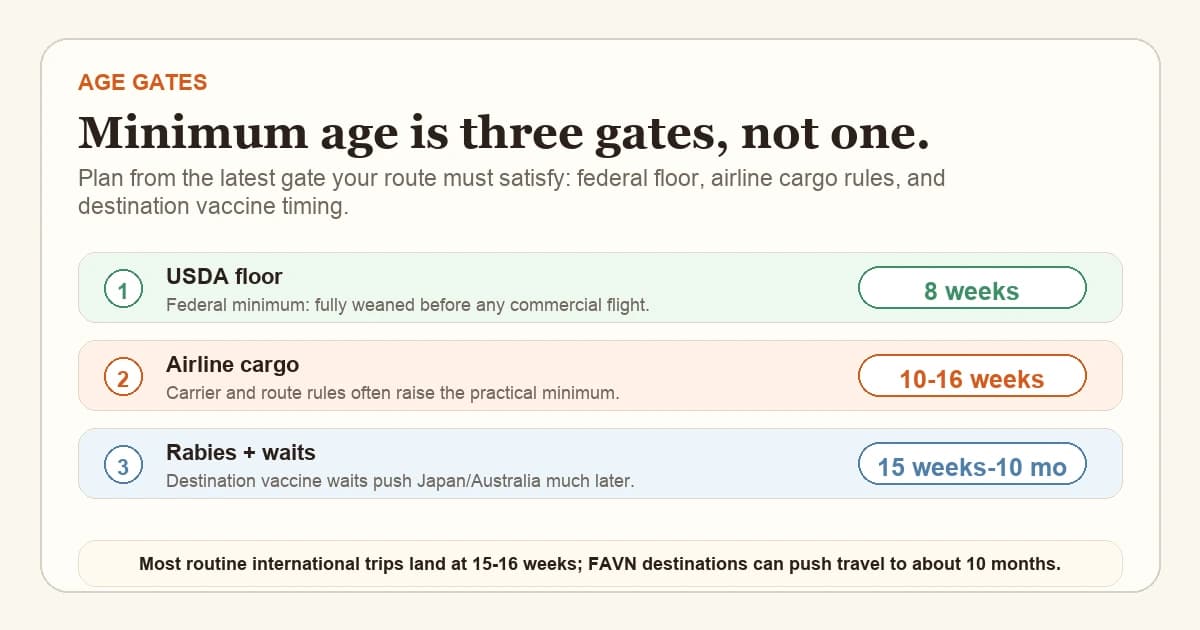
The three age gates
Three separate rules stack to determine when your puppy or kitten can actually fly internationally. You have to clear ALL of them.
Gate 1: USDA minimum (8 weeks, fully weaned)
USDA regulations require any pet shipped by air to be at least 8 weeks old and fully weaned. This is the federal floor. Younger than 8 weeks: not eligible for any commercial flight from the US, domestic or international.
Gate 2: Airline minimum (varies by carrier and route)
Each airline sets its own minimum age for international cargo:
- Most US-based carriers: 10–12 weeks minimum
- Some European carriers: 12–16 weeks for international routes
- Japan / Asia carriers: often 16 weeks for international cargo
- Pet relocation specialists: typically match airline minimums
Call your specific airline’s cargo line to confirm — these are operational minimums, not regulatory ones, and they shift.
Gate 3: Destination country’s vaccine + wait requirements
This is the gate that pushes the practical minimum up the most.
Almost every destination requires a rabies vaccine. Most rabies vaccines (manufacturer-spec) require the pet be at least 12 weeks oldat the time of vaccination. After the vaccine, the destination’s immunity wait kicks in:
- UK / EU: 21 days from vaccine = pet must be ≥15 weeks at travel
- China: similar 21-day or longer wait
- Korea: ~21 days
- Japan: needs TWO rabies vaccines (≥91 days old at first, ≥30 days apart, plus FAVN drawn after 2nd, plus 180-day wait) = pet must be ≥10 months at travel
- Australia: similar RNATT + 180-day wait = pet must be ≥9-10 months
- Hawaii (5-Day-or-Less): FAVN + 30-day wait = pet must be ~6 months
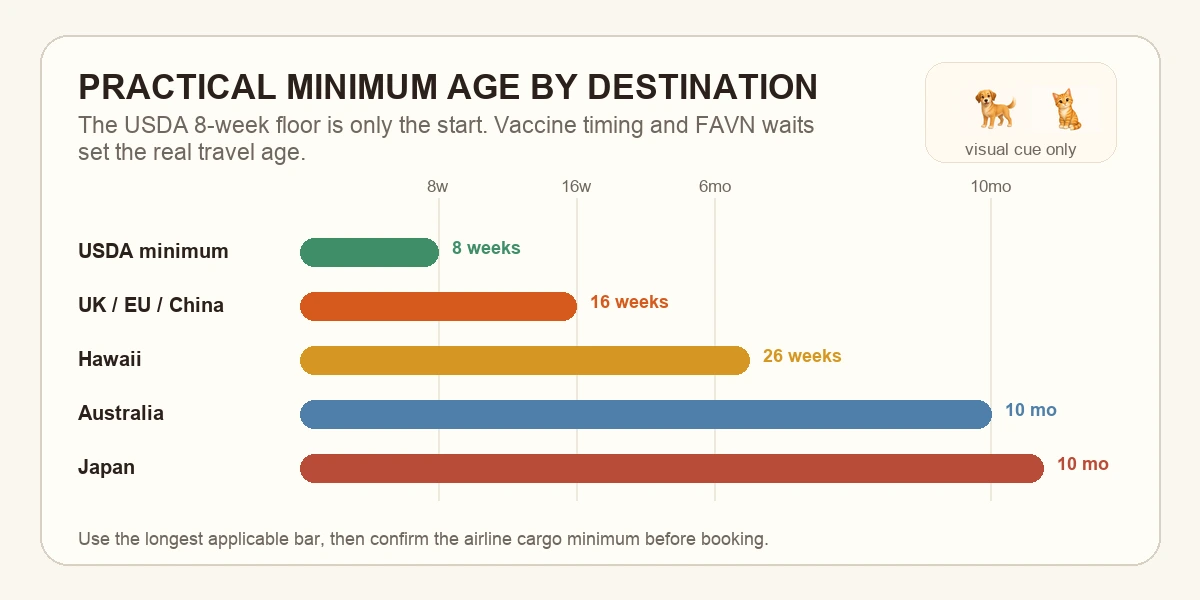
The practical minimums by destination
| Destination | Earliest legal travel age | Driver |
|---|---|---|
| Mexico | 8 weeks (USDA minimum) | No health cert required since 2019 |
| Canada (dogs >8 months) | 8 weeks; though many trips need rabies | USDA minimum, possibly cert-free |
| UK / EU / Switzerland / Norway | 15–16 weeks | 12-week rabies + 21-day wait |
| China | 15–16 weeks | Rabies + titer/certificate path |
| South Korea | 15–16 weeks | Rabies + FAVN (if applicable) |
| Hawaii (5DOL / DAR at HNL) | ~24–26 weeks (6 months) | Rabies + FAVN + 30-day wait |
| Taiwan (actual Hawaii/Guam origin) | ~10 months | ≥180-day Hawaii/Guam residence (not a layover) |
| Taiwan (US-mainland origin) | ~6–7 months | Rabies + FAVN sample 90 days before shipment |
| Japan | ~10 months | 2× rabies + FAVN + 180-day wait |
| Australia | ~9–10 months | RNATT + 180-day wait + BICON processing |
The “under 15 weeks” edge case for EU
The EU has a specific puppy rule: pets under 15 weeks can’tbe moved into the EU under the standard rules because they can’t have completed the 21-day rabies wait.
There’s a derogation in some EU countries (Sweden, Finland, etc.) that allows puppies 12–15 weeks if they’re accompanied by the mother who has all required vaccinations + are not destined for sale. This is for breeders, not typical pet owners.
For practical purposes: don’t plan an EU trip with a puppy under 16 weeks.
Kittens vs puppies
Cats follow the same general rules — USDA 8-week floor, airline minimums similar, rabies vaccine + wait same. Two differences worth noting:
- Some destinations have lighter cat rules. Japan’s cat requirements are simpler than dog (no FAVN, fewer steps). A 4-month-old kitten can clear Japan’s process faster than a 4-month-old puppy.
- Cats sometimes have lower airline weight limits in cabin. Means more cats can fly cabin (where allowed), so the “wait for cargo eligibility” pressure is lower.
But the basic rabies + wait math is the same. A kitten under 15 weeks can’t enter UK/EU. A kitten under ~6 months can’t enter Hawaii. A kitten under ~10 months can’t enter Australia.
The “we adopted a puppy and want to take it to Japan in 6 months” failure mode
This is the most common age-related search Pawvisa sees. Reality:
- You adopt the puppy at 8 weeks.
- Earliest rabies vaccine (first of two for Japan): 12 weeks.
- 30 days minimum between 1st and 2nd vaccine: 16 weeks at 2nd vaccine.
- FAVN sample must be drawn after 2nd vaccine: 16+ weeks.
- 180-day wait after FAVN sample collection: 16 weeks + 180 days = ~42 weeks = about 10 months old before earliest arrival in Japan.
If your puppy is 4 months when you start planning a Japan move, the earliest realistic arrival is when the puppy is about 10 months. Younger isn’t possible without breaking the rule chain.
For Japan owners with very young puppies who need to relocate sooner: the only legitimate way to compress is to fly to a non-Japan destination first (say, Hawaii at ~6 months), then move on to Japan after the puppy is older. But that’s a complex multi-leg move.
How to plan around an age constraint
Three principles:
- Start the rabies clock as soon as the puppy is legally vaccinatable. 12 weeks for most manufacturers. Don’t wait — delaying the 1st vaccine just delays everything else proportionally.
- For 180-day-wait destinations (Japan, Australia), plan from the back. If the trip needs to happen in 11 months, the FAVN sample needs to be drawn in 5 months, which means the 2nd vaccine ~6 months out, the 1st vaccine ~7 months out, the microchip-before-vaccine sequence locked in ~7 months out.
- Verify the specific airline’s puppy minimum before assuming cargo will accept your dog. Some carriers go higher than the regulatory 12 weeks for safety reasons.
For most LA owners with new puppies: a UK or EU move is doable at 4–5 months. A Japan or Australia move requires waiting until the puppy is about a year old, or postponing the human relocation.