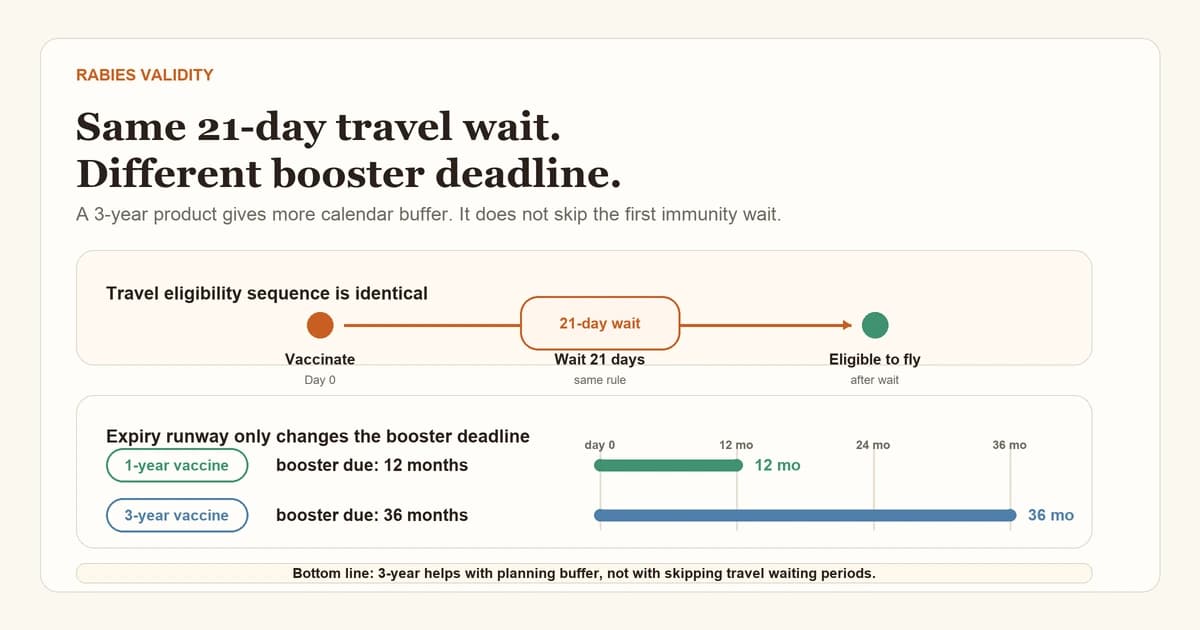
What “1-year” and “3-year” actually mean
These are manufacturer validity periods, not biological differences. Most rabies vaccines actually provide similar immunological protection. The “1-year” or “3-year” is the period during which the manufacturer (Merck, Boehringer Ingelheim, Zoetis, etc.) certifies the vaccine remains effective without a booster.
Practical implications:
- 1-year vaccine: booster required 1 year from administration date
- 3-year vaccine: booster required 3 years from administration date
For US owners with no international travel plans, either works fine. For international travel, the validity period matters because of the continuity rule.
The continuity rule (the international-travel-specific part)
Every major destination requires the rabies vaccine to be currently valid at the time of travel. Some destinations also require the chain of boosters to be continuous: each booster must be administered before the prior vaccine’s validity expires.
For most destinations (UK, EU, Korea, etc.), a lapse just means the next vaccine becomes a “new primary” — restart the 21-day immunity wait. Annoying but recoverable.
For Japan and Australia, the continuity rule is stricter. From the Japan article:
Japan requires continuous, in-date rabies vaccination from the first shot through arrival. If coverage lapses by even one day during the 180-day FAVN wait, the prior FAVN can become invalid and the clock restarts.
This is where the 1-year vs 3-year choice can matter operationally.
When 3-year helps your international planning
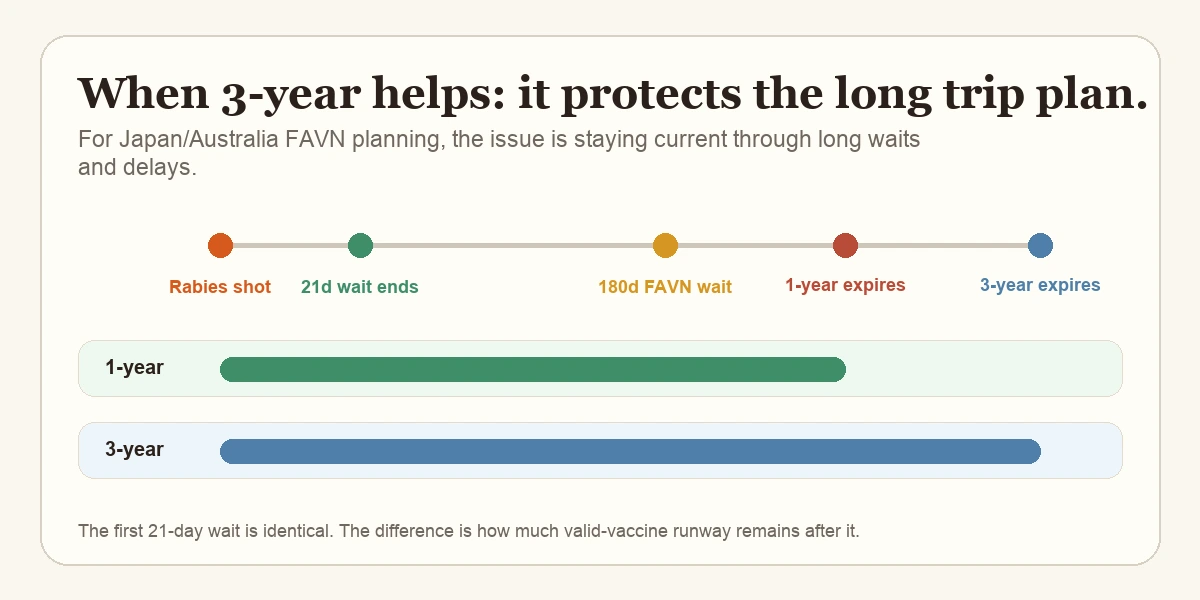
Three scenarios where the 3-year vaccine simplifies international planning:
1. You’re doing the 180-day FAVN wait for Japan or Australia.
If you vaccinate with a 1-year vaccine and draw the FAVN sample shortly after, you have ~11 months from FAVN draw to the booster deadline (1 year vaccine minus the ~1 month between vaccine and FAVN draw). The 180-day wait fits inside this window — but barely. Any delay risks the vaccine lapsing before arrival.
With a 3-year vaccine, you have ~35 months from the vaccine to the next booster. The 180-day wait is comfortably contained, with years of buffer if the trip slips.
2. You’re planning multiple international trips over 2-3 years.
A 3-year vaccine means one less “vaccine + 21-day wait” restart between trips. If you’re a digital nomad or your job requires repeat moves (military PCS rotations, diplomatic postings), a single 3-year vaccine covers more trip cycles.
3. You don’t want to forget the booster.
Vets remind you about boosters via reminder cards / emails, but a 3-year vaccine gives you 3 years of grace. Less risk of an accidental lapse that invalidates an international trip.
When 1-year is the right choice
Three counterpoints:
1. The 3-year vaccine might not be approved in your destination country’s framework.
A few destinations require the rabies vaccine to be a “1-year vaccine, boostered annually.” The 3-year vaccine, valid in the US for 3 years, might be treated as “lapsed after 1 year” by the destination’s rule book. This is rare but documented for a handful of stricter destinations — verify with your specific country.
2. Some destinations have “primary vaccine must be administered within X months” rules.
For example, some EU countries have rules that the rabies vaccine has to be administered within 12 months of travel. A 3-year vaccine given 18 months ago might fail this rule even though the vaccine itself is still valid by manufacturer terms. Again, rare but happens.
3. Cost difference is small.
Most US vets price 1-year and 3-year vaccines within $10-20 of each other. The 3-year isn’t dramatically more expensive — but it also isn’t always available in every clinic’s stock.
What your USDA-accredited vet should put on the cert
Either way, the rabies certificate must show:
- Vaccine manufacturer name (Merck, Boehringer Ingelheim, Zoetis, etc.)
- Full vaccine product namespelled out (not just “rabies vaccine”)
- Manufacturer validity period (1-year or 3-year)
- Lot number
- Date administered
- Microchip number of the pet
- Vet’s signature + USDA accreditation number
Some destinations require the manufacturer’s immunity periodto be specifically stated on the cert (Japan does, EU does). Vets sometimes use just “1-year” or “3-year” — better to have the manufacturer’s full text. Ask the vet to write it explicitly.
The “I’m boostering and going to Japan in 6 months” scenario
Common question. Reality:
- If you’re boostering with a 1-year vaccine: validity ends in 1 year. The Japan 180-day wait fits, but you need to nail the booster timing precisely.
- If you’re boostering with a 3-year vaccine: validity ends in 3 years. Japan trip easily fits with margin.
For Japan-bound dogs specifically, switching from a 1-year cycle to a 3-year cycle before the Japan FAVN draw reduces the “vaccine lapses during the 180-day wait” risk significantly.
How to time the upgrade from 1-year to 3-year
If your dog has been on annual 1-year vaccines and you’re now planning a Japan or Australia move:
- At the next booster, ask for a 3-year vaccine instead.
- Make sure the cert documents the 3-year validity explicitly.
- Microchip rule applies the same way — the 3-year vaccine still has to be administered after a valid ISO microchip.
- For Japan: the 3-year vaccine becomes “vaccine #1” in Japan’s two-vaccine sequence. The 2nd vaccine (30 days later) starts the FAVN clock. The 3-year validity covers everything from there.
This is the cleanest path for high-stakes destinations. Talk to your USDA-accredited vet about availability + cost at the next visit.