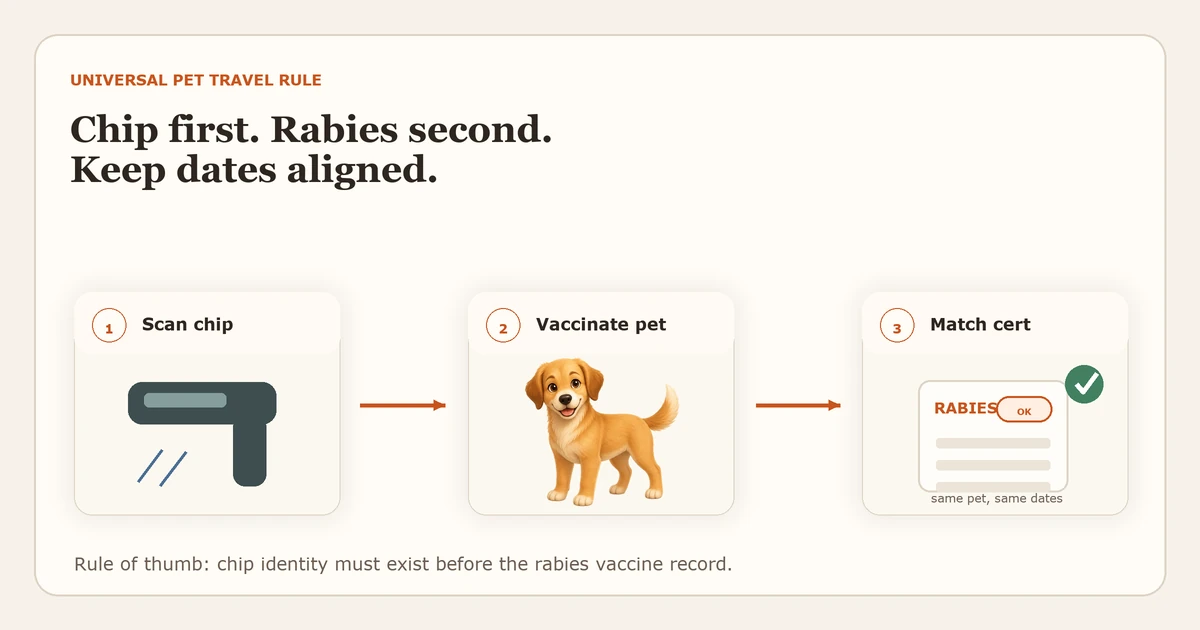
What the rule actually says
The sequencing rule is the same across UK, EU, Japan, Australia, China, Korea, and most other major destinations. The wording varies slightly but the gate is the same: the microchip implant date must be on or before the date of the rabies vaccination on the health certificate.
A few representative quotes from official sources:
- EU Regulation 576/2013 Annex III: “Anti-rabies vaccination must be administered by an authorised veterinarian on or after the date the transponder is implanted.”
- gov.uk pet travel(post-Brexit): “Your pet must be microchipped before, or at the same time as, getting its rabies vaccination.”
- APHIS Japan page, STEP 2: “The pet must be microchipped on the day of or before the 1st vaccination.”
“Before or on the same day” is the practical bar. Same-day chip + vaccine is accepted as long as the certificate documents the chip first.
Why this rule exists
The rabies vaccine timing is the centrepiece of every international pet entry rule — 21-day immunity windows in the UK and EU, 180-day FAVN post-test waits for Japan and Australia, etc. The microchip is what ties a specific vaccination event to a specific animal. Without a chip, there’s no way to verify that this dog is the one that got this shot.
So countries inverted the problem: a vaccine record without a chip identity is treated as if the shot didn’t happen. The chip has to be in place first, so its number can be written on the rabies certificate next to the date.
What “invalid” means in practice
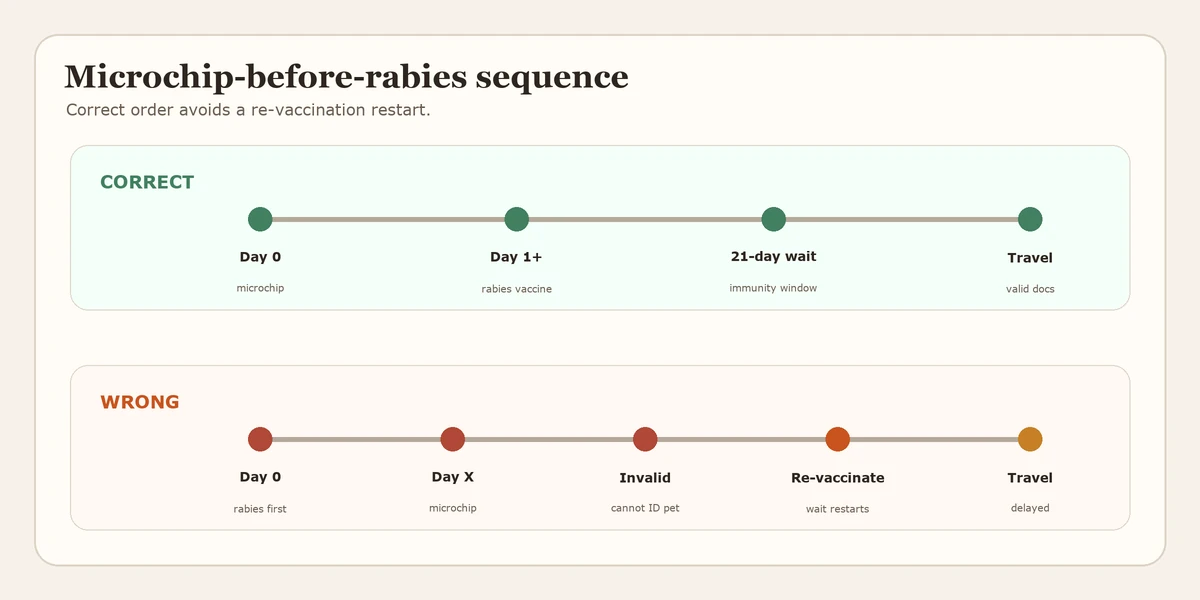
If you get caught with the wrong sequence — vaccine before chip — at any point in the timeline, the consequences vary by destination but always include some version of “do the vaccine again”:
- UK / EU: vet’s accredited health cert can’t be signed for travel until the rabies vaccine is re-administered post-chip. 21-day immunity wait starts over.
- Japan: the FAVN test (the rabies titer test) drawn from a pre-chip vaccination is invalid. You restart from a new vaccine, then re-titer, then wait 180 days again.
- Australia: BICON permit application gets bounced. RNATT test treated as invalid. 180-day wait starts over.
- China: the compliant no-quarantine entry path depends on chip-matched rabies and titer records; pre-chip rabies can invalidate that path.
The cost of getting this wrong isn’t just the vet appointment to re-vaccinate. It’s the months of waiting that get reset. Japan and Australia owners hit by this lose 6 months minimum.
The “I rescued a dog that was already vaccinated” trap
This is where the rule catches the most owners. The pattern:
- You rescue or adopt a dog that’s already been rabies-vaccinated (shelter or previous owner did the shot).
- The dog isn’t chipped, or has a non-ISO chip that won’t read at international ports.
- You plan an international move and get an ISO microchip implanted.
- You take the dog to a USDA-accredited vet expecting to start the international cert process.
- The vet looks at the dates — chip implanted AFTER the existing rabies — and tells you the existing vaccination doesn’t count for international travel.
The dog needs a new rabies shot, post-chip, even though they’re already protected from rabies. The shot is regulatory, not medical. Your dog isn’t unsafe; the paperwork is unsafe.
How to avoid it
For pets that don’t yet have either chip or rabies vaccine:
- Microchip first— book the chip appointment as the first action. Confirm it’s ISO 11784/11785 compliant (15 digits, not 9 or 10).
- Rabies second — same vet visit is fine, as long as the certificate documents the chip date first.
- 21-day wait, then everything else — FAVN, USDA endorsement, cargo booking all happen after the 21 days.
For pets that already have a rabies vaccine and no chip (the rescue scenario above):
- Implant the ISO chip now.
- Schedule a re-vaccination for rabies the same day or after — most vets are happy to do this; rabies is a routine vaccine.
- Treat the 21-day immunity wait as if you’d started fresh — because for international travel purposes, you have.
For pets that already have a chip AND a rabies vaccine:
- Pull the chip implantation date from your vet records. Pull the rabies vaccination date too.
- If chip date ≤ rabies date: you’re good. Verify the chip number on the rabies certificate matches the chip in your dog.
- If chip date > rabies date: you need a re-vaccination after the chip date. Talk to your vet.
The chip-number-on-the-cert detail
One detail the rule depends on: the microchip number must be on the rabies certificate. Some old paper certs from the 2010s only list the dog’s name and the vaccine date. Those don’t satisfy modern international requirements even if the dates work out — the chip number has to be on the document tying chip identity to vaccine event.
If your existing rabies cert doesn’t have the chip number on it, talk to the issuing vet about reissuing the cert with the chip number added. Some will, some won’t (depends on the chip + vaccine timing they have on file).
The cleanest path is always: chip first, vaccine second, cert at the time of vaccine with the chip number printed on it.