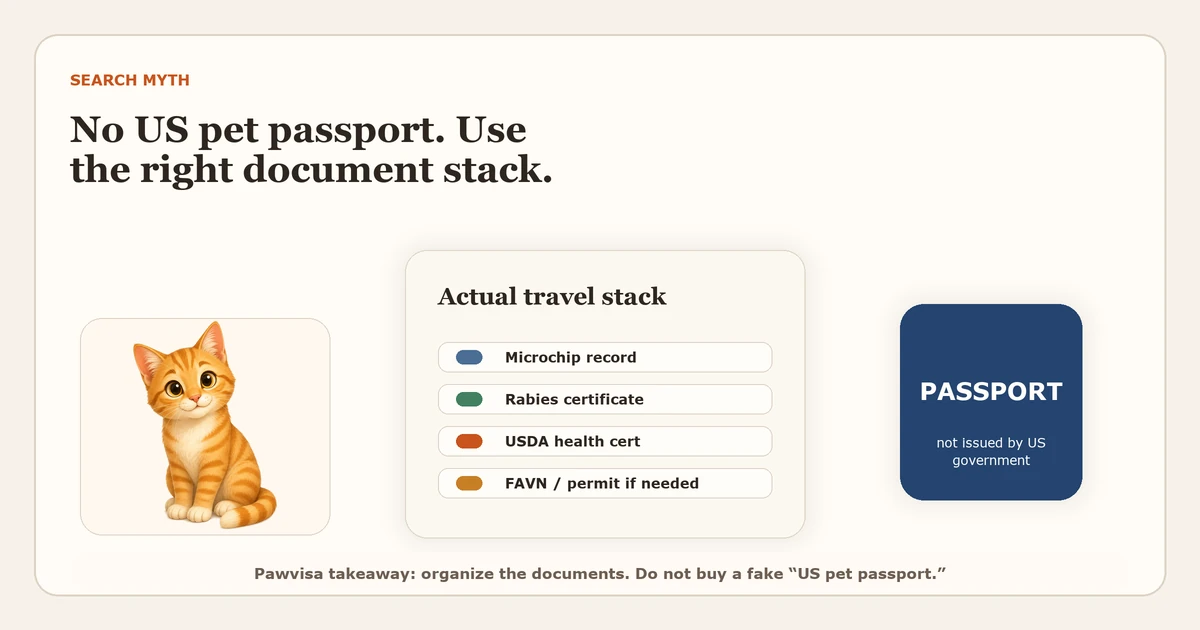
Where the confusion comes from
The “pet passport” term is real — for EU residents. Under the EU’s PETS scheme, EU member states issue a literal blue “pet passport” booklet that documents the pet’s identity, vaccinations, and titer status. EU residents use this passport for movement between EU countries.
That’s the EU’s system. The US never adopted it.
Three forces keep the term alive in the US:
- Word-of-mouth from EU expats. EU citizens move to the US and assume the US has the same system.
- Private “pet passport” vendors.Search “US pet passport” and you’ll find websites selling branded booklets you fill out yourself. They’re not government-issued. Some are legitimately useful as personal organisers; others are misleading marketing.
- Search engines mirror what people type.Because so many people search “US pet passport,” content sites use the term in their titles even when the article underneath explains the term is inaccurate.
So when a US owner searches “how do I get a pet passport for my dog” — the answer is you don’t, because the US doesn’t issue one. What you need is something different.
What you actually need: the document stack
For an international trip from the US, the paperwork is destination-specific. Pawvisa’s per-destination guides (UK, EU, Japan, Australia, etc.) cover the country-by-country requirements, but the common building blocks are:
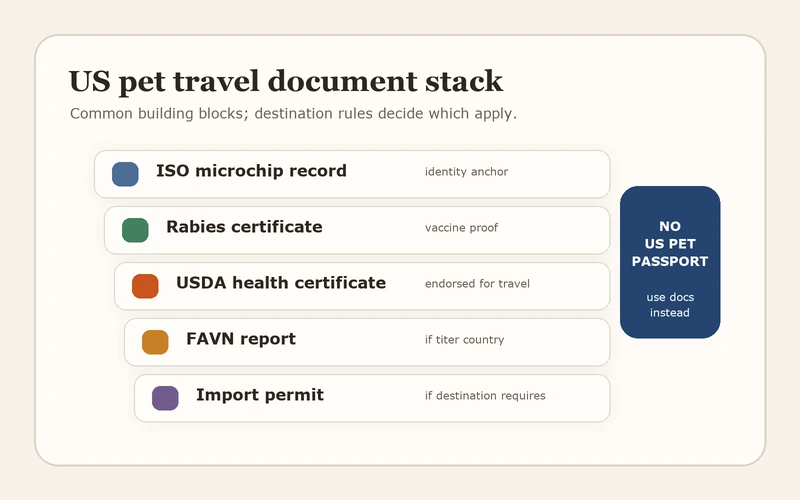
- ISO 11784/11785 microchip + record.Implanted by your vet. The chip number is referenced on every other document. Some destinations (Japan, China, EU) explicitly require ISO compliance — older non-ISO chips don’t read at international ports.
- Rabies vaccination certificate. Vaccine administered after the chip is in place (see the microchip-first rule). The cert lists the chip number, the vaccine manufacturer + product name, and the date.
- USDA-accredited vet health exam. Within a destination-specific window before travel (usually 10 days for EU, 14 days for China, up to 30 days for UK / Korea). The exam confirms the pet is healthy and fit to fly.
- Destination-specific health certificate, filled by your USDA-accredited vet. Different form per destination:
- UK: post-Brexit UK cert
- EU: EU Animal Health Certificate (AHC)
- Japan: Japan-specific health cert
- Australia: Australian DAFF cert via BICON permit
- China: USDA-endorsed cert; separate GACC permit only if the transport/status category requires it
- USDA APHIS endorsement.The accredited vet submits the cert to USDA APHIS via VEHCS (or paper); APHIS endorses it (signature, embossed seal). This is the “certificate” your customs inspection actually checks.
- Optional add-ons by destination. FAVN titer test (Japan, Australia, Hawaii, Korea, Taiwan), import permit (Australia BICON, Taiwan APHIA, and conditional China categories), tapeworm treatment (Finland / Ireland / Malta / Norway / Northern Ireland).
That’s the stack. There’s no single document called a “passport” that bundles all of this — it’s a sequence of separate certifications.
The “EU pet passport” detail (only if you become an EU resident)
The EU pet passport is a real thing, but it’s only issued to EU residentsby EU-authorised vets. Once you’re an EU resident and your pet has been there long enough, an EU vet can issue an EU pet passport. From then on, the passport lets you move the pet within the EU without re-doing the certificate dance for each trip.
This doesn’t help on the entry trip from the US. The US-to-EU first move still needs an EU AHC (the one-time entry certificate). The EU passport is for subsequent travel within Europe.
If you’re moving to Europe permanently with your pet, the EU passport becomes a quality-of-life upgrade about a year in. But it’s not part of the US-side paperwork.
Why the private “pet passport” booklets exist (and whether you need one)
A handful of US companies sell “pet passport” booklets — blue covers, embossed lettering, places to staple in your vaccine records. These aren’t government documents and aren’t required for any international trip.
They can be useful as personal organisers: somewhere to keep the originals of your rabies certificate, microchip implantation record, USDA cert copy, etc. all in one place. But the booklet itself doesn’t have any legal standing. Border inspectors look at the underlying USDA-endorsed cert, not the booklet.
If you’re organised in a binder or a folder, you don’t need to buy one. If a $30 booklet makes you feel calmer about not losing the paperwork, that’s a fine reason to buy it. Just don’t believe vendors who imply the booklet is a substitute for the underlying USDA cert.
The takeaway in one sentence
The US has no pet passport. International pet travel from the US needs a destination-specific USDA-endorsed health certificate, prepared and endorsed within the destination’s validity window before the flight. Pawvisa’s destination guides walk through the specific paperwork per country.