VEHCS: the electronic path
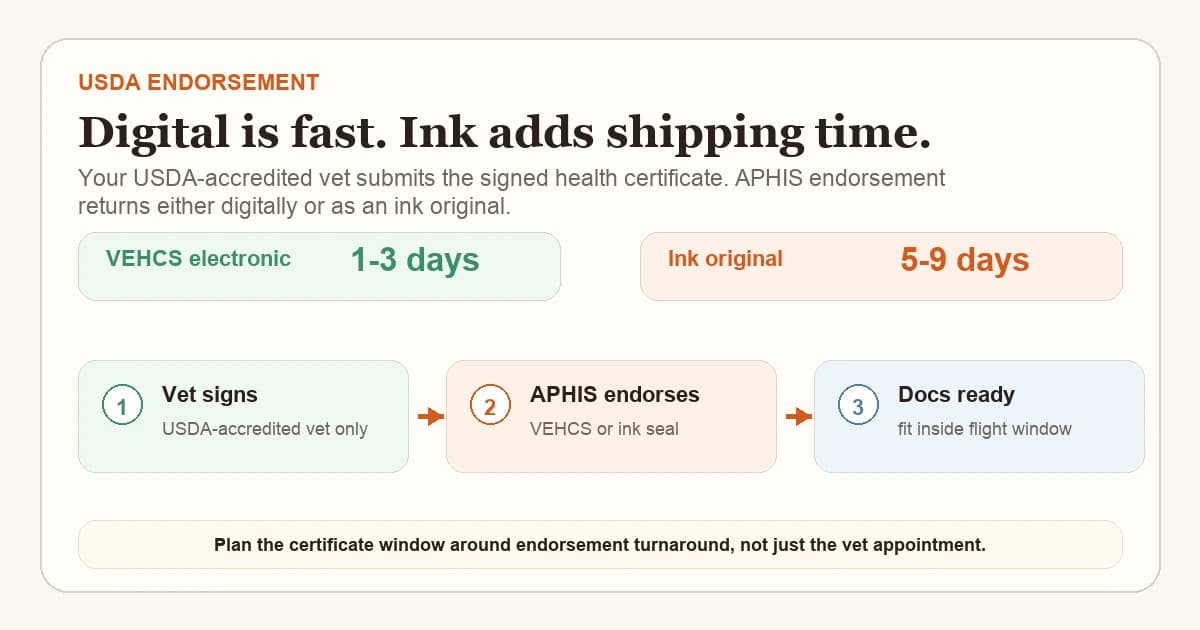
VEHCS (Veterinary Export Health Certification System) is APHIS’s online portal. Your USDA-accredited vet logs in, uploads the destination-specific health certificate they signed at your fitness-to-fly exam, attaches supporting documents (rabies cert, microchip record, FAVN if applicable, import permit if applicable), and submits.
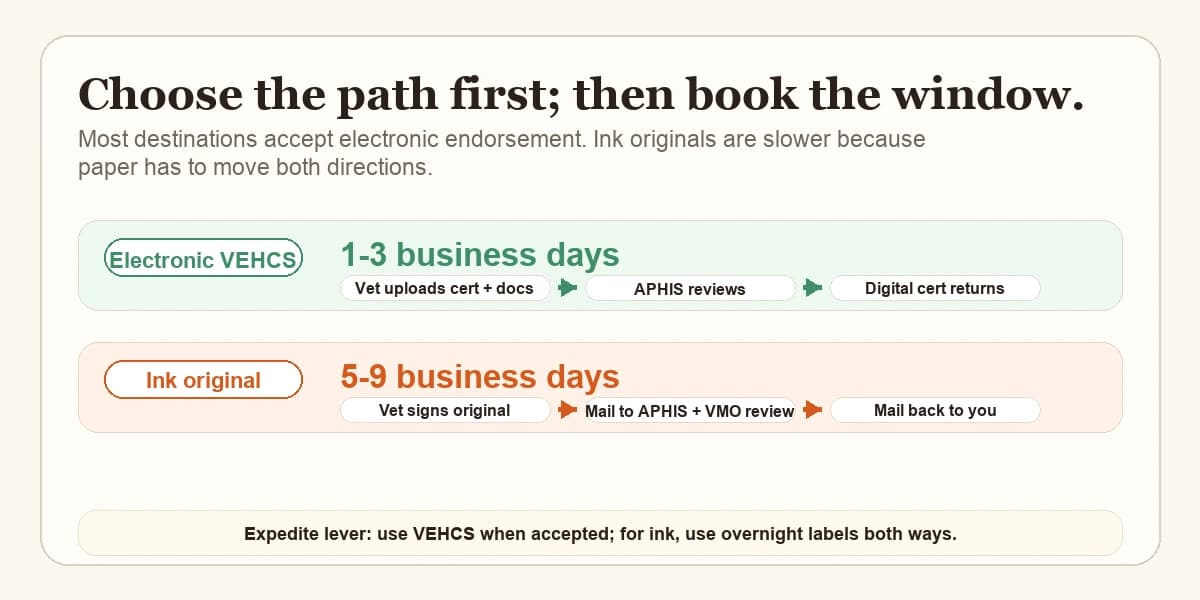
APHIS staff review and endorse digitally — typically 1–3 business days.
Most destinations accept the electronic endorsement. As of our scrape:
- Accepts electronic: UK (non-commercial), EU + EFTA, Japan, Canada, Mexico, Korea, Taiwan, Australia (with caveats), Singapore, Hong Kong
- Requires ink: some commercial moves, Saudi Arabia + some Middle East, occasionally specific UK commercial cases
If your destination accepts electronic and your vet submits VEHCS first thing on a business day, the cert is usually back to you (digitally) within 72 hours.
When ink endorsement is required
A few destinations won’t accept APHIS’s digital endorsement and require the original ink-signed cert with an embossed seal. Even then, the submission still runs through VEHCS: your vet encloses a pre-paid express return label so APHIS can mail back a physically endorsed paper cert. The process:
- Your USDA-accredited vet submits the cert through VEHCS with a pre-paid express return label enclosed.
- An APHIS endorsement officer reviews, ink-signs, and embosses a paper copy with the official seal.
- APHIS ships the endorsed paper cert back to you (or your vet) using that pre-paid label.
APHIS has retired its regional and state endorsement offices, so there is no in-person or drop-off endorsement and no local office to mail to anymore. A fully paper submission — which APHIS discourages — now goes to one central paper endorsement office for the whole country: USDA-APHIS, Attn: VETS, 920 Main Campus Dr., Suite 200, Raleigh, NC 27606. Because the cert travels cross-country instead of to a nearby office, budget the express round-trip plus APHIS processing. APHIS publishes no guaranteed turnaround, so treat 5–9 business days as a rough planning figure, not a commitment — and build in buffer, since a tight cert-validity window (EU’s 10 days, China’s 14) leaves little room if processing runs long.
How to expedite
Three legitimate ways to speed things up:
1. Use a USDA-accredited vet that has VEHCS experience.
Some vets handle VEHCS submissions weekly; others have never used it. The latter take longer because they’re learning the system on your dog’s clock. Ask before booking the exam: “Have you submitted to VEHCS recently? About how often?”
2. Submit on a Monday or Tuesday.
APHIS processes during business hours. Submitting Friday afternoon means waiting through the weekend before any review. Submitting Monday morning gives APHIS the full week to process.
3. For ink: make the return label overnight express.
If your destination requires a physically endorsed cert, the VEHCS submission has to include a pre-paid return label anyway — pay for overnight express rather than ground. APHIS mails the endorsed paper cert back on that label, so overnight service shaves the return leg from several days to about one, bringing ink turnaround down to roughly 4–5 days.
What doesn’t legitimately speed it up:
- Emailing APHIS repeatedly for a status update. Endorsement offices can’t confirm delivery or give status updates. Check status through your vet in VEHCS or a mail tracking number instead.
- “Expedited” services advertised by non-APHIS third parties. APHIS doesn’t have an official expedite pathway for routine pet endorsements.
The fee schedule
APHIS publishes endorsement fees on their animal export fee schedule. Current fees vary by:
- Species (dog vs cat vs others)
- Number of animals per cert (one cert for 2 pets is cheaper than two separate certs)
- Electronic vs ink (electronic typically cheaper)
- Expedited service (where offered — limited)
We don’t quote specific dollar figures here pending the pricing data brief results — APHIS adjusts the fee schedule and we want the article to show current numbers, not stale ones. The $29 readiness analysis includes current fees for your specific destination + animal count.
What can delay endorsement
Five common reasons APHIS bounces a submission:
- Cert missing chip number, vaccine date, or vet signature. Vet forgot to fill a field. APHIS sends it back; vet corrects; resubmit. Adds 2–5 days.
- Supporting document missing. No FAVN attached for Japan, no rabies certificate, no import permit for China. Same fix-and-resubmit cycle.
- Vet’s USDA accreditation expired.Rare but happens. Cert can’t be endorsed; you need a different vet. Reschedule entire exam.
- Destination-specific form is the wrong version. Destinations occasionally update their cert forms; vets sometimes use older PDFs. APHIS bounces it; need current form.
- Date errors.Vet signature date after the destination’s validity window starts; cert dated after the planned flight date; rabies vaccine date inconsistent with attached cert. APHIS catches these.
Most of these are fixable but each costs days. The cleanest path is a vet who’s done this destination recently and submits the right paperwork the first time.
How this fits into your overall timeline
If your destination has a 10-day cert validity (EU) and APHIS endorsement takes 3 days:
- Day 0: vet fitness-to-fly exam, vet signs cert
- Day 1: VEHCS submission
- Day 3-4: APHIS endorsement returns
- Day 5-10: travel must happen within the window from day 0 (vet signature) — so realistic flight window is days 5-9 (with buffer)
If you book a flight outside the window, you re-do the exam + endorsement.
For destinations requiring ink: add ~5 more days to all the downstream dates. Your flight window from a day-0 vet signature shrinks to almost nothing without expedited mail — plan the exam earlier.
Where Pawvisa fits
Pawvisa doesn’t submit VEHCS for you — your USDA-accredited vet does. What we do:
- The free 60-second timeline check lays out the cert-to-flight timing for your destination so you can pick a vet appointment date that works.
- The $29 readiness analysis includes a shortlist of California USDA-accredited vets who have submitted to VEHCS recently for your specific destination + handles current fee estimates.