
What APHIS actually requires
The continuity rule isn’t a Pawvisa interpretation — it’s right there in APHIS’s STEP 3 text. Read it carefully (emphasis ours):
Dogs and cats must be vaccinated against rabies twice or more after the microchip implanting.
First rabies vaccination: At least 91 days old. After the microchip implanting (including the same day).
Second rabies vaccination: More than 30 days apart from the first vaccination. Within the effective period (duration of immunity) of the first vaccination.
That last sentence is the rule that breaks people. The 2nd shot must happen before the 1st expires. Otherwise the chain is broken — and Japan treats the timeline as if you started fresh.
The same continuity logic threads through every subsequent booster, all the way to arrival. The customs inspector at Narita or Haneda checks the rabies certificate dates against the FAVN report and against the expected coverage window. Gaps show up.
Three windows where coverage usually breaks
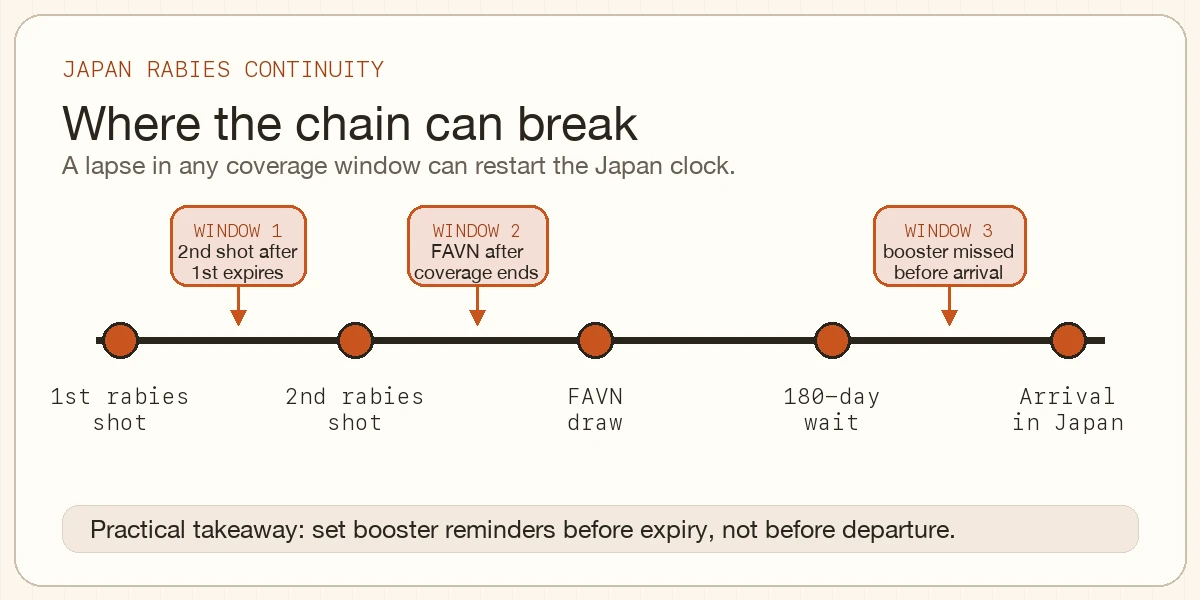
Window 1 — between the 1st and 2nd rabies vaccine.
US rabies vaccines are typically valid 1 year (1-year vaccine) or 3 years (3-year vaccine) per manufacturer. If your vet gives a 1-year vaccine on Jan 1 and you schedule the booster for Jan 30 of the next year, the 2nd shot is outside the 1st’s effective period. Chain broken. Start over.
Window 2 — between the 2nd vaccine and the FAVN draw.
APHIS allows the FAVN sample to be collected on the date of the 2nd vaccination, or any day until the end of the effective period of that vaccine. Drift past the expiry and the lab won’t have a valid “live coverage” window to test against.
Window 3 — during the 180-day wait, before arrival in Japan.
This is where most owners actually get burned. You’ve done both shots, drawn the FAVN, started the 180-day clock. At month 5 or 6, the rabies vaccine quietly expires. You miss the booster window. The prior FAVN — drawn against a vaccine that’s now lapsed — gets invalidated. The clock resets.
The “month 5” pattern
The r/TravelWithPets thread tagged 1s86qba documents an owner who hit this exact reset. The pattern: a 2-year rabies vaccine administered, FAVN drawn well after, 180-day wait begun. Around month 5 of the wait, the vaccine expired. The booster came too late. The FAVN — drawn during what was then a valid window — was retroactively invalidated. Full reset.
This isn’t an isolated horror story. The most common version we hear: owners (or their vets) didn’t realise Japan checks rabies-vaccine continuity all the way through to arrival, not just at the time of FAVN. The mental model people start with — “the vaccine was valid when I drew the blood, that’s what matters” — is the wrong model.
The honest take: most US vets handle rabies-for-Japan correctly on the first try. The lapse almost always happens during the 180-day wait, when the owner forgets to book the booster before the expiry buried in their files. Same lab caveats from our FAVN-lab article still apply on the re-test.
How to avoid the reset
Three things to do this week, even if your trip is months away:
- Find the 1st rabies vaccine’s expiry date. It’s on the rabies certificate from your vet. Write it down. Don’t trust memory — even owners with 3-year vaccines hit this.
- Calendar two reminders. One at 30 days before expiry: book the booster. One at the day of expiry: confirm the booster happened.
- Tell your vet you’re flying your pet to Japan. If they know, they’ll proactively manage the booster timing. Japan-bound trips need different calendar care than routine annual boosters.
If you’ve already hit the reset — you missed by a day, you’re staring at month 4, panic mode — talk to your vet about the recovery path. You may need to restart from the 1st shot. There usually isn’t a fast way around it, and that’s worth knowing early.