Why Australia is “expensive but knowable”
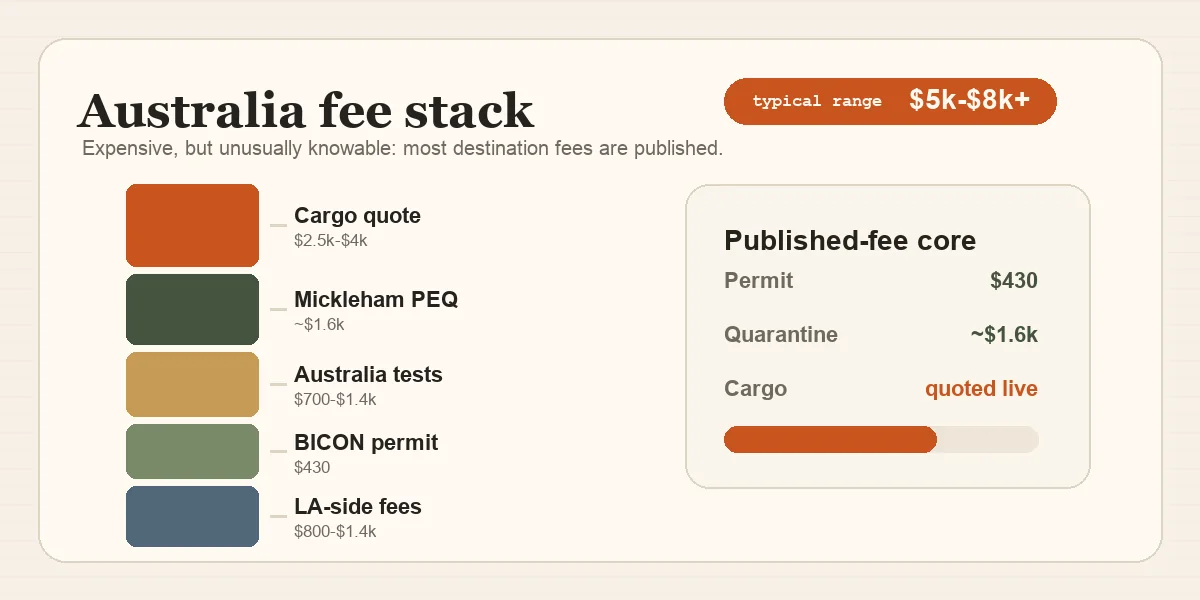
Unlike UK / Japan, where many fees are bundled or quoted live, Australia’s DAFF publishes a granular fee schedule for the Mickleham PEQ. That makes Australia the most predictable cost destination Pawvisa covers — even though the total is high.
The expense isn’t hidden; it’s just the actual cost of: (a) a long-haul cargo flight, (b) 10+ days at a single government quarantine facility, (c) several pre-export tests Australia requires that other destinations don’t.
The universal LA-side line items
Same as the other cost articles. Sources are LA-area mobile vets, Petmate, APHIS.
| Line item | USD | Source |
|---|---|---|
| ISO microchip implantation | $20–$75 (typical $35) | LA-area vet pricing |
| Rabies vaccine | $15–$55 (typical $25) | LA-area vet pricing |
| USDA-accredited vet exam (final fitness-to-fly) | $75–$249 (typical $100) | Same |
| International health certificate paperwork | from $400 | Saving Grace LA |
| APHIS endorsement (3–6 lab tests, 1 pet — Australia typically 3–4 tests) | $206 | APHIS fee schedule |
| IATA cargo crate (Petmate Sky Kennel 36″ medium dog) | $220 | Petmate official price — for larger dogs Australia commonly needs the 40″ ($270) or 48″ ($420) crate |
LA-side subtotal: roughly $800–$1,400 for a typical medium dog.
The Australia-specific tests + paperwork
Australia requires additional tests on top of the standard international vet cycle. From DAFF’s published rules + LA-area vet pricing:
| Line item | USD | Source |
|---|---|---|
| BICON import permit — first pet | $430 | DAFF biosecurity-trade page (AUD 603 × FX 0.71292) |
| BICON import permit — each additional pet | $205 | Same (AUD 288) |
| RNATT (Rabies Neutralising Antibody Titre Test) via KSU FAVN | $84–$91 | KSU Rabies Lab; DAFF does not publish a named KSU list on the public pages we checked, but the FAVN test is the standard route |
| FAVN sample collection — LA vet published package | $275 | Saving Grace LA mobile vet |
| Leishmania infantum test (required for dogs to Australia) | not publicly published | LA lab portals don't publish this test; vet pass-through pricing varies — get a vet quote. Budget reference: $150–$350 based on similar specialty serology tests |
| Brucella canis test (intact dogs only) | not publicly published | Same — lab portals don't publish. Budget reference: $80–$200. Desexed dogs skip this test entirely |
| Parasite treatments (internal + external) — LA public clinic round | $39–$97 (typical $69) | LA public clinic pricing — confirm Australia-export-compliant products with the vet |
| Second USDA-accredited identity verification visit (Australia requires two) | not publicly published | Most LA vets price this similarly to a second exam; budget reference: $75–$200 for the second visit |
Australia-test subtotal: roughly $700–$1,400 depending on intact status + which tests apply.
The Mickleham PEQ fee stack
This is where Australia’s transparency stands out. DAFF publishes every line:
| Line item | USD | Source |
|---|---|---|
| Mickleham PEQ reservation charge | $192 | DAFF biosecurity-trade page (AUD 269) |
| Mickleham PEQ importation charge | $769 | Same (AUD 1,079) |
| Mickleham PEQ daily husbandry / accommodation | $38 / day | Same (AUD 53/day) |
| Mickleham PEQ 10-day accommodation (identity check completed) | $378 | Same (AUD 530) |
| Mickleham PEQ 30-day accommodation (identity check not completed) | $1,134 | Same (AUD 1,591) |
| Mickleham PEQ inspection fee (30 minutes) | $57 | Same (AUD 80) |
| Mickleham PEQ document assessment (30 minutes) | $57 | Same (AUD 80) |
| Mickleham PEQ release / airline handling charge | $121–$250 (typical $186) | Same (AUD 169–351) |
For a 10-day Mickleham stay after completing the optional identity check:
- Reservation $192
- Importation $769
- Accommodation 10 days × $38 = $378
- Inspection $57
- Document assessment $57
- Release / airline handling $186
Mickleham subtotal: ~$1,600 for the 10-day identity-checked path. Without that completed check, use the 30-day accommodation line and budget the additional daily costs.
If the stay extends (paperwork issues, additional inspection requirements), every extra day adds $38 + any additional inspections. Worst-case 30-day stays push Mickleham alone above $2,400.
The cargo flight — LAX to Melbourne
| Carrier | LAX→MEL rate | Notes |
|---|---|---|
| Qantas Freight | not publicly published | Direct LAX→MEL; call Qantas Freight cargo line |
| United Cargo | not publicly published | Via SYD typically; cargo line quotes individually |
| Korean Air Cargo | not publicly published | Via ICN; sometimes competitive on the Pacific route |
Industry knowledge for a 40-lb dog in a 36-inch crate on LAX→MEL via a major carrier: typical third-party-relocator quotes online sit around $2,500–$4,500, but these are not verifiable to a primary source. The long Pacific route + Australia’s biosecurity surcharges push this above LAX→LHR.
For oversize crates (48-inch+ for large breeds) or peak-season bookings, $5,000+ is realistic.
Total scenarios
For one medium desexed dog (40 lb, no Brucella test needed), DIY, identity-check-complete 10-day Mickleham stay:
| Scenario | LA side | AU tests | Mickleham | Cargo | Approx total (USD) |
|---|---|---|---|---|---|
| Budget DIY | ~$800 | ~$700 (just RNATT + parasite + lower-end Leishmania) | ~$1,600 | ~$2,500 | ~$5,600 |
| Typical DIY | ~$1,100 | ~$900 | ~$1,600 | ~$3,500 | ~$7,100 |
| Premium DIY (large dog, peak season) | ~$1,400 | ~$1,200 | ~$1,800 (longer stay) | ~$4,500+ | ~$8,900+ |
| Intact dog (adds Brucella) | +$80–$200 | included | included | included | +$80–$200 |
| Agency-managed | +$1,500–$3,500 on top | Same | Same | Often included | +$1,500–$3,500 |
Australia is the most expensive destination Pawvisa covers— but it’s also the destination where the most cost is published up-front. The unknowns are concentrated in three places: cargo, the two specialty tests (Leishmania, Brucella), and the second vet visit.
What we don’t know yet — and what to do
Five items left null in our public-source compilation:
- All three carrier-specific cargo rates for LAX→MEL (Qantas, United, Korean Air). Call each cargo line directly with your specific dates + crate dimensions + dog weight.
- Leishmania infantum test fee at a US lab. Lab portals don’t publish this publicly. Ask your USDA-accredited vet to quote the test + their pass-through markup. Industry-typical budget: $150–$350.
- Brucella canis test fee (intact dogs only). Same — vet pass-through pricing varies. Industry-typical: $80–$200. Desexed dogs avoid this entirely.
- Second USDA-accredited identity verification visit. Australia requires twoaccredited vets to verify the dog’s identity. Most LA clinics charge this as a second exam ($75–$200). Some clinics have multiple accredited vets and can do both signatures in one visit — saves money. Ask before booking.
- Domestic Australian pet flight after Mickleham release. Once Mickleham clears the dog, you fly to your final Australian city (Sydney, Brisbane, Perth, etc.). Qantas Freight publishes domestic rates, but specific live-animal-on-domestic-flight pricing isn’t on a public page we found.
If your trip is in the next 6 months: the $29 readiness analysis includes a recent verification of Qantas Freight, United Cargo, and Korean Air rates for LAX→MEL on your dates + LA vet quotes for Leishmania + Brucella + the second-vet visit.
The structural insight
Australia is the destination where being organised pays off most. Every published fee is fixed and predictable. The variables are: how long Mickleham holds your dog (paperwork-driven, so meticulous prep helps), which carrier you book (call all three for quotes), and whether your dog needs Brucella (desexed dogs save ~$150).
Plan from Mickleham’s slot date backwards (see our Mickleham booking article), and the cost variance shrinks. For an Australia move that goes smoothly: ~$5,500–$7,500 all-in for one medium desexed dog is realistic on a 2026 schedule.