The single-facility constraint
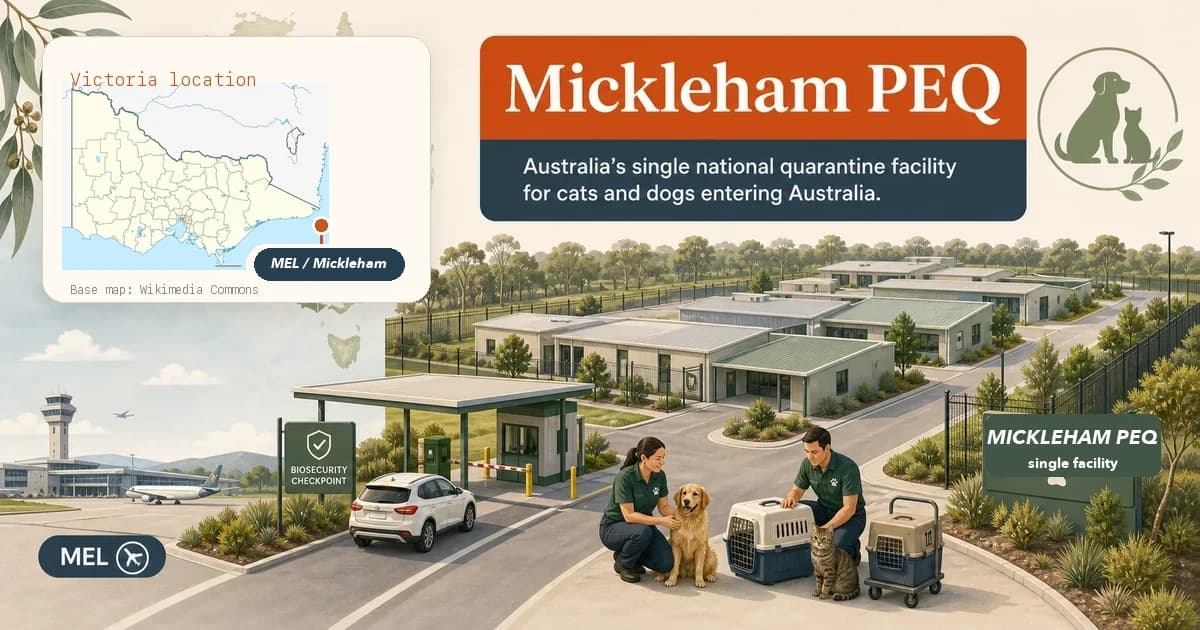
Most countries with rabies-import controls operate multiple quarantine sites — China runs them in PEK and CAN, Hawaii has facilities on each island, the UK uses several private kennels. Australia consolidated everything to one government-run site.
That site is Mickleham Post-Entry Quarantine (PEQ), in Victoria — about 30 km north of Melbourne. Every cat and dog entering Australia from anywhere goes through Mickleham, regardless of which Australian city is the eventual home.
The geographic implication: every Australia-bound pet flight from LA lands at Melbourne (MEL). The pet is collected at MEL by DAFF biosecurity staff and transferred to Mickleham. Domestic onward transfer to Sydney, Brisbane, Perth, or anywhere else inside Australia is not permitted until quarantine is complete.
If your final home is Sydney, your dog stays at Mickleham for the quarantine period, then flies SYD as a domestic pet — which is much easier than the international leg.
What it costs (AUD)
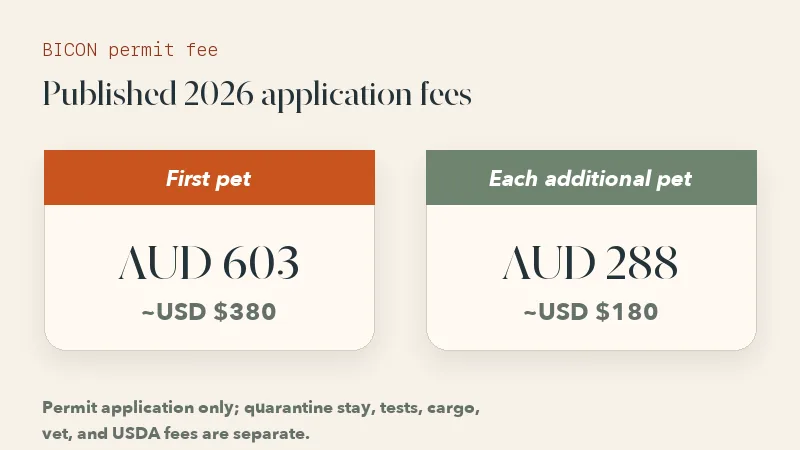
DAFF publishes the BICON permit fees on the biosecurity-trade page. Current 2026 rates from our scrape:
| Item | AUD | USD (approx) |
|---|---|---|
| BICON permit — first pet | $603 | ~$380 |
| Each additional pet in same consignment | $288 | ~$180 |
The BICON permit fee is for the application. It doesn’t include:
- The required vet tests (rabies titer, Leishmania, Brucella for intact dogs, parasite treatments)
- The actual Mickleham quarantine stay (charged separately by night, varies by species)
- Cargo flight
- USDA-accredited vet appointments + USDA endorsement
- Any commercial pet relocator fees (if you use one)
The full cost of an Australia move (LA → MEL → Mickleham → final city) is one of the highest of any destination Pawvisa covers. A future cost article will break the line items down with sourced numbers.
The 7-step sequence in order
DAFF’s permit flow follows a strict sequence. Skipping or reordering steps invalidates the application:
- Microchip + rabies vaccine. Both must stay valid through the export date. ISO 11784/11785 chip implanted before — or on the same day as — the primary rabies vaccination.
- Optional identity verification process. Complete Australia’s identity-check process if you want eligibility for the 10-day Mickleham stay. If it is not fully completed, plan for 30 days of post-entry quarantine.
- RNATT (Rabies Neutralising Antibody Titre Test) — FAVN or RFFIT, ≥0.5 IU/mL. Followed by a mandatory 180-day wait after the sample arrives at the lab. This wait is the lead-time gate for the whole import.
- BICON permit application. Only after the RNATT report + declaration are in hand. Apply 30 days minimum before intended arrival. Typical processing: 20–40 business days; complex cases up to 123 business days.
- Additional dog testing: Leishmania + parasite treatments. Intact (non-desexed) dogs need a Brucella canis test on top.
- Book the Mickleham quarantine slot via PEBS. This must happen BEFORE booking the cargo flight. Slots fill out months in advance — see next section.
- Book direct flight to MEL. No domestic transfer permitted. The cargo flight must land at Melbourne.
Quarantine duration: 10 days or 30 days
The 10-day stay is conditional. Pets that complete Australia’s optional identity-check process are eligible for 10 days at Mickleham. If that process is not completed, the required stay is 30 days. Put the selected path into the permit, slot, cost, and post-release plan rather than assuming every paperwork-complete pet gets 10 days.
Why the slot booking happens before the flight
This is the step most owners get backwards. Logic says: book the flight, then arrange quarantine on arrival. Mickleham logic is reversed.
When you apply for the Mickleham slot, you give DAFF an expected arrival window. They give you a slot — a specific date range — based on facility capacity. Only then do you book a flight that lands within your slot window.
If you book a flight first and apply for a slot second, you’ll often find no available slot within the flight date. You either rebook the flight (cargo cancellation fees apply) or extend the slot wait by weeks. Either is expensive.
The owners we’ve heard of who got this right started the BICON application 5–6 months before intended arrival, booked the slot the moment the permit issued, then booked the cargo flight onto that slot’s window.
The 2026 Bengal cat ban (new)
Effective March 1, 2026, Bengal cats can no longer enter Australia. DAFF revoked the previous 5th-generation Bengal exemption after a biosecurity review.
If you own a Bengal cat and were planning an Australia move — this is a hard stop, not a paperwork workaround. Bengals are not eligible for BICON permits as of 2026-03-01.
This kind of last-minute species/breed ban is the reason we recommend confirming current eligibility with DAFF directly close to your intended application date, not just relying on a guide written months earlier.
The honest take
Australia is the strictest pet import destination Pawvisa covers. Single quarantine facility. ~AUD 603 + add-ons. 6+ month total timeline. MEL-only arrival.
It’s also one of the most predictableonce you accept the timeline. The 7 steps are clearly sequenced, the fees are published, the slot booking system (PEBS) works as documented. The owners we’ve seen succeed approach it as a multi-month project with a checklist, not a single decision they make a month before flight.
Start the BICON permit work at least 6 months out. Book the Mickleham slot the moment the permit issues. Book the flight last, into the slot window. In that order, it works.