Why this list looks short
Most owners assume “international pet travel = quarantine.” That was true 20 years ago. It isn’t now. The UK abolished mandatory pet quarantine in 2000 (replacing it with the PETS scheme, now the post-Brexit non-commercial regime). Japan abolished mandatory quarantine for paperwork-complete pets (the 180-day FAVN wait is the quarantine equivalent, done before flight). The EU never had mandatory quarantine for compliant pets in the modern era.
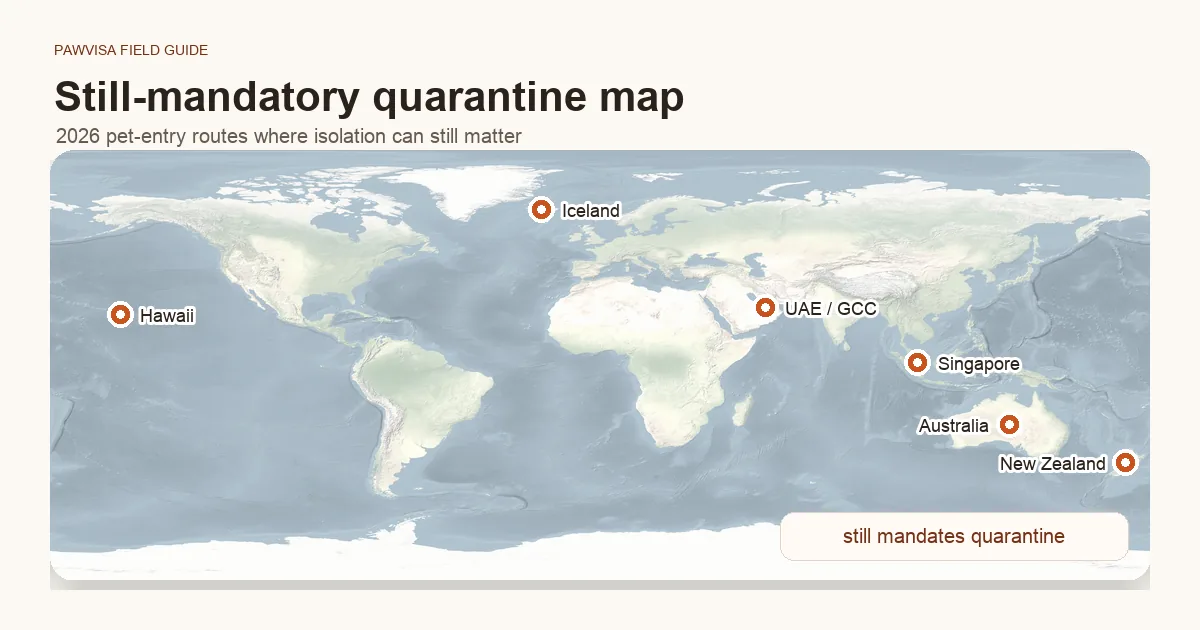
What’s left is a small island/peninsula group where biosecurity demands real isolation: Australia, New Zealand, Hawaii. Plus the UAE and parts of the GCC, which use short quarantine for veterinary inspection rather than long-form isolation.
The full table
| Destination | Quarantine length | Where | Cost (approx) | Pre-book? |
|---|---|---|---|---|
| Australia | 10 days with identity check; otherwise 30 days | Mickleham PEQ (only facility) | ~AUD 2,500+ for 10 days | Yes — months ahead |
| New Zealand | 10 days | MPI facilities | ~NZD 2,500+ | Yes — book early |
| Hawaii (5-Day-Or-Less) | Up to 5 days | DAR animal quarantine station, O'ahu | ~$280–$500 | Yes — pre-arrival NIIP |
| UAE (Dubai / Abu Dhabi) | 24–48 hours (inspection-style) | Airport veterinary facility | Per arrival fee | At arrival |
| GCC (some — Saudi, Bahrain, Kuwait, Oman) | Varies, often inspection-style | Airport facility | Varies | At arrival |
| Iceland | Conditional 4-week quarantine via Keflavik | Stóra-Mörk | ISK varies | Yes |
| Singapore | Conditional 10–30 days for Cat-3 origins; US is Cat-2/Cat-3 depending on year | Sembawang Animal Quarantine | SGD varies | Required pre-booking |
| Most of EU + UK | None for compliant pets | — | — | — |
| Most of Asia (Japan, Korea, China, Taiwan, HK) | None for paperwork-complete pets | Cargo terminal walk-through | — | — |
| Most of Americas (Mexico, Canada, Brazil) | None for compliant pets | — | — | — |
Why these specific destinations still require it
Island isolation matters.Australia, New Zealand, and Hawaii share a common biosecurity logic: they’re geographically isolated and disease-free for a list of pet-relevant pathogens (rabies, Echinococcus, ehrlichiosis, etc). Mandatory quarantine catches incubating disease that paperwork wouldn’t.
Iceland uses the same logic — small, isolated, expensive to introduce a pathogen — and the only entry pathway is Keflavik with a mandatory conditional quarantine.
Singaporesits between “compliant = walk through” and “mandatory quarantine” depending on the rabies categorisation of your pet’s origin country. Cat-1 (rabies-free, like Australia/NZ) = no quarantine. Cat-2 (US in most years) = no quarantine if paperwork complete. Cat-3 = mandatory.
UAE and GCC use short-form quarantine more as a veterinary inspection holdoverthan a true isolation period. Inspection at the animal-import facility is the actual function; the “quarantine” label is regulatory wording.
What Australia’s 10-day / 30-day split looks like
Australia’s Mickleham Post-Entry Quarantine (PEQ) facility, Victoria, is the only legal entry point for pets on this import path into Australia. Pets arrive at MEL airport, are transported to Mickleham directly, and stay there for 10 days if the optional identity check was completed, or 30 days if it was not.
You can’t visit during the quarantine. The pet gets vet checks, food, and exercise, then is released after the assigned 10-day or 30-day stay. The cost is per-day, per-pet, with a flat booking fee on top. See our Mickleham booking-window article for the full timeline and cost breakdown.
What Hawaii’s 5-Day-Or-Less looks like
Hawaii’s quarantine is much shorter and much cheaper than Australia’s — the 5-Day-Or-Less program (NIIP) allows release to the owner in 5 days or less (often the same day if paperwork is pre-cleared and the pet arrives at HNL). Eligibility requires:
- Two rabies vaccinations on file
- A FAVN serology result ≥0.5 IU/ml dated within the previous 36 months
- Microchip scanned on arrival
- All Hawaii-specific paperwork pre-submitted
We have a deeper article on the Hawaii-specific path: HNL vs neighbour island NIIP.
The 6-month / 180-day “wait” is NOT the same as quarantine
Confusion alert: Japan’s 180-day post-FAVN wait, Australia’s RNATT lookback, and Korea’s FAVN lookback are pre-flightwaits done in the US — your pet stays home, vaccinated, with continuous immunity, while the clock runs. They aren’t quarantine.
Quarantine is post-arrival, in an isolation facility, away from the owner. The 180-day wait is pre-arrival, at home, with the owner.
Don’t double-count: a Japan-bound dog does the 180-day wait in LA, then flies to Tokyo and walks out of the cargo terminal with the owner. There’s no quarantine on top.
What this means for the LA owner moving abroad
- Australia or NZ: for Australia, budget for 10 days only with completed identity verification; otherwise use 30 days. Add Mickleham/MPI fees and extra cargo carrying-time. Book the facility slot months in advance.
- Hawaii: budget for a few hundred dollars and a few hours at HNL (sometimes same-day release).
- UAE / GCC: budget for a single day of veterinary inspection — closer to a long customs hold than a real quarantine.
- Everywhere else: there’s no quarantine in your timeline. Your clock is set by the FAVN wait (Japan, AU, NZ, KR, MY, TW) or the cert validity window (EU 10d, UK 30d, China 14d), not by quarantine.