
What the FAVN + 180-day cycle actually costs
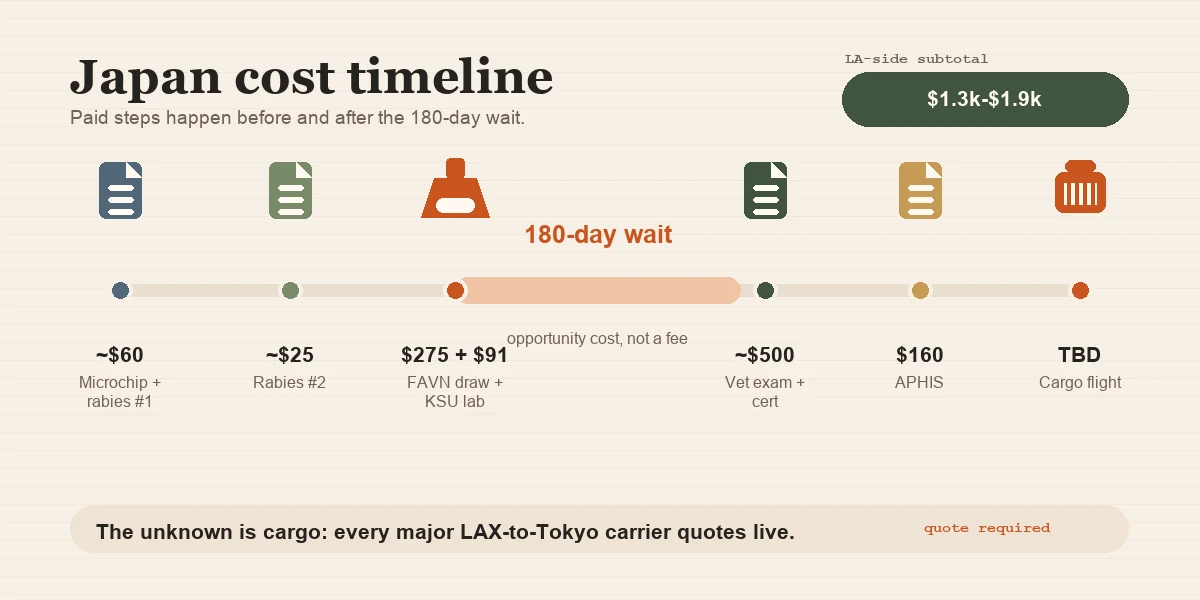
The expensive part of a Japan move feelslike the 180-day FAVN wait. The wait itself doesn’t have a dollar amount — it’s an opportunity cost (your timeline, not your wallet). The real fee structure is concentrated in the vet visits + lab fee + APHIS endorsement, which we have solid public-source data on.
| Line item | USD | Source |
|---|---|---|
| ISO microchip implantation | $20–$75 (typical $35) | LA-area vet pricing |
| Rabies vaccine #1 (1-year or 3-year) | $15–$55 (typical $25) | CAMP LA + others |
| Rabies vaccine #2 (Japan-specific — must be ≥30 days after #1) | $15–$55 (typical $25) | Same |
| KSU FAVN lab fee + rabies accession | $84–$91 | KSU Rabies Lab |
| FAVN sample collection — LA vet published package | $275 | Saving Grace LA mobile vet — does not break out draw / shipping / lab fee components |
| USDA-accredited vet exam (final fitness-to-fly) | $75–$249 (typical $100) | LA-area vet pricing as above |
| International health certificate paperwork | from $400 | Saving Grace |
| APHIS endorsement (1–2 lab tests, 1 pet — Japan FAVN = 1 test) | $160 | APHIS fee schedule |
| IATA cargo crate (Petmate Sky Kennel 36″ medium dog) | $220 | Petmate official price |
LA-side subtotal for a typical medium dog: roughly $1,300–$1,900 depending on which vet + crate size.
The Japan-side line items (AQS, port inspection)
Japan’s AQS (Animal Quarantine Service) handles arrival inspection at NRT / HND / KIX / NGO. Two fees would normally appear here, but neither is publicly published as of our compilation:
| Line item | USD | Source |
|---|---|---|
| Japan AQS advance notification fee (≥40 days before arrival) | not publicly published | Official MAFF AQS pages describe the workflow but no fee table — likely free for non-commercial dogs/cats but confirm by emailing your destination AQS office |
| Japan AQS arrival inspection fee | not publicly published | Same — process documented, no fee schedule |
| 180-day wait period after FAVN sample collection | N/A — opportunity cost | The wait itself is not a fee but a constraint on your timeline |
| Japan pre-departure clinical inspection window | within 10 days of export | APHIS Japan page — timing constraint, not a fee |
Treat the AQS line as roughly $0–$100 for budgeting (low-confidence range based on industry norms for similar non-commercial veterinary inspections). Email AQS at your specific port (Narita’s typically handles the highest pet volume) to confirm — they respond in English.
The cargo flight — every major carrier quotes live
None of the major LAX→Tokyo cargo carriers publish public live-animal rates. Our compilation searched all four routes and found:
| Carrier | LAX→NRT/HND cargo rate | Notes |
|---|---|---|
| ANA Cargo | not publicly published | Direct LAX→NRT; cargo line quotes individually |
| JAL Cargo | not publicly published | Direct LAX→HND; cargo line quotes individually |
| United Cargo | not publicly published | LAX→NRT route; partner-cargo arrangements vary by season |
| Korean Air Cargo | not publicly published | Via ICN (Seoul); often a competitive option for LAX→Tokyo |
Industry knowledge for a 40-lb dog in a 36-inch crate, LAX to Tokyo on a major carrier: typical published online estimates (from third-party relocator blogs, not airline tariffs) sit around $1,800–$3,500, but these are not verifiable to a primary source. Get a live quote.
Also missing publicly: carrier-specific LAX terminal receiving fees for ANA / JAL / United / Korean Air for live animals. Virgin Atlantic Cargo (which doesn’t fly LAX→Tokyo direct) publishes $103–$203 — treat that as a reference point only.
Total scenarios
For one medium dog (40 lb), DIY:
| Scenario | LA side (fees) | Japan AQS | Cargo + terminal | Approx total (USD) |
|---|---|---|---|---|
| Budget DIY | ~$1,300 | ~$0–$50 | ~$1,800 | ~$3,150 |
| Typical DIY | ~$1,600 | ~$50 | ~$2,500 | ~$4,200 |
| Premium DIY | ~$1,900 | ~$100 | ~$3,500+ | ~$5,500+ |
| Agency-managed | +$1,500–$3,500 | Same | Often includes cargo | +$1,500–$3,500 |
The cargo uncertainty is what makes Japan harder to price than UK or Mexico. The LA-side fees are solid public data. The Japan-side AQS line is small and unconfirmed. The cargo gap is where most of the variance lives.
What we don’t know yet — and what to do
Four items left null in our public-source compilation:
- All four cargo carriers’ LAX→Tokyo rates. Call ANA Cargo, JAL Cargo, United Cargo, and Korean Air Cargo (NOT passenger reservations). Ask for a “medium dog, 36-inch crate, LAX origin, Tokyo NRT or HND, date window [your dates]” rate. Get all four — variance is significant.
- AQS advance notification + arrival inspection fees. Email the destination AQS office (e.g.,
nrt-aqs@maff.go.jpfor Narita). Industry norms suggest these are minimal or zero for non-commercial dogs/cats, but confirm. - Carrier-specific LAX terminal receiving fees for ANA, JAL, United Cargo, Korean Air. Each carrier’s cargo facility at LAX has its own fee schedule.
- The “split FAVN cost” question. The $275 LA mobile-vet FAVN package bundles the blood draw, shipping to KSU, and (sometimes) the KSU lab fee. If your vet charges the lab fee separately, expect a separate $84–$91 line from KSU. Confirm with the vet before the appointment.
If you’re moving in the next 3 months: the $29 readiness analysis includes a recent verification of ANA / JAL / United Cargo rates on the LAX→Tokyo route for your specific dates + a check on AQS fees with the destination port office.
The unrecoverable cost: time
Japan’s 180-day post-FAVN wait isn’t a line item. But for owners whose human relocation is timed to a job offer or family event, the 180 days of “the dog can’t move yet” can cost more than every other line combined — temporary housing, extra travel back to LA, kennel boarding, or a second household.
We can’t put a dollar figure on that. The article you’re reading + the Japan rabies-lapse article + the FAVN labs article are the planning tools. Start the FAVN cycle as early as the puppy’s age allows — see the age-minimum article.