The two labs Japan actually accepts
Japan’s MAFF (Ministry of Agriculture, Forestry and Fisheries) maintains a short list of approved labs by country. For the US, the list has two entries — and that’s it:
| Lab | Where | Access | Notes |
|---|---|---|---|
| Kansas State University Rabies Laboratory | Manhattan, KS | Civilian — any US vet can ship samples | What virtually every Japan-bound pet uses. Submission form on ksvdl.org. |
| DOD Veterinary Food Analysis and Diagnostic Laboratory | Fort Belvoir, VA | Primarily military families on PCS orders | APHIS lists it without civilian restriction; we have NOT independently confirmed civilian access. DOD page. |
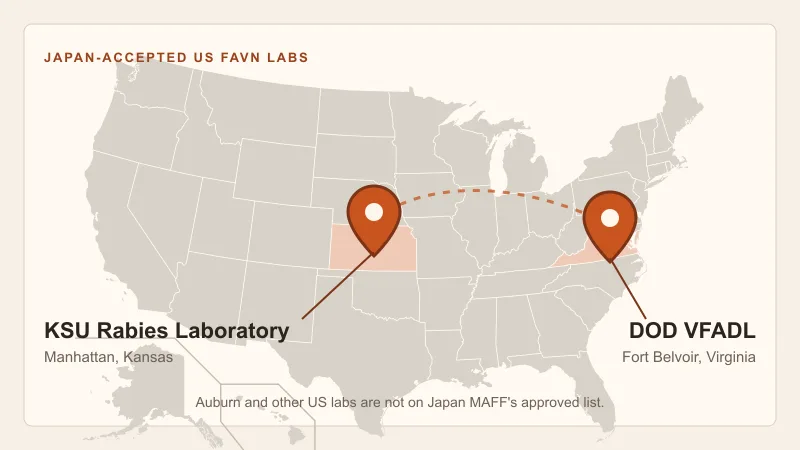
Here’s what trips people up: the list is short because Japan keeps it short, not because there aren’t other competent US labs. Auburn University’s lab runs FAVN, is USDA-accredited, and is cheaper than KSU. None of that matters — Japan’s MAFF didn’t approve them. The port-of-entry inspector checks the lab name on the titer report against MAFF’s approved list. Mismatch, refused.
Why Auburn keeps coming up — and why it fails at the port
If you Google “FAVN test for Japan” right now, several pet-relocation blogs will mention Auburn. It’s not a conspiracy — Auburn used to be on more approved lists for other destinations, the test methodology is the same, and US vets who haven’t shipped to Japan before sometimes reach for the closer or cheaper lab by default.
The failure mode is consistent and unpleasant. Owners pay for the Auburn FAVN, wait the 180 days, fly in, and discover at Narita or Haneda that the cert won’t clear inspection. The dog or cat then goes into AQS quarantine while the owner figures out what to do next — which is usually a new FAVN at an approved lab, plus another 180 days.
This isn’t theoretical. It’s documented in the team’s note alongside the scraped MAFF data:
“If rabies vaccine dates lapse by even 1 day, prior FAVN invalidates — full 180d reset (per Reddit thread r/TravelWithPets 1s86qba).”Different failure mode, same outcome: 180-day reset.
What “rejected” actually means: the 180-day reset
Japan’s rule is that the FAVN sample must be collected at least 180 days before arrival, and the test must come from an approved lab. The 180 days isn’t a paperwork waiting period — it’s a serological clock. The country uses it as an immunity proxy.
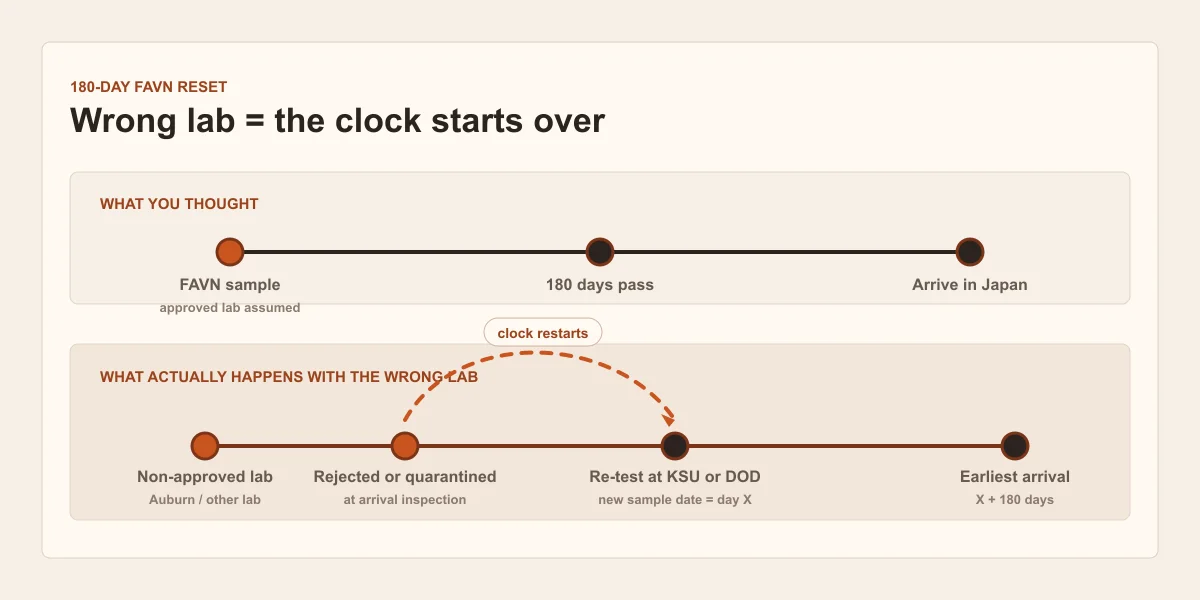
When the test goes to a non-approved lab, the practical options at the port are:
- The pet enters AQS (Animal Quarantine Service) post-arrival quarantine while the owner arranges a new FAVN — quarantine billed to the owner
- The pet is returned to the US
There’s no path where the owner argues at the desk and gets through. The lab list isn’t a guideline; it’s an enumerated rule with a checkbox.
If your vet has already sent the sample to Auburn, the honest move is to find out now — not at Narita six months later. Pull up the titer report, check the issuing lab against MAFF’s two-name list, and if it’s wrong, you’re better off cutting losses early and re-testing at KSU than discovering the problem in the customs hall.
How to order the test so it lands at the right lab
The actual mechanics are simple. KSU accepts samples shipped overnight from any US accredited vet. The submission form is on their site and asks for the destination country (so they know to format the report for MAFF). Three things to confirm with your vet before they draw the blood:
- The submission lab is KSU, not Auburn or whichever the clinic uses by default for other titer work. Say “Kansas State, Rabies Laboratory” out loud.
- The dog or cat is microchipped first, then rabies-vaccinated, then sampled at the right point in the immunity window — KSU will reject a sample drawn outside the methodology window.
- The vet ships overnight refrigerated. A weekend in transit invalidates the sample.
Your vet sees more rabies titer paperwork than Japan exports. Don’t assume they know which lab Japan accepts — the most common failure we’ve seen is vets defaulting to a lab they have a long relationship with, because the test is the same.