Why this is one of the most-misunderstood pieces of EU pet paperwork
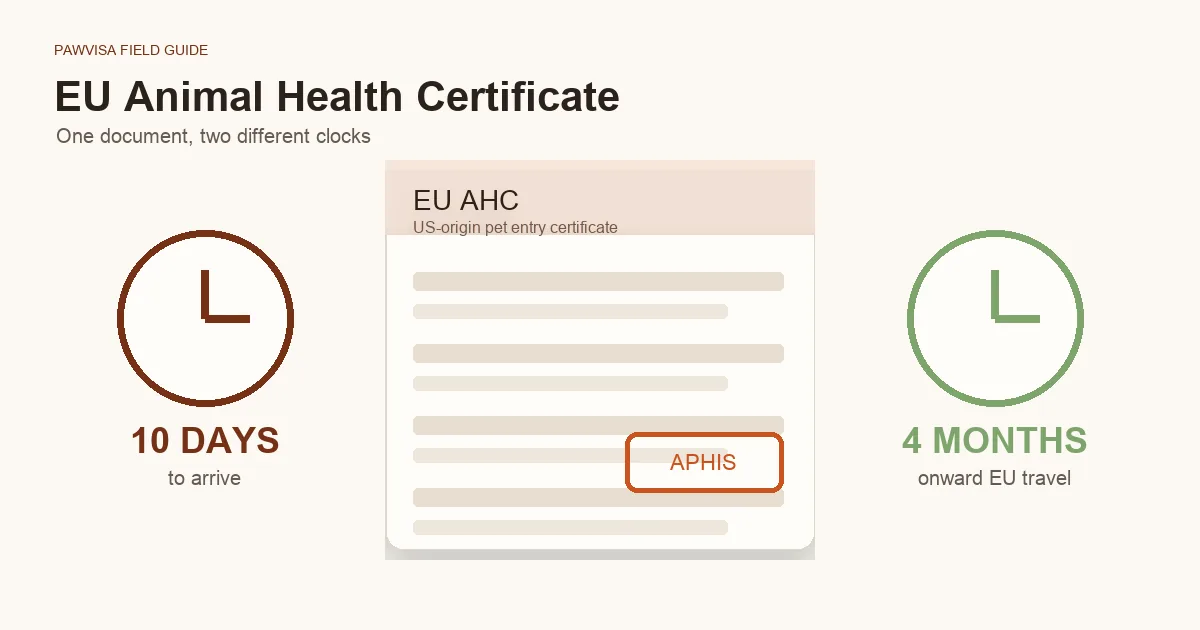
US owners often arrive in the EU thinking the EU AHC is “an EU passport for pets.” It isn’t. The EU Pet Passport is a different document — issued only by EU vets, only for EU-resident pets. US-origin pets entering the EU use the AHC, which is single-use, valid for a specific 10-day arrival window, and good for 4 months of onward EU travel after arrival.
The two-window structure trips up almost everyone the first time.
What an AHC actually contains
A standard EU AHC includes:
- Pet identification: microchip number (ISO 11784/11785), species, breed, sex, date of birth, colour
- Owner details: name, address, passport/ID
- Rabies vaccination record: vaccine name, batch, vaccination date, expiry, vet who administered
- Echinococcus treatment (only for Finland, Ireland, Malta, Norway, Northern Ireland): praziquantel administered 24–120 hours before arrival. See our EU tapeworm article.
- Vet signature + date — this starts the 10-day clock
- APHIS endorsement — federal stamp confirming the cert is valid for international travel
The form is multilingual (English + the destination country’s language). The US version is in English + each EU member state language depending on the destination.
The two windows you absolutely must hit
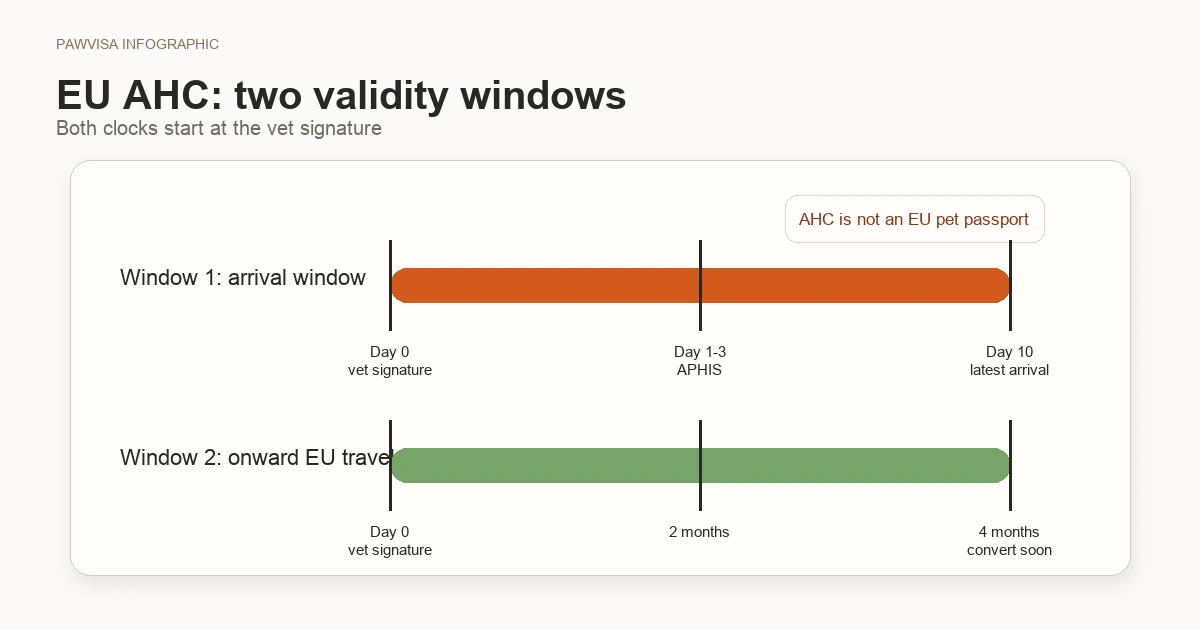
Window 1: 10 days from vet signature to arrival
The AHC is valid for 10 daysfrom the date the USDA-accredited vet signs it, to the pet’s arrival at the EU border. This means:
- Day 0: vet signature
- Day 1–9: APHIS endorsement (1–3 business days for VEHCS electronic), cargo flight time, etc.
- Day 10: the latest the pet can land at the EU airport
If the flight delays push arrival past Day 10, the cert is invalid. The pet is held at the airport, the cert has to be re-issued from the US end (which means a vet re-exam + new APHIS endorsement), and the pet either flies back or waits in the airport’s animal facility.
Window 2: 4 months inside the EU for onward travel
Once the pet is in the EU, the AHC is good for onward travel between EU member states for 4 months from the vet signature date.
This is the practical window you use:
- Arrive at CDG → drive to your apartment in Lyon (covered)
- 2 months later, take the train to Geneva and back (covered)
- 5 months later, fly to Madrid (NOT covered — AHC expired)
For onward EU travel after 4 months, you either:
- Convert to an EU Pet Passportvia any EU vet (a 1-visit process). This becomes your pet’s permanent EU travel document.
- Apply for a fresh AHC from a US vet (impractical if you’re already in Europe).
Most LA-based owners moving to Europe long-term do the EU passport conversion in their first 2 months.
Who can issue an AHC
An AHC for entry into the EU has to be:
- Signed by a USDA-accredited veterinarian in the US (your regular USDA-accredited vet — APHIS publishes a list of accredited vets by state)
- Endorsed by APHIS (the federal agency) — typically electronic via VEHCS for most EU destinations; ink for a small subset
If either is missing, the cert isn’t an “EU AHC” — it’s a piece of paper. EU border officials will refuse it.
The 10-day clock starts at the vet signature, NOT at endorsement
This trips owners up. The 10-day window starts when the vet signs the cert, not when APHIS endorses it. The endorsement happens in the middle of the window.
Standard timeline:
- Day 0: vet signs cert
- Day 1–3: APHIS endorses (electronic via VEHCS = 1–3 business days)
- Day 3–9: pet flies to EU
- Day 10: latest possible arrival
If APHIS endorsement is slower (ink, or a backlogged regional office), the available cargo-flight window shrinks. Plan for endorsement turnaround when you pick the vet appointment date. See our USDA endorsement turnaround article for the full timing math.
What about EU + tapeworm-treated destinations
Five EU/EFTA destinations require additional Echinococcus (praziquantel) treatment 24–120 hours before arrival:
- Finland
- Ireland
- Malta
- Norway
- Northern Ireland
The treatment is recorded on the AHC itself — the vet doesn’t issue two documents. But the 24–120 hour window adds a logistical constraint to your move. The treatment can’t be too early (≥120 hours = invalid) or too late (≤24 hours = invalid). See our EU tapeworm article for the full timeline.
What about Northern Ireland specifically
Northern Ireland is part of the UK but follows EU pet movement rules for arrivals from outside the UK/EU. That means: arrivals from the US to Belfast use an EU AHC, not a UK GB Health Certificate.
This is one of the few cases where the political boundary (UK) and the regulatory boundary (EU) diverge. We have a deeper article on this: Northern Ireland vs UK pet rules.
What this article doesn’t cover
- EU Pet Passport conversion: separate process, done by an EU vet after arrival. Future article.
- Commercial moves: use a different cert + CHED-A entry document. See our commercial vs non-commercial article.
- Return to the US from EU: USDA + CDC rules apply on the US side; outside Pawvisa’s scope.
The “what if my flight is delayed past Day 10” failure mode
The standard outcome:
- Pet held at the EU port-of-entry’s animal facility
- Owner contacts US-side vet for a re-issued cert + APHIS endorsement
- New cert + endorsement shipped/emailed to EU vet at the port
- Pet released after paperwork is sorted (typically 1–3 days)
- Owner pays for: facility holding fees, re-issue cert fee, vet exam (if a new vet exam is needed), expedited APHIS endorsement
Total damage: typically $400–$1,200 plus emotional cost.
The lesson: build a 2–3 day buffer between expected APHIS endorsement receipt and your cargo flight. If endorsement takes longer than expected, you can still hit the 10-day window.