The short version
| Great Britain (England, Scotland, Wales) | EU + EFTA (27 + Norway / Switzerland) | Northern Ireland | |
|---|---|---|---|
| Health certificate | UK-specific post-Brexit cert | EU Animal Health Certificate (AHC) | EU AHC (same as EU) |
| Rabies wait | 21 days from primary vaccination | 21 days from primary vaccination | 21 days from primary vaccination |
| Microchip | ISO 11784/11785, before rabies | ISO 11784/11785, before rabies | ISO 11784/11785, before rabies |
| Cabin allowed? | No — cargo only | Varies by carrier / country | Follows EU rules |
| Approved arrival airports | LHR, LGW, EDI (3 total) | Designated EU Border Control Posts (BCPs) by member state | EU BCPs |
| Tapeworm treatment for dogs | Not required | Required for Finland, Malta, Ireland, Norway | Required (NI is one of the five) |
| TRACES NT pre-notification | No | Yes — vet pre-notifies BCP via TRACES | Yes |
| HARC pre-check (optional) | Yes, at LHR | N/A | N/A |
| Banned breeds | UK national list (XL Bully, Pit Bull terrier, Tosa, Dogo Argentino, Fila Brasileiro) | Country-by-country (Italy: none; France: Cat 1/2; Germany: Länder-level) | Country list (similar to EU) |
The 21-day rabies wait is the one piece of common ground. Everything else diverges in some way.
What’s actually the same
Three things genuinely are identical across UK and EU:
- Microchip first, rabies second. Both require an ISO 11784/11785 microchip implanted before — or on the same day as — the primary rabies vaccination. A rabies shot given to an unchipped pet is invalid in both regimes. This is the rule that catches owners more than any other.
- 21-day immunity wait. Day 0 is the vaccination date. Day 21 is the earliest the pet can enter UK or EU. Some manufacturer vaccines specify a longer wait (often 30 days) — that supersedes the 21-day minimum.
- USDA-accredited vet + USDA endorsement. Same vet appointment process, same USDA endorsement office on the US side. The form the vet fills out is different (UK cert vs EU AHC), but the workflow is parallel.
What diverged at Brexit
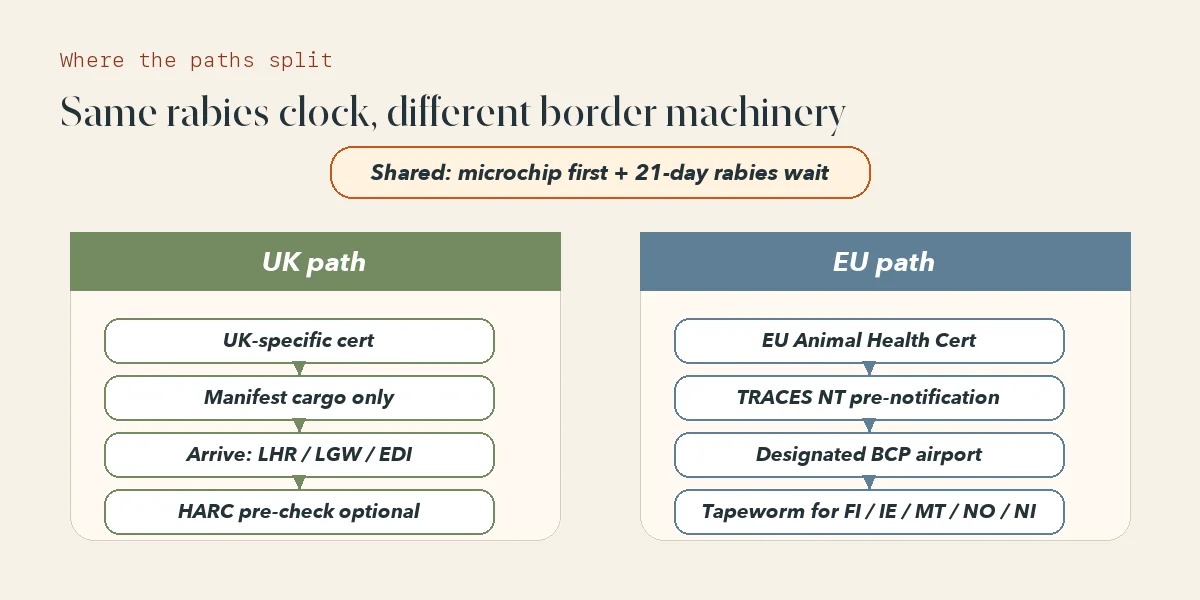
The certificate.The EU uses its Animal Health Certificate (AHC) — a multi-page form harmonised across all 27 member states plus Norway and Switzerland. The UK created its own post-Brexit cert that mirrors the EU AHC’s structure but isn’t accepted at EU borders, and vice versa.
Approved arrival airports.The UK shrank its non-EU pet arrival list to three airports: London Heathrow (LHR), London Gatwick (LGW), Edinburgh (EDI). The EU has dozens — each member state designates its own Border Control Posts. France has CDG, ORY, LYS, NCE, MRS, TLS, RUN. Germany has FRA, MUC, BER, HAM, HAJ, CGN. Look up your specific EU destination’s BCP list before booking.
Cabin pets. The UK prohibits pets in cabin or as checked baggage — every pet must arrive as live-animal manifest cargo. The EU has no such blanket rule; some carriers operate cabin-pet routes into EU airports (regulation varies by country and aircraft). See our UK cargo-only article for the full breakdown.
Tapeworm treatment. Five EU/EFTA destinations require a vet-administered tapeworm pill (praziquantel) 24–120 hours before arrival: Finland, Ireland, Malta, Norway, and Northern Ireland. Great Britain dropped the post-Brexit equivalent in 2022. See our EU tapeworm article for the full mechanics.
TRACES NT pre-notification.EU bound pets need their vet to pre-notify the destination Border Control Post via the TRACES NT system (1 working day lead time minimum). The UK doesn’t use TRACES — HARC pre-check at Heathrow is an optional service, not a required pre-notification.
The Northern Ireland exception
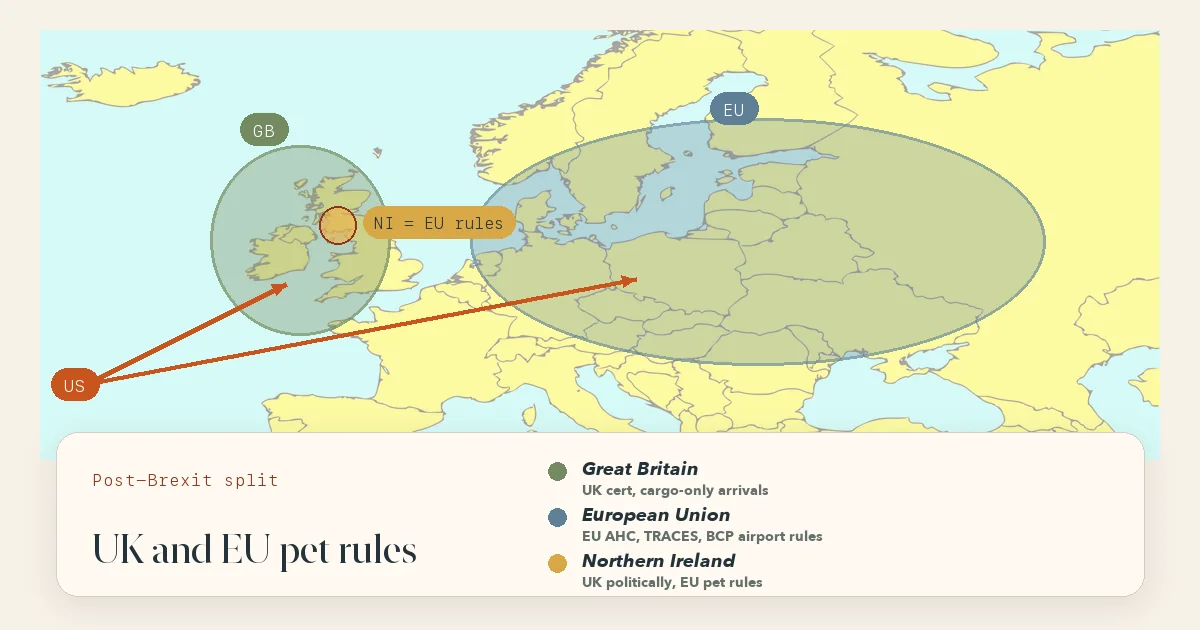
Politically NI is UK. Regulatorily, for pets, NI is on EU rules under the Windsor Framework. A pet entering Belfast from the US needs an EU AHC, not a UK cert. A dog entering NI needs the tapeworm treatment (same as Ireland and the other four). NI airports designated as EU BCPs are limited — in practice many NI-bound arrivals route via Dublin or continental EU hubs.
The full NI breakdown lives in our Northern Ireland article. The short version: if you’re flying into Belfast, treat it as an EU trip, not a UK trip.
The transit trap nobody warns about
If you’re booked LAX → Frankfurt → London, the key question is whether the pet remains in the airport’s international transit zone. Under the current EU rule, a qualifying non-commercial dog, cat, or ferret continuing to a third country does not need an EU health certificate while it stays in that zone.
The exemption can disappear if the pet clears the EU border, changes to an unconnected shipment, needs a pet hotel outside the zone, or travels unaccompanied/commercially. Ask the airport animal facility and operating carriers to confirm the exact handoff in writing.
For an EU final destination, transit through another EU country en route is usually fine on a single AHC — but always verify with the specific BCP your pet arrives at.
How to decide which set applies to you
Three questions:
- Is your final destination Great Britain (England / Scotland / Wales)? → UK cert.
- Is it Northern Ireland? → EU AHC + tapeworm.
- Is it any EU member state, Norway, or Switzerland? → EU AHC + check for tapeworm if FI / IE / MT / NO.
The mistake to avoid: assuming the UK cert “covers Europe” or that the EU AHC works for arrivals into LHR. They’re separate paperwork regimes. If you book a UK destination on EU paperwork (or vice versa), the cert won’t clear inspection.