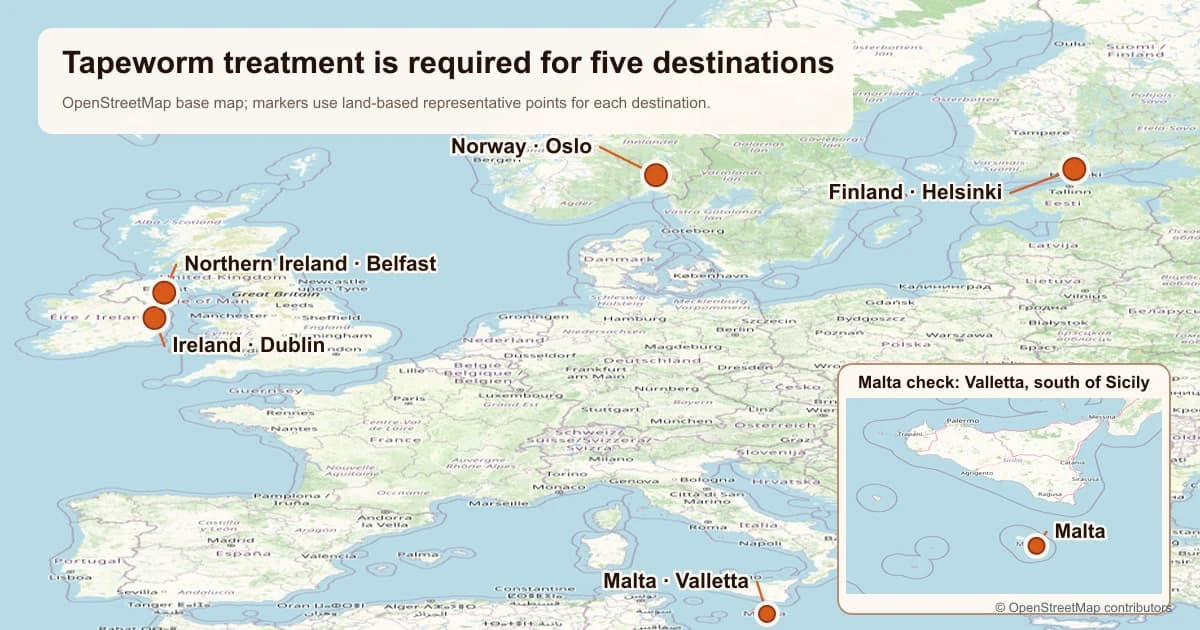
The five-country list, and why it’s these five
The treatment requirement exists because four EU member states plus Norway are officially considered free of Echinococcus multilocularis — a tapeworm that can cause severe disease in humans and other animals. They protect that status by requiring every entering dog to be dewormed against it.
| Destination | EU member? | Same rule applies on entry from… |
|---|---|---|
| Finland | Yes | Anywhere, including other EU countries |
| Ireland (Republic of) | Yes | Anywhere, including the UK |
| Malta | Yes | Anywhere |
| Norway | No — but adopts EU pet-import rules | Anywhere |
| Northern Ireland | Politically UK, but on EU rules under the Windsor Framework | Anywhere, including Great Britain |
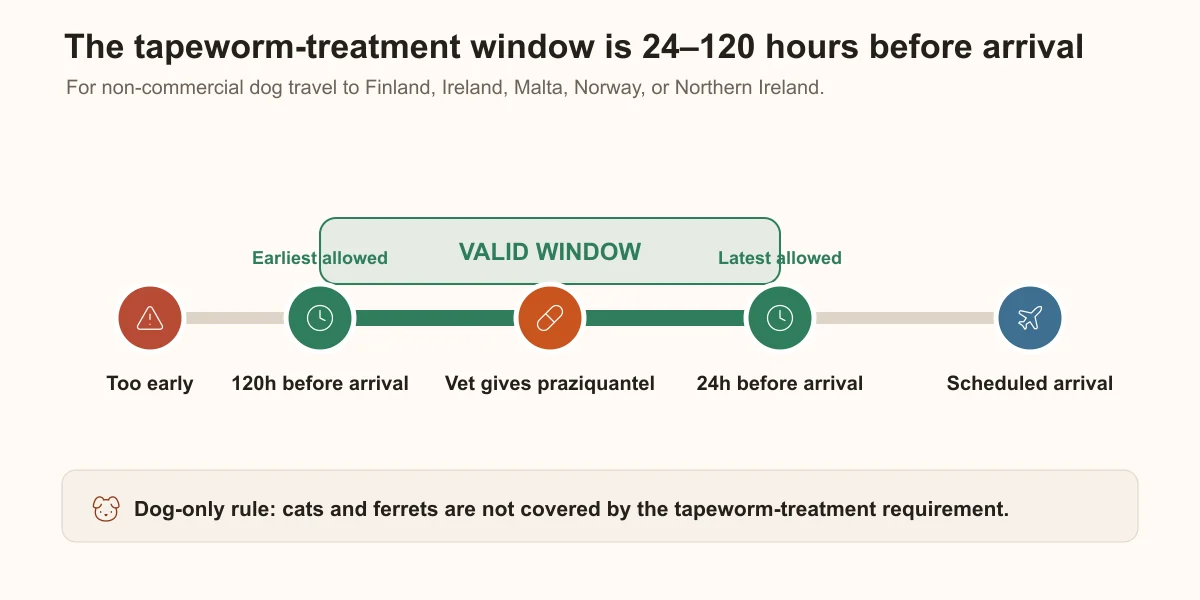
Cats and ferrets aren’t covered — the requirement is dog-only. That’s per the EU regulation 576/2013 plus each country’s national Echinococcus controls.
The treatment itself
Three things have to be true for the treatment to count:
- The drug is praziquantel (or labelled equivalent that treats Echinococcus multilocularis). Your US vet probably stocks it; if they don’t, the EU AHC paperwork won’t clear.
- A USDA-Accredited Veterinarian administers it. Not the owner, not a tech, not a pharmacist. The vet’s signature on the Anti-Echinococcus treatment table in Part II of the health certificate is what customs checks.
- It happens 24 to 120 hours before scheduled arrival. That’s a strict window. Treat too early (more than five days out) and you’ll be turned around. Too late (less than 24 hours) and you won’t have the paperwork in order.
Treatment can occur before orafter the USDA endorses the health certificate — there’s flexibility there. But the timing relative to arrival in destination is what matters.
The “I’m only transiting through, why does this apply?” trap
Worth knowing: the rule applies to destination, not transit. If your dog is connecting through Frankfurt en route to Dublin, the dog gets dewormed within the 24–120h window before arriving in Ireland, not Frankfurt. The deworming protects the destination country, not the airline route.
But here’s the gotcha that catches EU-residing owners: if you’re already in mainland Europe with a dog and you’re flying internally to Finland, Ireland, Malta, Norway, or Northern Ireland, the treatment is still required. Per the Finnish Food Authority’s own guidance, the rule applies “every time entering one of these countries, even from another EU country.” Your dog was dewormed before flying from the US to Germany three months ago — that doesn’t count for the Helsinki trip.
For LA-based readers going direct to one of these five, this is straightforward. For LA-based readers planning a multi-country EU itinerary that ends in one of the five, plan for treatment within the window before the final hop.
Commercial vs non-commercial
The 24–120 hour window is for non-commercial (owner-accompanied) pet movement. Commercial movement uses a different window: 24–48 hours before departure from the US. Most Pawvisa readers are non-commercial. If you’re shipping the pet unaccompanied or as part of a sale, talk to a relocator who deals with TRACES CHED paperwork.
How to not get this wrong
Two things to confirm with your vet at the appointment that’s within the 24–120h window:
- The drug administered is the one Echinococcus-labelled. Some general dewormers don’t qualify — they’ll be missing the specific labelling. The vet checks; the certificate has a place for the product name and active ingredient.
- The Part II anti-Echinococcus table is signed at the time of treatment. Not “we’ll sign it later” — the dated signature is what evidences the timing.
If your appointment is outside the window — you booked the only vet slot available, and it’s 10 days before flight — you need to reschedule, not just deworm anyway. The customs check is on the dates, not the molecule.