Why most single owners get this wrong
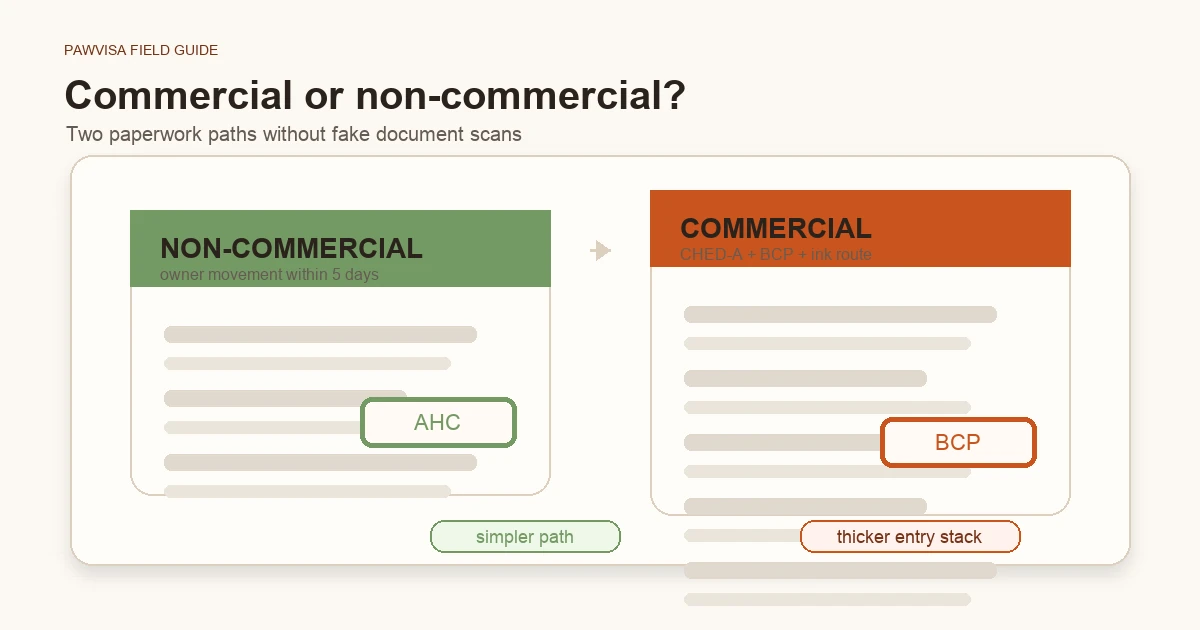
Most owners assume that because they only have one pet, they’re non-commercial by definition. The rule is more specific than that. The EU (Regulation 576/2013) and UK (post-Brexit pet-import rules) both split imports into two regimes:
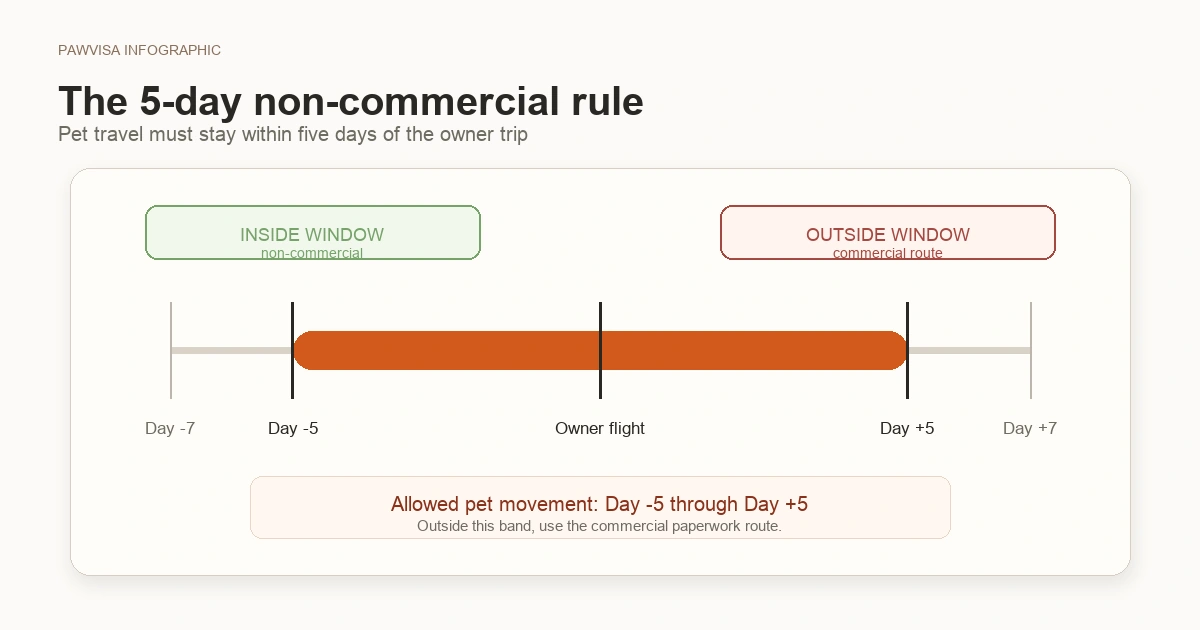
- Non-commercial: ≤5 pets, owner travels with them, no sale or transfer of ownership, pet movement is within 5 days of owner’s movement.
- Commercial: everything else — including ≥6 pets, change of ownership, pets sent unaccompanied by more than 5 days, or pets being sold.
The trap is the “owner travels with the pet” + 5-day rule detail. An LA family flying United on Tuesday and shipping their golden retriever on Saturday cargo — because the cargo flight didn’t have weekend availability — is, strictly read, commercial. That’s most paid corporate relocations, where a relocation company handles the pet on its own schedule.
The comparison table
| Dimension | Non-commercial | Commercial |
|---|---|---|
| Pet count | ≤5 | ≥6, or any pet for sale |
| Owner travels with pet | Yes (or within 5 days) | No |
| Change of ownership | No | Allowed |
| EU regulator | National vet authorities | TRACES NT + CHED (common entry doc) |
| EU document | EU AHC (Annex IV of Reg 577/2013) | Different cert + CHED-A entry, BCP-only entry |
| UK form | GBHC (non-commercial) | Different commercial form |
| UK endorsement | Electronic via VEHCS | Ink endorsement only |
| BCP / port restriction | Approved arrival airports | Border Control Post (BCP) with veterinary services |
| Vet fees on US side | Standard | Often higher — extra paperwork |
| Failure cost | Refused at port, redo cert | Refused at port, redo + commercial cert + ink endorsement (slower) |
Why this matters: the LA corporate relocation trap
We’ve seen this fail twice in our LA caseload. Both times the relocation package paid for the pet to fly cargo on a different date than the family — typically because the cargo flight slot didn’t line up with the family’s passenger flight. The relocation paperwork went out as non-commercial; the destination customs checked the dates and reclassified the move as commercial; the cert was rejected; the pet was held at the port at the owner’s expense for 4–7 days while paperwork was redone.
The relocation companies often don’t catch this. They’ve shipped pets under EU rules for years and treat the move template as routine. The rule change post-Brexit (for UK) and the TRACES NT enforcement tightening (for EU) made what used to slide stop sliding.
What to do about it: three real options
- Compress your own dates.If your family flies Tuesday and the dog flies Saturday, that’s 4 days — within the 5-day rule. Stay within it.
- Pay for the commercial regime.This means: getting an ink-endorsed cert (slower at APHIS — 5–9 business days vs 1–3 for electronic via VEHCS), getting a CHED-A entry document filed in TRACES NT (your destination vet handles this), and arriving at a Border Control Post airport. For EU, BCPs aren’t every airport. For UK, commercial arrivals also have specific cargo-channel handling. Budget an extra $400–$800 in paperwork + endorsement fees, and 1–2 extra weeks of timeline.
- Send a friend or relative with the pet.The 5-day rule allows an authorised person to travel with the pet on the owner’s behalf, in writing, with a signed power-of-attorney-style authorisation. The destination’s pet-import authority will check whether the named person matches the cargo paperwork. This is the cheapest legal workaround and the one Pawvisa recommends if your relocation logistics push you outside the 5-day window.
What “commercial” looks like at the airport
For EU non-commercial arrivals, you go through the regular pet-import channel at most major airports (CDG, FRA, AMS, MAD, etc). The cert is checked, the chip is read, you walk out.
For EU commercial arrivals, the pet goes through a Border Control Post(BCP) — a separate veterinary inspection facility. Not every EU airport has one. CDG and FRA do; some smaller airports don’t. The CHED-A document is checked alongside the cert. Inspection can take 4–12 hours.
For UK commercial arrivals, the pet flies into LHR (or another approved cargo airport), is processed through the live-animal cargo terminal (HARC at LHR), and the commercial paperwork has a tighter cert validity window — 48 hours from vet signature vs 30 days for non-commercial. See our validity windows article for the per-destination breakdown.
The “is my relocation commercial?” checklist
A move is commercial if any one of these is true:
- Pet ships on a different calendar date than the owner (by more than 5 days)
- Pet ships without the owner ever travelling (unaccompanied)
- A relocation company is named on the cargo manifest, not the owner
- Ownership changes (the pet is going to a friend/family member who’s now the legal owner)
- More than 5 pets in the move
- Pet was bought / adopted during the trip and is being brought home
If any of these is true, you can’t use the non-commercial cert. Plan for the commercial regime.
When in doubt, ask APHIS
The USDA-accredited vet who signs your international health certificate is the first line of defence. They’ve seen the commercial-vs-non-commercial question hundreds of times. Tell them:
- Your travel date
- The pet’s travel date (cargo flight date)
- Who’s listed as shipper on the cargo paperwork
- Whether a relocation company is involved
- Whether the pet’s ownership is changing
They’ll tell you which cert format to use and route the paperwork to the right APHIS endorsement channel — electronic via VEHCS for most non-commercial moves, ink for the commercial track. Our USDA endorsement turnaround article covers the timing.
What this article doesn’t cover
- Return to the US: USDA + CDC dog-import rules use a different framework. Pawvisa’s product covers US → outbound only — partner with a vet on the destination side for return logistics.
- Multi-pet moves (≥6 pets): those are commercial by default and require additional regulatory paperwork. Pawvisa is built for 1–4 pet households.