
Why the multi-pet line matters
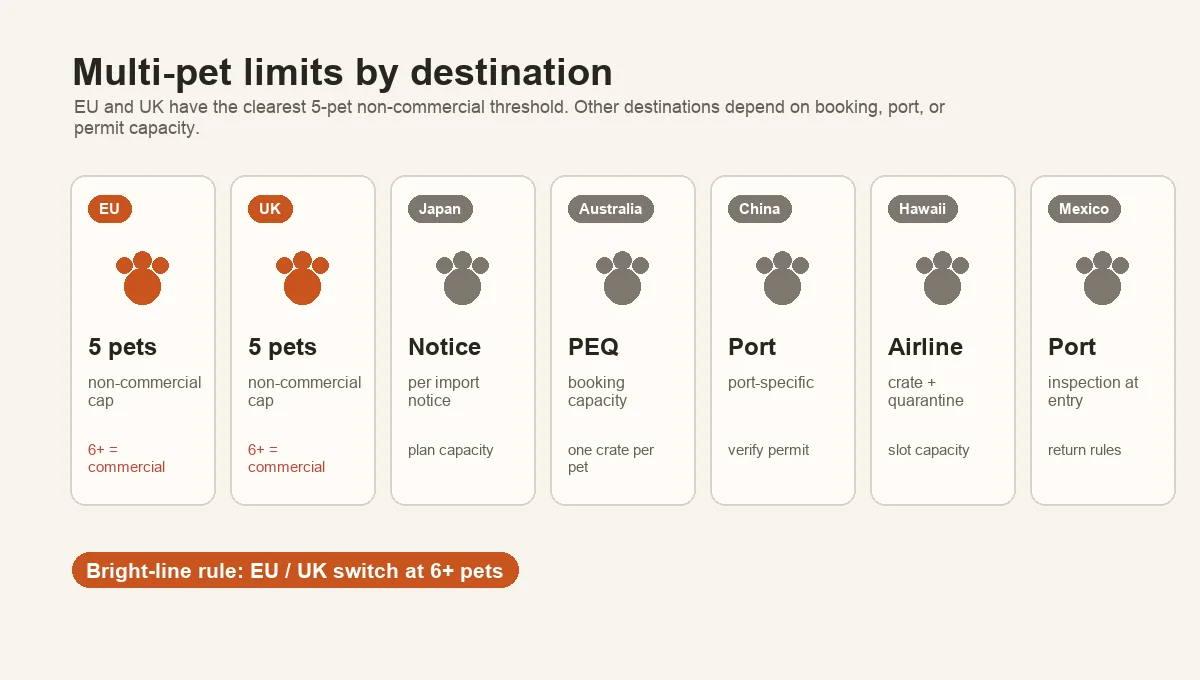
A single owner with 1–4 pets generally falls into “non-commercial” import — the simpler regime everywhere. Add a fifth pet, and the rules change in specific ways depending on the destination:
- EU + UK: 6th pet is commercial — different forms, ink endorsement, Border Control Post (BCP) airport-only entry, CHED-A entry document
- Most other destinations: per-pet permits and fees scale up; some carriers limit cargo bookings per shipper
This article maps which destinations care about counts and how to plan a multi-pet move.
The destination map
| Destination | Non-commercial limit | Commercial threshold | Per-pet permit fee | Notes |
|---|---|---|---|---|
| EU + EFTA | 5 pets | 6+ | EU AHC per pet | TRACES NT + CHED-A for commercial. BCP entry. |
| UK | 5 pets | 6+ | UK GBHC per pet (non-comm); commercial uses different form | Ink endorsement for commercial. |
| Northern Ireland | Follows EU rules | 6+ | Same as EU | EU AHC, not UK GBHC. |
| Japan | No formal limit | n/a | Per pet AQS notification | Each pet needs own FAVN + 180-day wait. |
| Australia | No formal multi-pet rule | n/a | AUD 430 first + AUD 205 each additional | Mickleham PEQ books per pet — pets can share kennels in some cases. |
| New Zealand | No formal limit | n/a | Per-pet MPI permit fee | MPI permits per pet. |
| China | No formal limit | Some categories per GACC | GACC permit per pet (if required) | Verify current GACC bulletin. |
| South Korea | No formal limit | n/a | None — notification at arrival | Each pet needs cert + FAVN if applicable. |
| Taiwan | No formal limit | n/a | BAPHIQ permit per pet | Similar to Japan. |
| Hawaii (NIIP) | No formal limit | n/a | $185 per pet NIIP | Each pet processed separately. |
| Mexico | No formal limit | n/a | None | Each pet inspected at port. |
| Canada | No formal limit | n/a | None | Each pet inspected at port. |
What “commercial” actually means in EU/UK
The commercial vs non-commercial distinction is the trap in this category.
In short: ≥6 pets triggers commercial regardless of whether the owner travels with them. Commercial means:
- Different cert format: not the EU AHC (Annex IV); a commercial import cert (Annex II of EU Reg 577/2013)
- Ink endorsement only on the US side (5–9 business days at APHIS)
- CHED-A document filed in TRACES NT by the destination vet
- BCP airport-only entry: not every EU airport has a Border Control Post with veterinary services. CDG, FRA, AMS yes; smaller airports no.
- UK commercial routes: also have stricter cert validity (48 hours from vet sig vs 30 days for non-commercial)
The cost difference: ~$400–$800 in additional paperwork + endorsement fees, plus 1–2 extra weeks of timeline.
Multi-pet carrier limits at the airline level
Even when the regulatory regime doesn’t change, cargo airlines have practical limits per booking:
- KLM Cargo, Air France Cargo: typically up to 4 pets per AWB (airway bill); beyond requires multiple bookings
- Lufthansa Cargo: similar 3–4 pets per AWB limit
- Qatar Cargo, Emirates SkyCargo: 2–3 pets per booking is common
- US carriers (UA, AA, DL Cargo): limited to 2–3 pets per shipper per flight on most routes
For a 5+ pet move, you typically split into multiple cargo bookings across different flights, or work with a pet shipper that coordinates the bookings.
The brachy + multi-pet combo
If you have multiple brachycephalic dogs (e.g., 2 French bulldogs + 2 pugs) moving together, the multi-pet problem doubles:
- Temperature embargo applies per pet
- Brachy refusal applies per pet
- Multi-pet booking limit applies per shipment
We’ve seen owners with 3+ brachycephalic dogs need to:
- Use multiple flights spread over different dates
- Pick the coolest possible season
- Work with a specialty pet shipper that handles brachy cargo routinely (Pet Express, Air Animal)
- Sometimes ship 1 pet at a time over the course of weeks
This is expensive — multiply the per-pet cost by 3–5× for the specialty handling.
The “all my pets at once” timeline
For a 4-pet move to the EU (within non-commercial threshold):
- 6–12 weeks ahead: All 4 pets get microchipped (if not already)
- 5–11 weeks ahead: All 4 pets get rabies vaccinated (or boosters)
- 3–4 weeks ahead: USDA-accredited vet exams x 4
- 2 weeks ahead: International health certificates issued for each pet, all submitted to APHIS for endorsement
- 1 week ahead: Endorsed certs received
- Day of flight: 4 pets to LAX cargo, 4 crates, 4 AWBs (or one multi-pet AWB if the carrier supports it)
- Arrival: 4 pets cleared through destination customs
- Within 4 months: optional EU pet passport conversion for each
For 5+ pets to EU: add commercial regime overhead (~3 extra weeks) to step 4.
Per-pet cost stacking
For a 4-pet EU move (LAX → AMS via KLM Cargo), rough budget:
- Microchipping x 4 (~$50 each): $200
- Rabies vax x 4 (~$30 each): $120
- USDA-accredited vet exam x 4 (~$150 each): $600
- USDA endorsement x 4 (VEHCS, ~$38 first + $0 each additional per cert; some destinations have additional fees): $40–$200
- IATA CR-1 crate x 4 ($150–$400 each): $600–$1,600
- LAX → AMS cargo x 4 ($1,500–$3,500 each, per crate dimensions): $6,000–$14,000
- Pet shipper coordination (optional): $1,000–$3,000
Total: ~$8,500–$20,000 for 4 pets to the EU.
The marginal cost of each additional pet is dominated by the cargo shipping fee per crate, not the paperwork. Stacking permits and endorsements is cheap; stacking flights is not.